
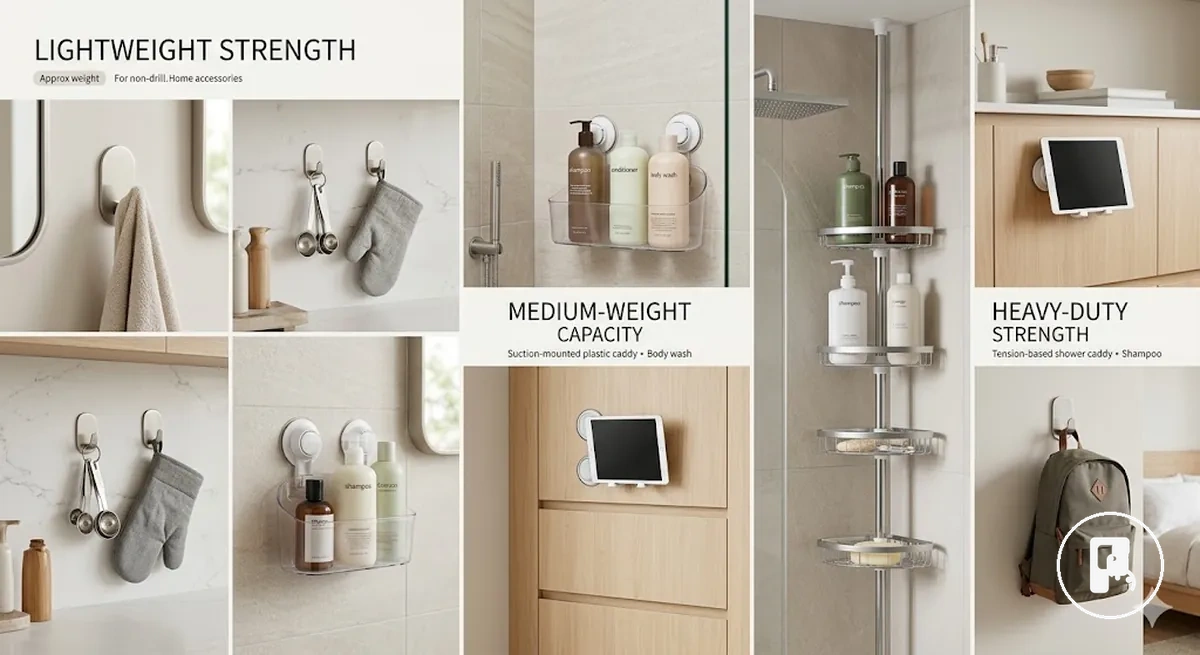
No-Drill Home Accessories Load Capacity and Holding Strength
No-drill home accessories are wall-mounted or surface-mounted solutions that rely on adhesive, suction, or tension-based systems instead of drilling. Load capacity refers to the maximum weight these accessories can support under specific conditions. Holding strength describes how securely they maintain grip over time based on surface condition, contact area, and usage environment. These properties are conditional and vary by installation quality and material interaction.
In real use, the same no-drill accessories may behave differently on smooth tiles, painted walls, or glass surfaces. Adhesive systems depend on bond quality and contact area, while suction systems rely on airtight sealing on smooth surfaces. Tension-based options distribute force differently across mounting points. Daily movement, moisture, and temperature changes can also influence stability.
Load capacity and holding strength should be interpreted as a decision framework rather than a fixed guarantee. Evaluating rated capacity against surface condition, mounting method, and expected load helps determine a safe everyday load. Falling or loosening can occur when these conditions are mismatched, so selection should always be based on realistic use conditions rather than nominal weight limits.
What Load Capacity Means for No-Drill Home Accessories
Load capacity for no-drill home accessories is a conditional weight-support limit that defines how much weight these systems can hold under specific surface condition and use condition. It is based on how adhesive, suction, or tension-based mounting behaves when applied to a wall or other surface. The load capacity reflects expected holding outcome rather than structural strength.
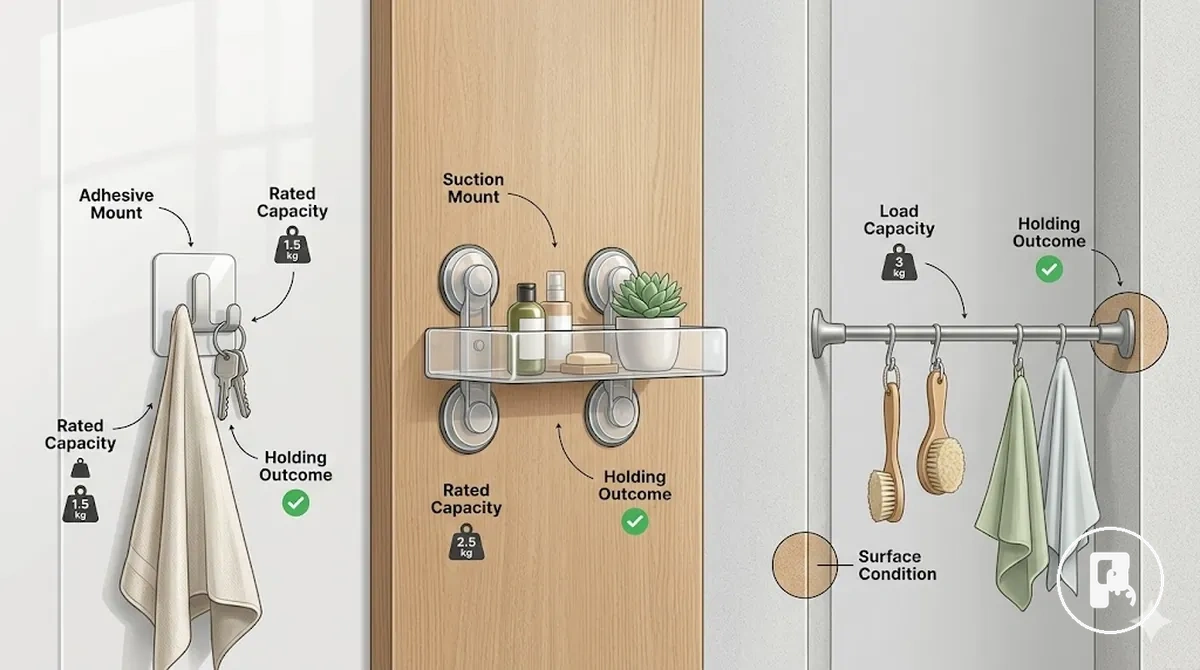
Within no-drill home accessories, the stated load limit represents a rated capacity tested under controlled conditions. When the phrase no-drill home accessories is used, it refers to systems where load capacity depends on surface condition, contact area, and installation quality rather than permanent fixtures or drilling-based support.
The difference between rated capacity and safe everyday load is important because real use conditions vary. Surface condition, mounting accuracy, and load direction can influence holding outcome, meaning the safe everyday load may be lower than the stated load limit in practical environments.
Load capacity in no-drill systems does not represent permanent structural support. It defines a holding boundary where exceeding the weight limit or using unsuitable surfaces can reduce holding strength and stability depending on the mounting method.
Holding Strength Factors That Change Real-World Performance
Holding strength is defined by multiple interacting attributes that determine how no-drill home accessories perform beyond their printed rating. Real-world performance changes based on surface condition, attachment mechanism, contact area, and load direction. These factors influence how the system distributes force and maintains stability under use.
Surface condition and contact area are primary variables that shape actual hold. Smooth, clean, and stable surfaces allow better bonding or suction, while uneven or dusty surfaces reduce effective contact. The attachment mechanism also plays a role because adhesive, suction, and tension systems each respond differently to the same wall texture and material.
Load direction, daily movement, moisture, heat, and time under load further modify holding behavior. Pulling forces, sideways stress, or repeated movement can gradually reduce stability. Environmental exposure such as moisture and heat may weaken bonding efficiency over time, especially when combined with long-duration loading.
Holding strength factors that change real-world performance can be better understood when visualized together as interacting variables.
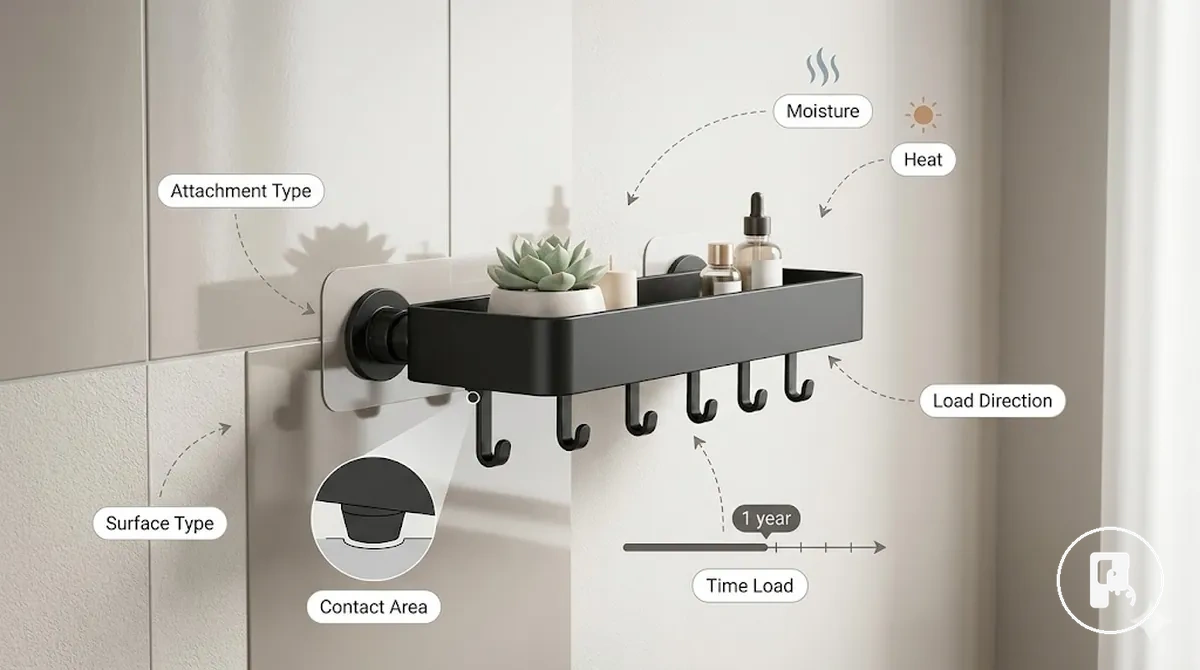
The diagram organizes holding-strength factors by effect to show how surface condition, contact area, load direction, moisture, heat, temperature, and time under load influence practical performance outcomes.
- Surface condition: affects bond stability and grip consistency
- Contact area: determines how force is distributed across the mount
- Attachment mechanism: changes how adhesion or suction responds to load
- Load direction: introduces pull force or shear stress risks
- Daily movement: increases gradual loosening pressure
- Moisture: can reduce adhesive effectiveness over time
- Temperature, heat, and time under load: may weaken long-term stability
A bathroom shelf and a bedroom wall hook can show different holding outcomes even if they have similar printed ratings. Higher moisture and temperature changes in bathrooms may reduce practical strength over time, while stable indoor environments may maintain more consistent holding performance.
Surface Texture, Material, and Contact Area
Surface condition defined by surface texture, surface material, and contact area affects holding strength by controlling how a bond or suction seal forms on a wall, tile, or glass. This compatibility depends on how consistently the mounting system can maintain contact across different surface finishes and materials.
A smooth non-porous surface such as glass or glazed tile typically supports a more stable bond or suction seal because the contact area remains even and continuous. In contrast, rough or porous surfaces can interrupt bonding zones, reduce airtight sealing, and weaken holding strength even when the attachment mechanism remains the same.
The checklist below verifies how surface texture, surface material, and contact area influence bond or suction seal behavior across different mounting conditions.
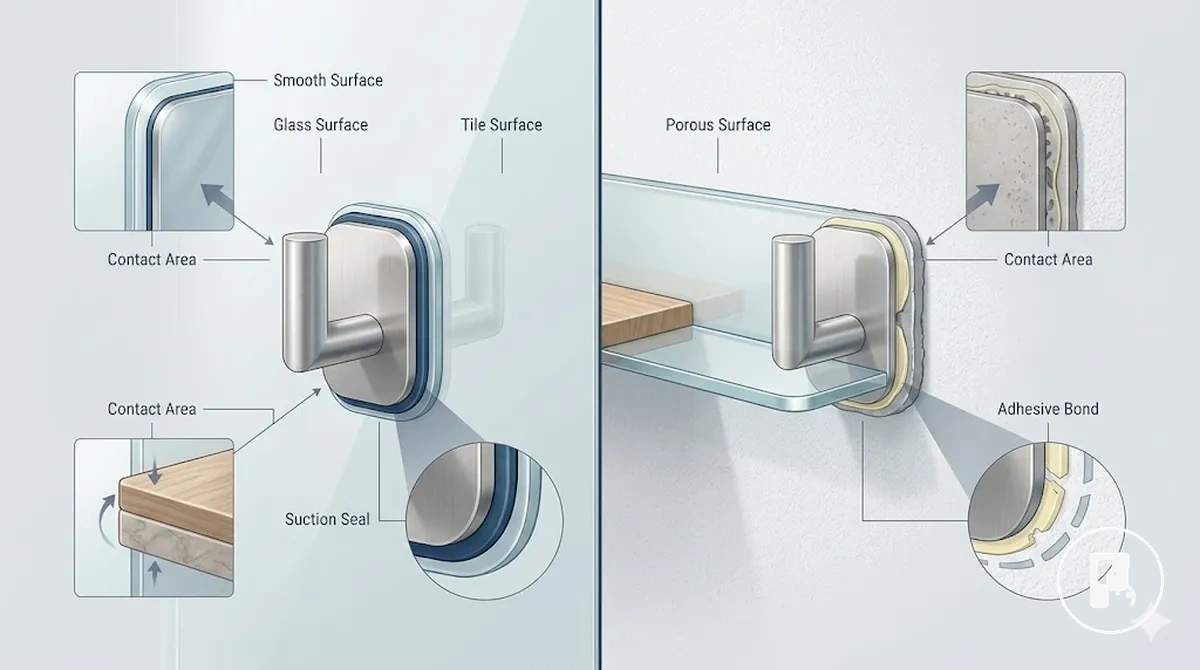
- Surface texture: determines how evenly the bond or suction seal can form on the wall
- Surface material: affects compatibility with glass, tile, or porous surfaces
- Contact area: controls how much of the surface supports the holding strength
- Smooth surface: improves continuous bonding and stable suction seal formation
- Porous surface: reduces adhesion due to air gaps and uneven bonding zones
Adhesive Bond, Suction Seal, and Pressure Fit
Attachment mechanisms such as adhesive bond, suction seal, and pressure fit define different load transfer paths that distribute force between the mounted object and the wall surface. Each mechanism contributes to holding strength through bond area, contact condition, and applied tension, but the way load transfer occurs varies by mechanism.
Adhesive bond, suction seal, and pressure fit differ in how they respond to contact condition and movement. An adhesive bond relies on bond area and surface adhesion to resist peeling under load direction. A suction seal depends on airtight contact on smooth surface conditions to maintain vacuum-based grip, while a pressure fit uses mechanical tension and fit condition to stabilize load transfer. Their holding strength varies based on surface quality, alignment, and movement exposure.
| Mechanism | Required contact condition | Strength behavior | Main limit |
|---|---|---|---|
| Adhesive bond | Stable surface with sufficient bond area | Consistent under static load, sensitive to peeling force | Reduced by dust, uneven load direction, or weak surface condition |
| Suction seal | Smooth surface with airtight contact | Stable grip when vacuum is maintained | Weakened by air leakage or textured wall and tile surfaces |
| Pressure fit | Controlled tension and correct fit condition | Holds through mechanical compression and friction | Reduced by vibration, misalignment, or movement over time |
In practical conditions, each mechanism shows different holding strength behavior depending on surface, movement, and load direction. None of the mechanisms can be considered universally dominant because performance depends on how well the contact condition matches the intended load transfer path.
Static Weight, Pull Direction, and Daily Movement
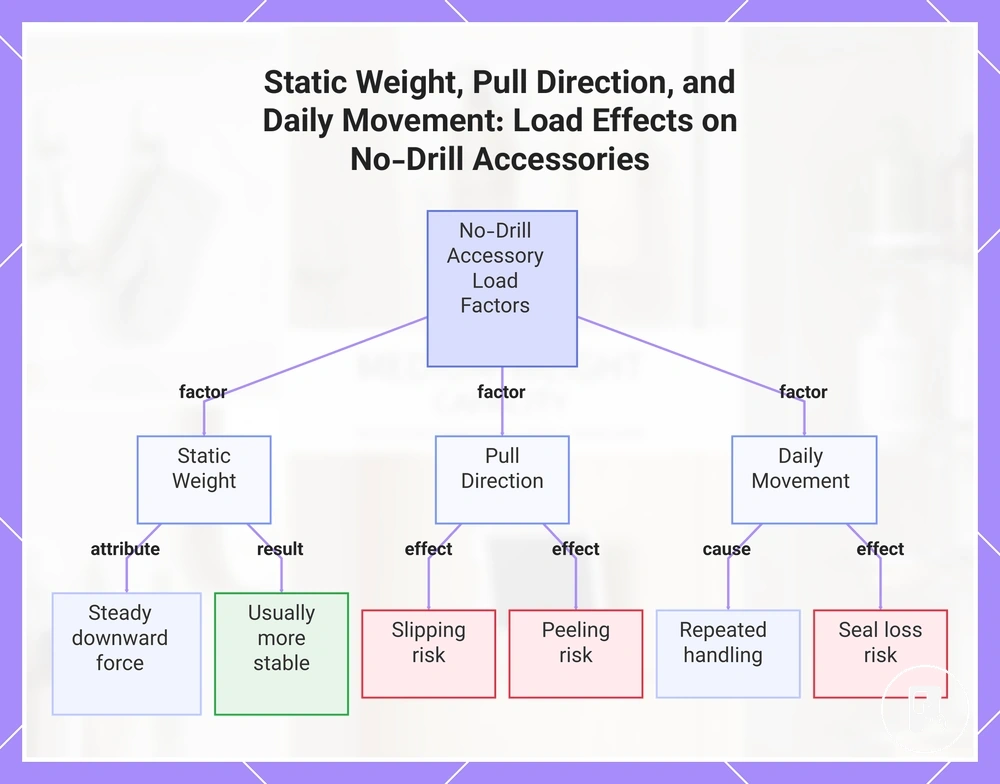
Static weight, pull direction, and daily movement describe how force direction and usage frequency change the load on a no-drill accessory. Static weight creates downward load, while pull direction and daily movement introduce shifting forces that change overall stability and holding strength.
A wall hook holding a hanging bag illustrates this behavior. Static weight applies steady downward load, but pulling the bag outward or repeated handling changes force direction and introduces slipping risk, peeling risk, or loosening over time. Daily movement introduces repeated handling that may contribute to seal loss depending on surface and contact condition.
In practice, downward static load is usually more stable, while pull direction and frequent movement create variable stress that depends on surface type, installation quality, and contact condition, influencing overall holding behavior.
This chart shows how static weight, pull direction, and daily movement create different load conditions and stability risks for no-drill accessories.
Moisture, Heat, and Long-Term Load Stress
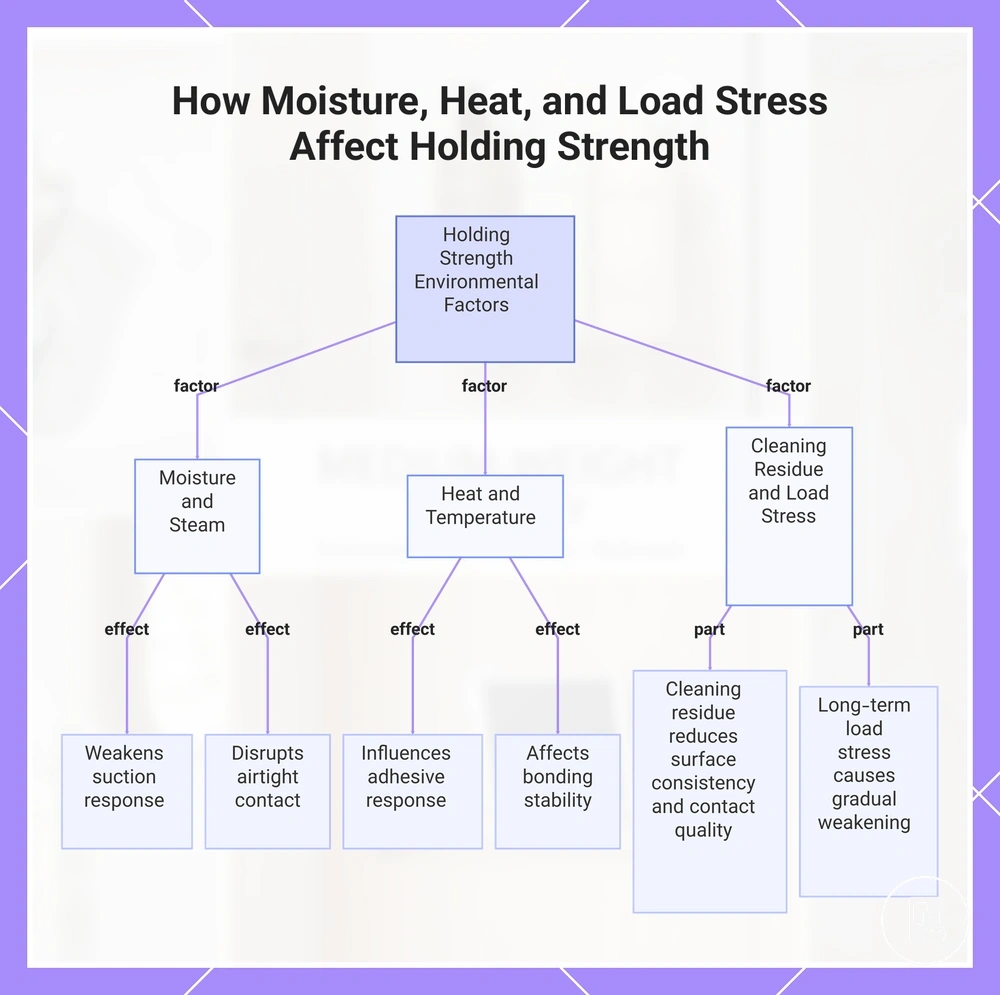
Moisture, heat, steam, cleaning residue, and long-term load stress influence how holding strength behaves over time by affecting adhesive response, suction response, and stability under continued use. These environmental conditions do not act in isolation and typically vary by room conditions, surface type, and mounting method.
Moisture and steam can change how a mounted accessory behaves after installation. In some cases, adhesive response may weaken under persistent humidity, while suction response may lose efficiency if steam disrupts airtight contact. Heat and temperature changes can also affect bonding stability, especially when combined with long-term load stress and repeated use in the same position.
- Moisture and steam: may affect suction response and airtight contact depending on room conditions
- Heat and temperature: can influence adhesive response and bonding stability over time
- Cleaning residue: may reduce surface consistency and contact quality
- Long-term load stress: can contribute to gradual weakening under continuous use patterns
These effects depend on surface material, mounting type, and usage frequency, so environmental impact is best understood as a gradual and conditional factor rather than a fixed outcome.
This chart shows the key environmental factors that influence holding strength over time and their specific effects on adhesive and suction performance.
Weight Ranges for Strong No-Drill Accessories
Weight ranges for strong no-drill accessories refer to practical load class groupings that help interpret how different accessories perform under light load, medium load, and higher load use conditions. These categories act as decision guides rather than guaranteed limits, since real performance depends on surface condition, mounting method, and safety margin requirements.
These weight ranges should be understood as comparative load classes rather than fixed weight limits. The same no-drill accessory may shift behavior depending on use condition, especially when static load is combined with movement or uneven weight distribution.
The table below summarizes how strong no-drill accessories are typically grouped by load class for easier selection and interpretation.
| Load class | Typical accessory examples | Main condition to check | Safer decision cue |
|---|---|---|---|
| Light load | Hooks, small holders | Low static weight with minimal movement | Suitable for single-item use with low handling frequency |
| Medium load | Organizers, racks | Combined weight with moderate daily movement | Works when surface is stable and contact area is strong |
| Higher load | Reinforced accessories | Higher weight distribution with controlled movement | Requires stronger surface compatibility and higher safety margin |
These weight ranges should be treated as interpretation categories rather than exact thresholds, since real-world performance varies with installation quality, surface type, and long-term use conditions.
Light Loads for Hooks and Small Holders
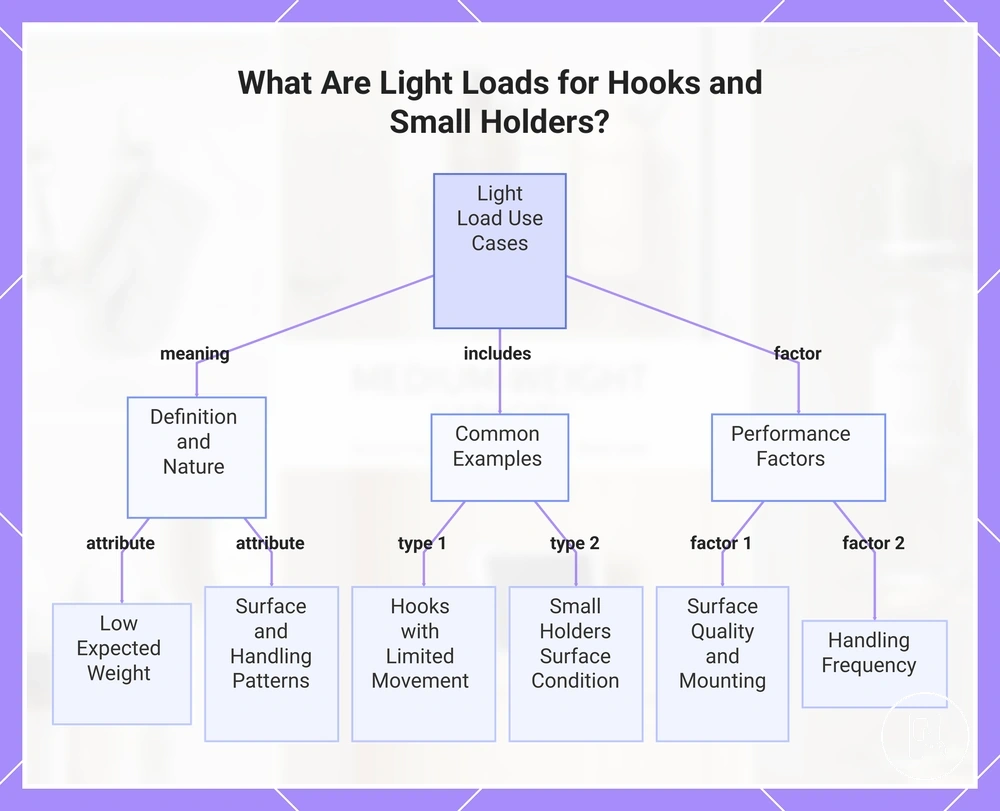
Light loads for hooks and small holders refer to low expected weight use cases such as hooks, key holders, and other lightweight items that rely on surface condition and handling patterns rather than structural strength. These light loads depend on how the surface supports adhesion or contact and how frequently the item is handled in daily use.
Hooks and small holders used under light loads typically perform well when mounted on stable, smooth surfaces and when the use condition involves limited movement. Key holders and similar lightweight items may still experience reduced stability if frequent pulling or repeated handling increases stress on the contact area, especially on weaker or uneven surfaces.
- Hooks: light loads with low expected weight and limited movement on stable surfaces
- Small holders: lightweight items that rely on consistent surface condition
- Key holders: may be affected by frequent pulling and repeated handling
- Lightweight items: suitable for light-duty use when mounting conditions are stable
Light loads should be understood as conditional use cases where acceptable performance depends on surface quality, mounting method, and handling frequency rather than being risk-free across all surfaces.
This chart explains the definition of light loads for hooks and small holders, common examples, and the key factors that affect performance.
Medium Loads for Organizers, Rails, and Caddies
Medium loads for organizers, rails, and caddies depend on combined weight, stored items, balance, surface match, and daily handling, where stronger contact and a higher safety margin are typically required compared to light-load use. These medium loads remain within common home use patterns but increase sensitivity to movement and uneven distribution.
Organizers, rails, and caddies in medium load situations usually carry multiple stored items, so the combined weight becomes the main factor affecting stability. A rail may experience repeated pull direction stress during daily handling, while an organizer or caddy may shift load concentration depending on how items are placed, removed, or redistributed.
In cases involving moisture exposure or frequent handling, medium loads may show reduced consistency over time because surface match and contact reliability can gradually change under repeated movement conditions.
Medium-load verification checklist:
- Combined weight: confirm total stored items stay within moderate load expectations
- Stored items: check how items are distributed across organizer, rail, or caddy
- Balance: ensure load is evenly distributed to avoid tilt or stress concentration
- Surface match: verify stable contact between mounting surface and accessory
- Daily handling: assess frequency of pulling, movement, or repeated access
Higher Loads for Reinforced and Heavy-Duty Accessories
Higher loads for reinforced and heavy-duty accessories refer to use conditions where stronger mechanisms and larger bond areas may be considered to support increased weight, but only when surface condition, installation quality, declared load condition, and no-drill limits are suitable. These higher loads remain within no-drill limits and must be interpreted as conditional rather than structural guarantees.
Reinforced or heavy-duty no-drill accessories typically rely on a larger bond area or a stronger mechanism to distribute force more evenly across the mounting surface. This can help under higher loads, especially when stored items create concentrated pressure or when daily use introduces repeated stress on the same contact points under a defined declared load condition.
In practical use, higher loads should be treated cautiously when involving valuable, fragile, or safety-critical items, as performance depends heavily on surface match, environmental stability, and correct installation conditions rather than the reinforcement label alone.
Caution note: Higher-load performance in no-drill accessories depends on declared load condition and surface compatibility within no-drill limits. Items that exceed safe handling expectations or introduce sudden force changes may increase failure risk even with reinforced designs.
How Adhesive, Suction, and Tension Mounts Handle Load
Adhesive mounts, suction mounts, and tension mounts handle load through different load transfer paths defined by contact requirement, surface condition, and mechanical behavior. Each mounting method transfers force differently, which affects its strength behavior under specific use conditions rather than creating a universal load outcome.
The comparison below explains how adhesive mounts rely on bond area, suction mounts depend on airtight sealing on smooth surfaces, and tension mounts distribute force through pressure-based fit. These differences define the best-fit load scenario for each method and highlight their main limitation under varying installation conditions.
The table summarizes mounting method strength differences across key load-related criteria and shows how each system behaves under suitable conditions.
| Mounting method | Contact requirement | Strength behavior | Best-fit load scenario | Main limitation |
|---|---|---|---|---|
| Adhesive mounts | Stable surface with sufficient bond area | Steady under static load, sensitive to peeling forces | Organized storage with limited movement | Reduced performance on uneven or dusty surfaces |
| Suction mounts | Smooth, non-porous surface with airtight seal | Depends on vacuum stability and surface smoothness | Light to moderate loads on glass or tile | Air leakage or textured surfaces weaken hold |
| Tension mounts | Pressure fit between two fixed points | Distributes force through mechanical tension | Adjustable spacing installations with controlled load | Movement or misalignment reduces stability |
Within mounting method strength differences, each system shows distinct load transfer behavior that influences how safely it can be applied under different conditions of surface quality, daily handling, and load distribution.
Selection between adhesive, suction, and tension mounts depends on load transfer behavior, contact requirement, and environmental stability rather than a universal strength ranking, since each method performs differently under its suitable conditions.
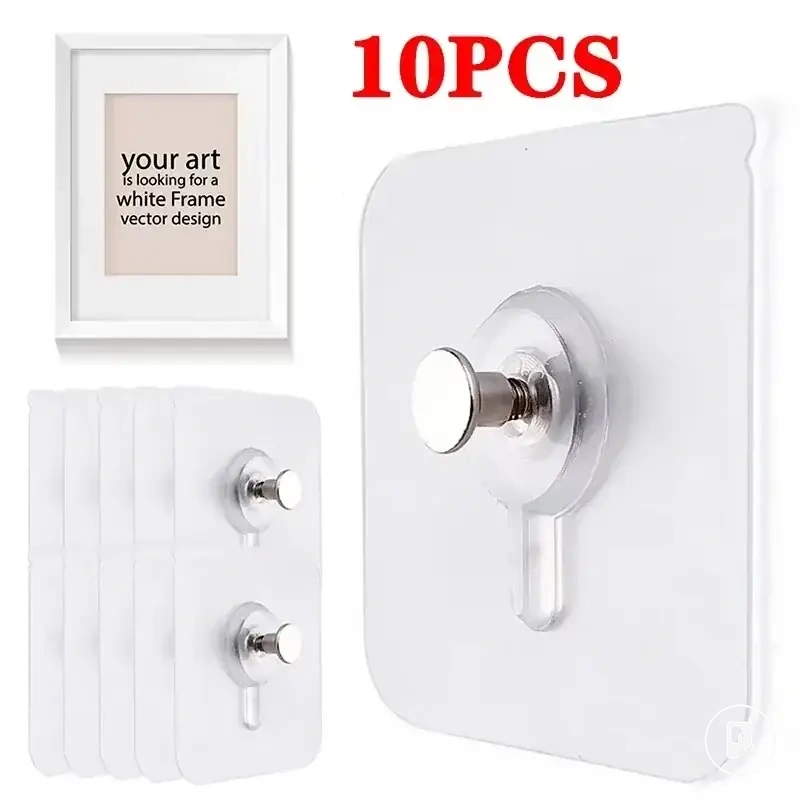
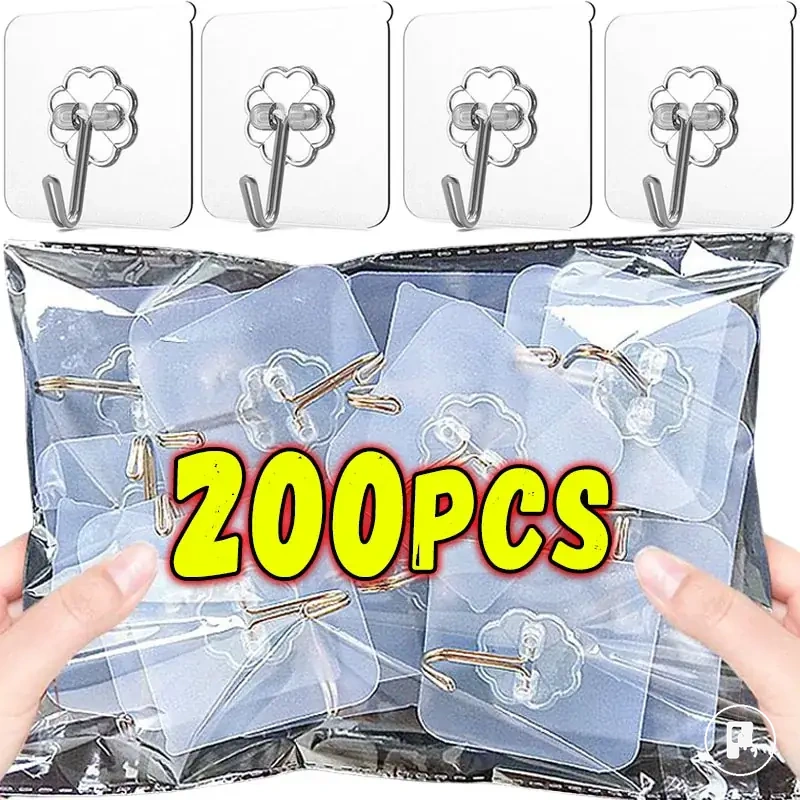
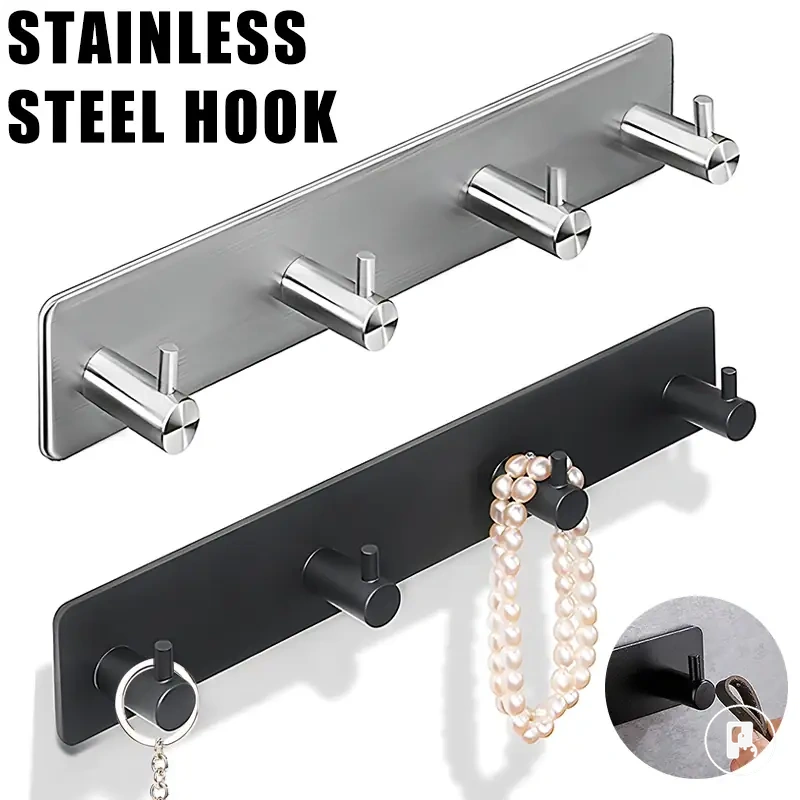
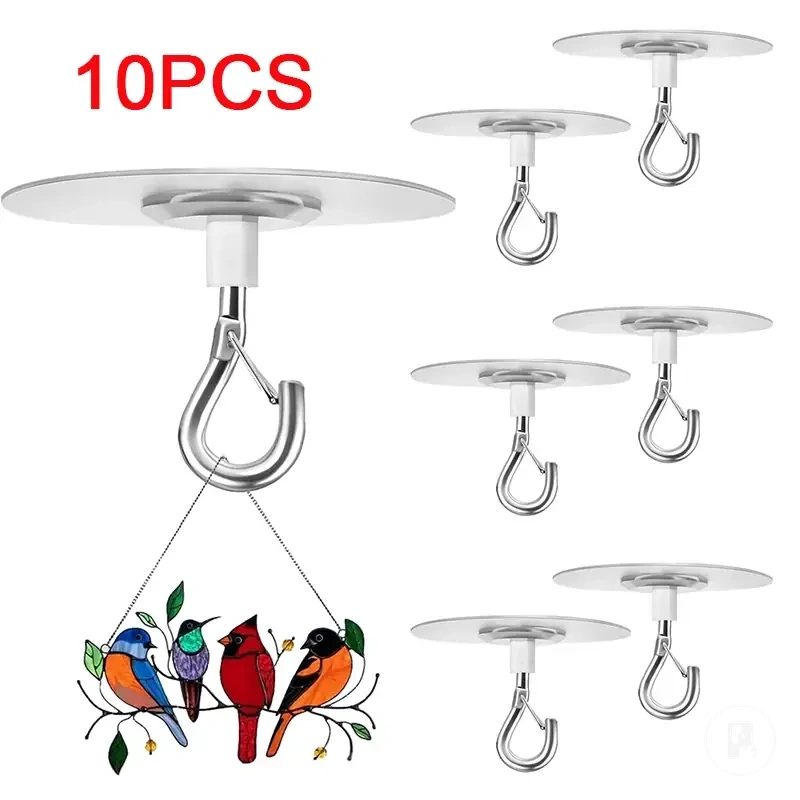
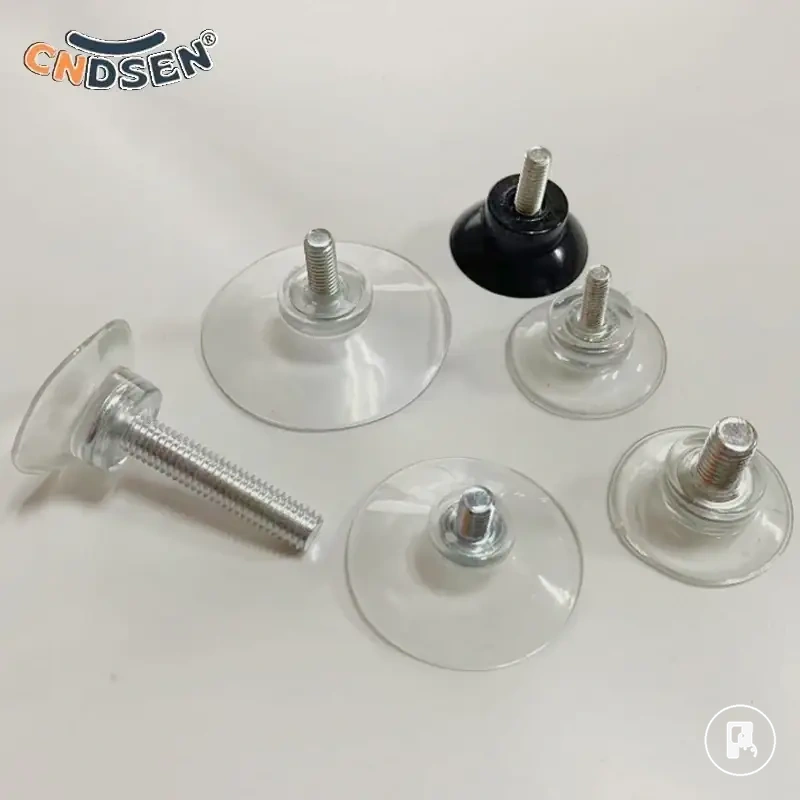
Here are product examples that may make comparison easier. Before buying, always review the compatibility criteria, essential features, and product details.
Choosing No-Drill Accessories by Expected Weight
Choosing no-drill accessories depends on expected weight combined with use case, surface condition, mounting method, and movement, because weight alone does not determine safe everyday decision performance. The same load can behave differently depending on how force is applied and how stable the mounting environment is.
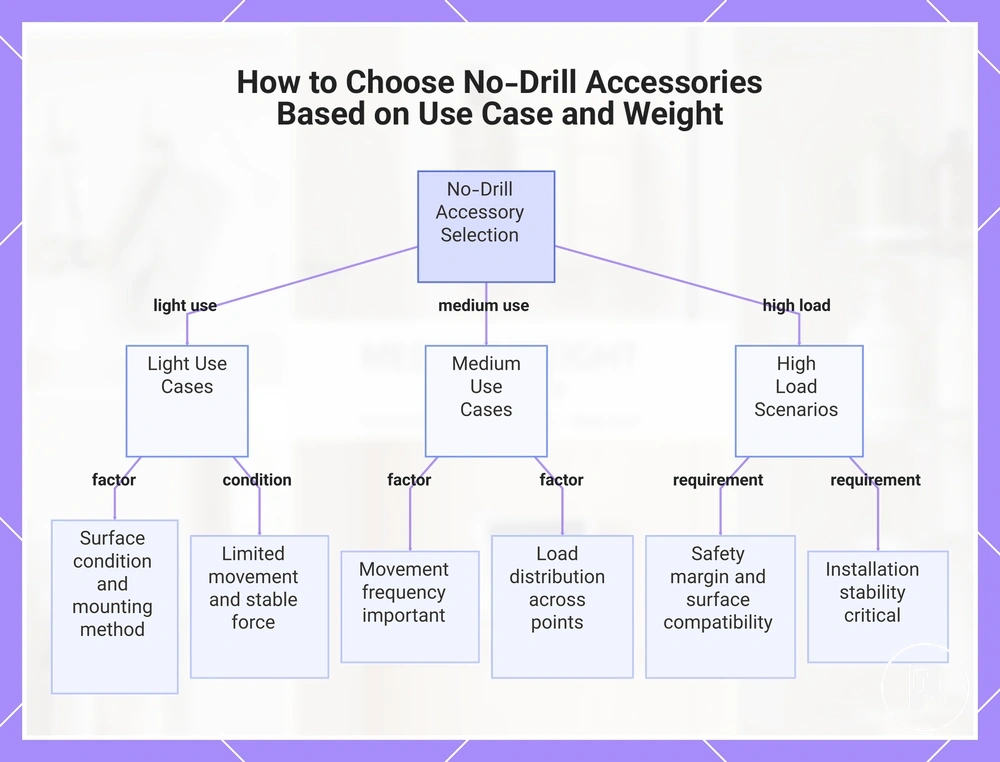
The decision process below helps translate expected weight into a more reliable selection approach by linking use case conditions with mounting behavior rather than treating load as a single fixed value.
Light use cases such as hooks for small items typically involve lower expected weight and limited movement. In these cases, surface condition and mounting method consistency matter more than raw load, especially when daily handling is minimal and force direction remains stable.
Medium use cases such as organizers often involve combined weight and repeated interaction. Movement frequency and load distribution across multiple contact points become important, since uneven placement can change how the accessory responds over time.
Within choose by use case and weight, selection becomes more accurate when expected weight is evaluated together with surface condition and mounting method strength behavior instead of isolated load assumptions.
Higher load scenarios involving reinforced wall accessories require additional attention to safety margin, surface compatibility, and installation stability, since increased weight and movement can amplify small inconsistencies in contact or alignment.
Here are product examples that may make comparison easier. Before buying, always review the compatibility criteria, essential features, and product details.
- Use case: identify whether the item is a hook, organizer, or reinforced accessory
- Expected load: estimate total weight including combined or dynamic load
- Surface condition: check smoothness, cleanliness, and material type
- Mounting method: match adhesive, suction, or tension behavior to conditions
- Safer decision cue: choose the option with higher stability under real movement
Safe everyday decision making improves when expected weight is treated as a starting point and validated against surface condition, mounting method, and movement rather than used as the only selection factor.
This chart shows how to select no-drill accessories by evaluating expected weight within light, medium, and high load use cases, considering surface condition, mounting method, and movement.
Load Capacity Claims, Safety Margins, and Use Limits
Load-capacity claims, safety margins, and use limits for no-drill accessories must be interpreted as conditional values that depend on real surface conditions, mounting method, and everyday use behavior rather than fixed guarantees. Rated capacity reflects a stated limit that may come from controlled testing conditions that differ from real installation environments.
Load-capacity claims depend on claim context, including how and where the accessory was tested, what surface type was used, and whether movement or environmental factors were included in the evaluation. In everyday use, variations in surface texture, load direction, and mounting stability can change how closely the accessory operates to its stated capacity.
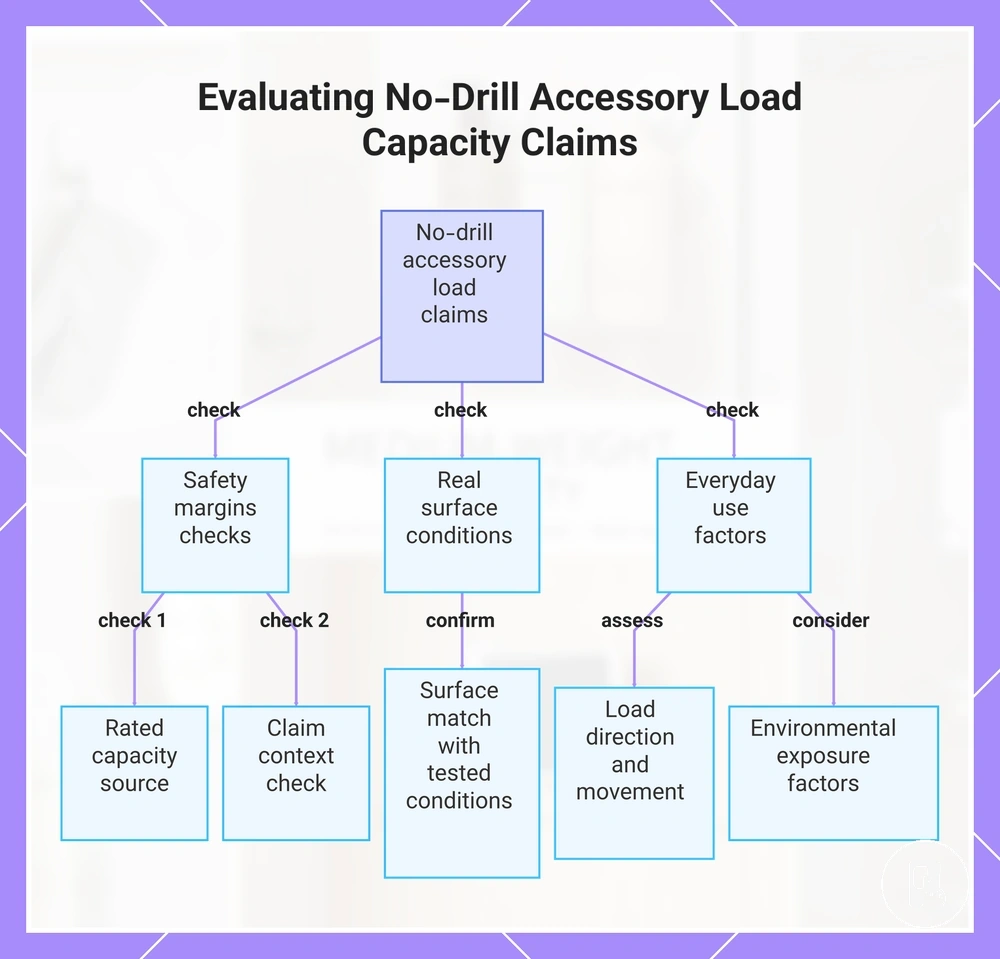
The checklist below helps evaluate load-capacity claims by focusing on safety margins, real surface conditions, and everyday use factors before relying on a stated limit.
In real use scenarios, approaching or exceeding stated limits can increase failure consequence risks, especially when heavy or fragile items are involved or when mounting conditions differ significantly from the original claim context.
- Rated capacity: verify whether the stated limit comes from controlled testing or general use conditions
- Claim context: check surface type and environment used during capacity rating
- Real surface: confirm whether your installation surface matches tested conditions
- Load direction: assess whether force is static, pulling, or shifting during use
- Movement: evaluate daily handling or repeated stress on the mounted accessory
- Environment: consider moisture, heat, and long-term exposure factors affecting stability
This chart shows the three main check areas for interpreting load capacity claims: safety margins, real surface conditions, and everyday use factors.
Rated Capacity Versus Safe Everyday Load
Rated capacity and safe everyday load differ because the printed rating of no-drill accessories is typically based on ideal condition assumptions, while safe everyday load reflects real-use load influenced by surface condition, movement, and installation variability. The printed rating represents a stated weight limit that may not fully account for everyday variation.
In ideal condition, rated capacity assumes stable surface condition, correct installation, and minimal movement, whereas everyday variation introduces shifting load direction, repeated handling, and environmental changes that can reduce practical performance. This difference creates a caution signal when translating printed rating into real-use load decisions.
| Rated capacity | Safe everyday load |
|---|---|
| Based on ideal condition and controlled testing assumptions | Based on real surface condition and everyday variation in use |
| Reflects printed rating or stated weight limit | Reflects practical load under movement and handling |
| Does not fully account for surface condition changes | Adjusts for movement, load direction, and usage behavior |
A simple hook example shows the difference clearly: a hook may meet its printed rating under ideal condition, but in everyday use, frequent pulling or uneven load direction can reduce the safe everyday load compared to the stated limit.
Strength, Removability, and Surface Risk Trade-Offs
Strength, removability, and surface risk are directly linked because stronger hold in no-drill accessories often increases surface risk while reducing removability. In many cases, higher strength improves stability under load but can make clean removal more dependent on surface condition, adhesive type, and how long the accessory has been installed.
Different mounting approaches show this trade-off through strength, removability, and surface protection behavior. Stronger hold typically relies on higher bonding force, which may increase removal difficulty, while removable adhesive options aim to support cleaner removal with lower surface risk when used on suitable surfaces. On painted wall and delicate finish surfaces, outcomes may vary depending on surface condition and duration of application rather than adhesive type alone.
In renter or frequently changed setups, this balance becomes more important because repeated repositioning can affect surface protection and increase surface risk even when removable adhesive is used. The decision depends on balancing stronger hold for load stability with removability and surface protection under real use conditions.
When Heavy Loads Exceed No-Drill Accessory Limits
Heavy loads, valuable items, fragile items, and safety-critical items may exceed no-drill accessory limits when load behavior goes beyond what the mounting surface and contact area can safely support. In these cases, excessive load conditions move the setup outside the stable range of no-drill accessory limits.
High-risk items change load behavior through concentrated weight, uneven distribution, or repeated movement, which can increase surface consequence over time. This may raise loosening risk and increase falling risk, especially when the load is not evenly supported by the mounting contact area.
Caution checklist for identifying when to avoid or reconsider no-drill mounting:
- Weight level: heavy loads relative to accessory type and mounting surface
- Fragility: valuable items or fragile items where failure consequence is high
- Safety impact: safety-critical items where falling risk affects people or property
- Surface condition: visible stress or reduced stability on the mounting surface
- Movement frequency: repeated handling that increases loosening risk over time
When these conditions appear together, the load should be treated as beyond safe use for no-drill accessories. More context on instability patterns is explained in what causes no-drill accessories to fall.