
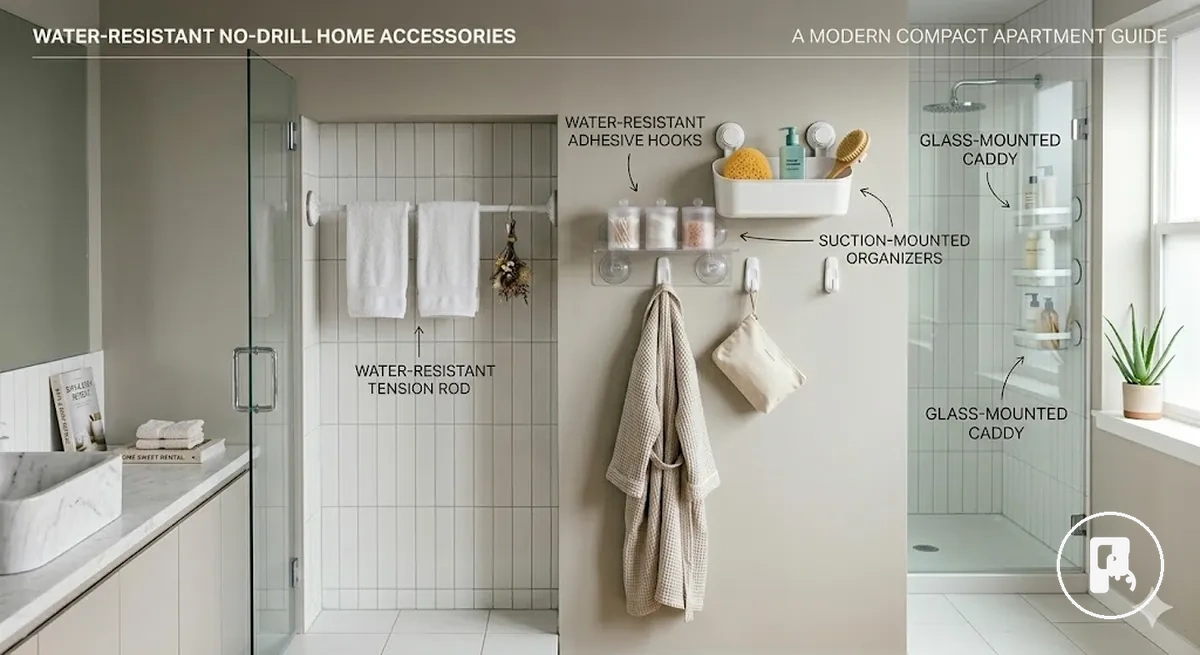
No-Drill Bathroom Accessories for Wet-Area Surfaces and Shower Walls
No-drill bathroom accessories are mounting solutions designed for wet-area surfaces where drilling into bathroom tile or shower walls is not required. These systems rely on adhesive mounts or suction mounts to stay attached under varying levels of water exposure. Their performance depends on surface condition, load, rust-resistant material finishes, and humidity exposure in wet environments, which together determine whether wet-area fit remains stable or limited.
No-drill bathroom accessories depend on surface smoothness, water exposure level, mounting method, and realistic load conditions to qualify for safe use. Fit can vary across shower walls and bathroom tile because adhesive mounts and suction mounts react differently to moisture and surface texture. In broader evaluation contexts, they are often described as no-drill home accessories when grouped by installation-free design and usage scope in wet areas.
Wet-area conditions introduce practical constraints that must be assessed before any placement decision for no-drill bathroom accessories. Continuous humidity, direct water exposure, and steam can influence how mounts interact with bathroom surfaces over time. This creates a clear boundary between bathroom-safe usage zones and constant water contact zones, which helps define whether shower wall or tile compatibility remains viable.
Wet-Area Conditions That Change No-Drill Accessory Fit
Wet-area conditions change how no-drill bathroom accessories fit, hold, and perform over time in moisture-prone bathrooms. Humidity, direct splash, steam, cleaning chemicals, surface temperature shifts, and repeated handling all influence mounting stability on shower walls and bathroom tile. These factors interact with adhesive mounts and suction mounts, affecting how long they maintain contact and resist movement. Moisture exposure ultimately changes hold behavior and durability expectations rather than allowing fixed performance assumptions.
Moisture creates multiple pressure points that affect no-drill bathroom accessories in different ways. Humidity can soften adhesive performance, while direct splash increases localized water exposure on shower walls. Steam spreads moisture across bathroom tile surfaces, and cleaning chemicals may leave residue that weakens mounting contact. Surface temperature changes and repeated handling introduce additional stress on attachment points.
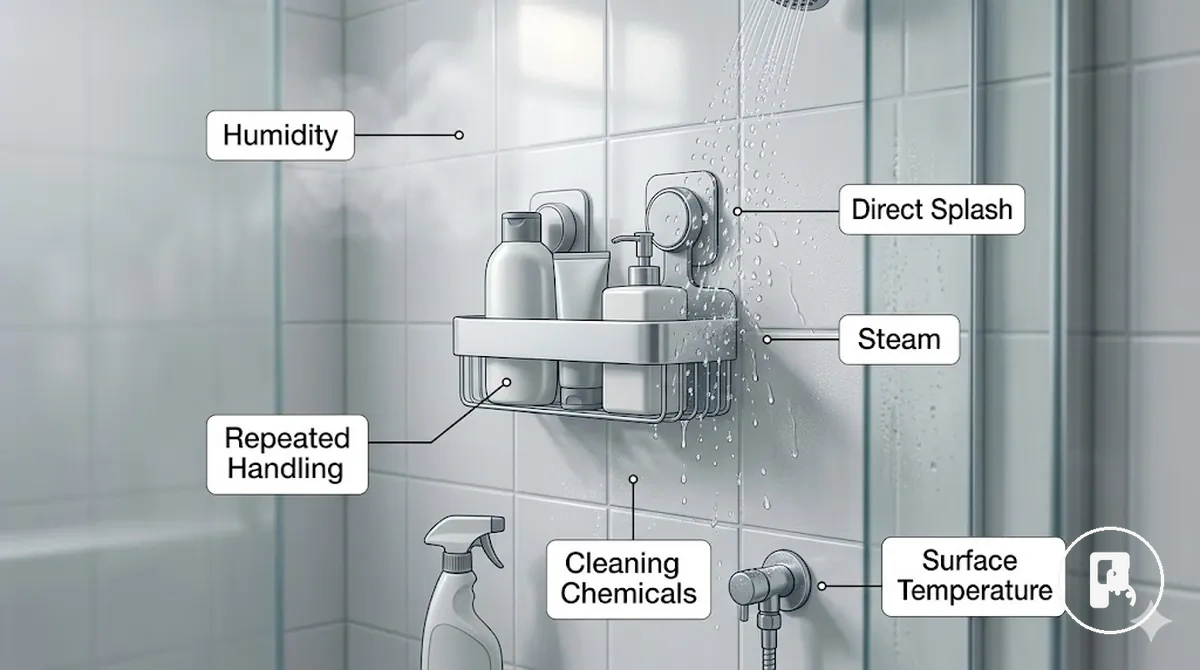
Wet-area conditions vary depending on how close an accessory is to direct water exposure and how often it is handled in daily use. This distinction helps separate general bathroom humidity from constant spray zones where performance limits become more visible.
Wet-area conditions can affect corrosion behavior and long-term hold because continuous exposure patterns influence how mounting surfaces and materials respond over time.
Wet-Area Conditions That Change No-Drill Accessory Fit organizes the main environmental factors that influence performance in moisture-prone bathrooms before installation decisions are made.
- Humidity levels that can gradually affect adhesive mounts and suction mounts
- Direct splash exposure on shower walls increasing localized water contact
- Steam buildup influencing surface moisture and attachment stability
- Cleaning chemicals leaving residue that may reduce mounting grip on bathroom tile
- Surface temperature shifts affecting material expansion and contraction
- Repeated handling such as towel pulling or bottle access creating movement stress
Bathroom Surfaces That Support No-Drill Mounting
Bathroom surfaces determine whether no-drill mounting can maintain stable contact or lose grip under daily use. Smoothness, porosity, sealing, and surface evenness directly affect how bathroom surfaces interact with adhesive and suction mounting systems. Tile, glass, metal, and sealed stone usually provide more reliable contact, while textured walls, porous surfaces, grout lines, and uneven surfaces increase hold risk. These surface properties determine the compatibility structure shown in the table below.
Bathroom surfaces that support no-drill mounting can be evaluated through visual differences in smoothness, sealing, and interruption points like grout lines. The following layout combines a visual reference with a structured breakdown of how each surface type behaves under no-drill mounting conditions. The image helps clarify how smooth and uneven surfaces differ in real bathroom environments before reviewing the table of compatibility conditions.
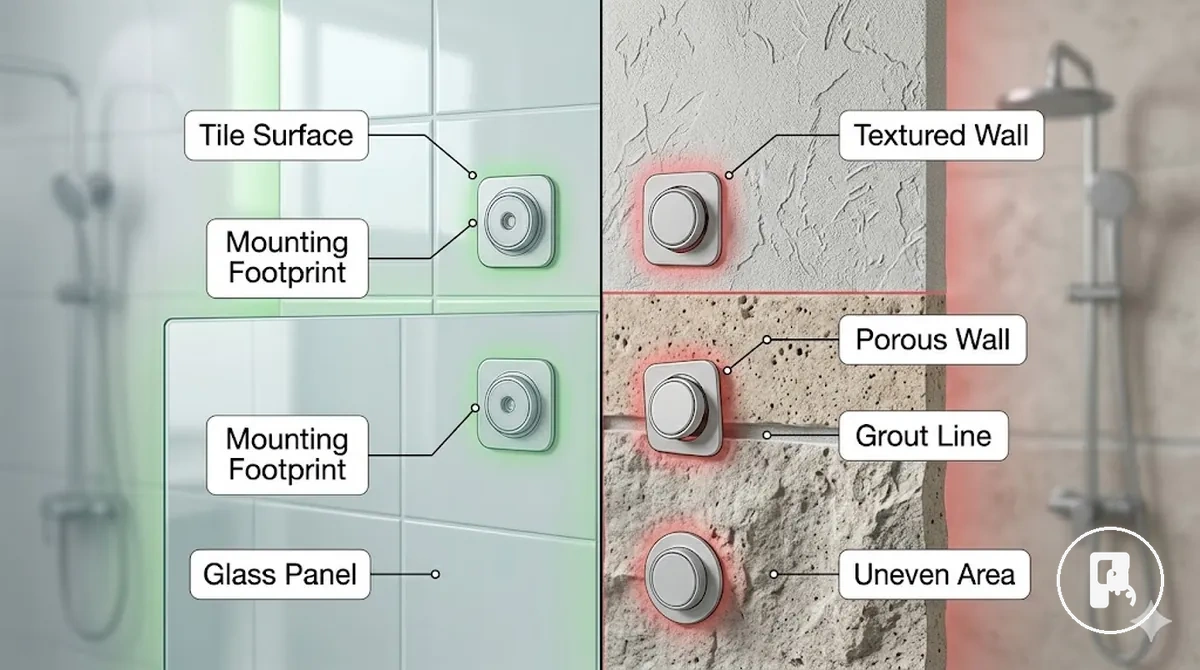
Smooth non-porous bathroom surfaces typically provide more stable contact for no-drill mounting because they reduce air gaps and improve adhesion consistency. In contrast, porous surfaces and uneven bathroom surfaces interrupt contact points and increase failure risk under moisture or load. The table below organizes bathroom surface types, key attributes, suitable mounting conditions, and likely risks for clearer comparison.
| Surface | Key attribute | Suitable mounting condition | Likely risk |
|---|---|---|---|
| Tile | Smooth surface | Clean, flat, non-porous finish | Grout line interference and edge air gaps |
| Glass | Non-porous | Fully sealed flat contact area | Seal failure under moisture or misalignment |
| Metal | Rigid surface | Flat, corrosion-resistant coating | Reduced grip on coated or uneven finishes |
| Sealed stone | Sealed surface | Properly treated and smooth finish | Variable adhesion due to seal wear |
| Painted walls | Coated surface | Strong, non-flaking paint layer | Peeling or paint separation under load |
| Textured walls | Uneven surface | Generally unsuitable without flat contact points | Air gaps and unstable adhesion |
| Porous surfaces | Absorptive | Not suitable for stable adhesion | Moisture absorption weakens bond |
| Grout lines | Interrupted contact | Requires full tile coverage only | Loss of seal continuity |
| Uneven surfaces | Irregular plane | Limited compatibility even with adhesive support | High failure risk due to poor contact |
Most compatibility differences come from how smooth non-porous bathroom surfaces maintain continuous contact, while interrupted or porous surfaces weaken adhesion stability. This distinction prevents the assumption that all bathroom surfaces behave the same under no-drill mounting conditions. Broader tile and glass behavior is further explained in tile and glass surface compatibility where surface-specific performance differences are detailed.
Smooth Tile, Glass, Metal, and Sealed Stone Surfaces
Smooth tile, glass, metal, and sealed stone surfaces are usually stronger candidates for no-drill mounting because they allow consistent flat contact between the mounting base and the bathroom surface. These smooth bathroom surfaces can support adhesive contact or suction seal when flatness is high and the surface is properly non-porous. Their reliability depends on residue levels, edge placement, and water contact during daily use.
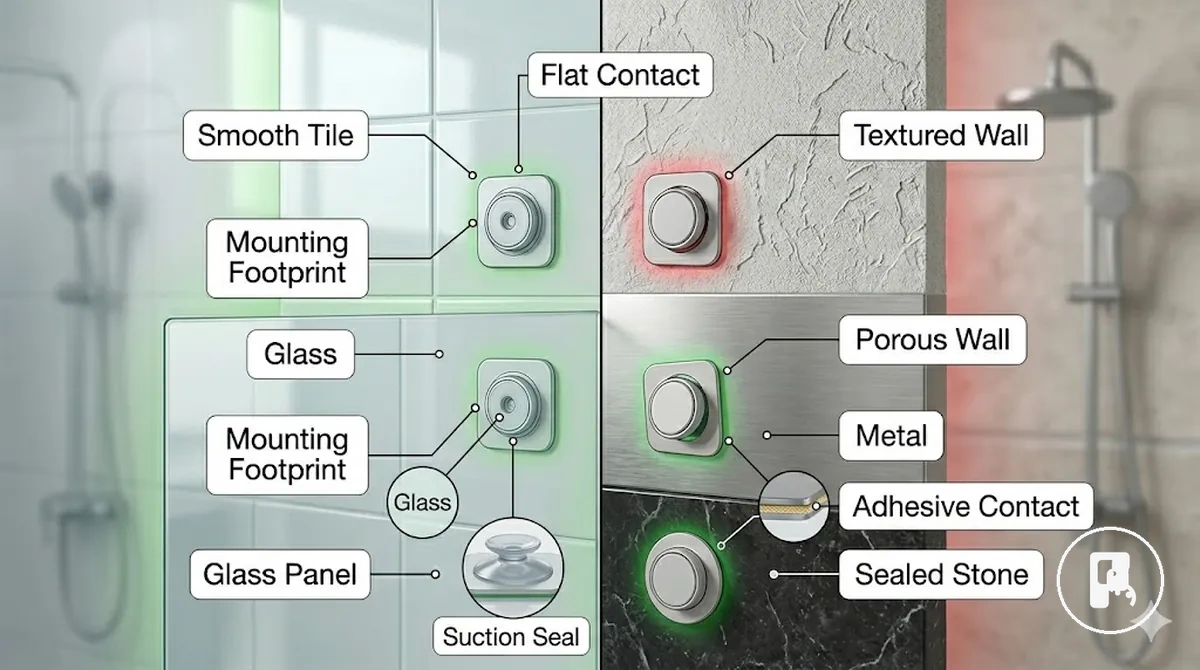
Flatness is the key factor that allows smooth tile, glass, metal, and sealed stone to maintain stable contact, while residue or grout interruption can reduce adhesion strength. Even when surfaces are classified as non-porous, minor contamination or uneven sealing can interrupt suction or adhesive performance and affect hold quality over time.
A shower glass panel or glossy tile surface may support no-drill mounting when the contact area is fully flat and clean, but suitability still varies based on water contact, edge placement, and surface condition. This means performance remains conditional rather than universally consistent across all installations.
Painted, Textured, Porous, and Uneven Bathroom Surfaces
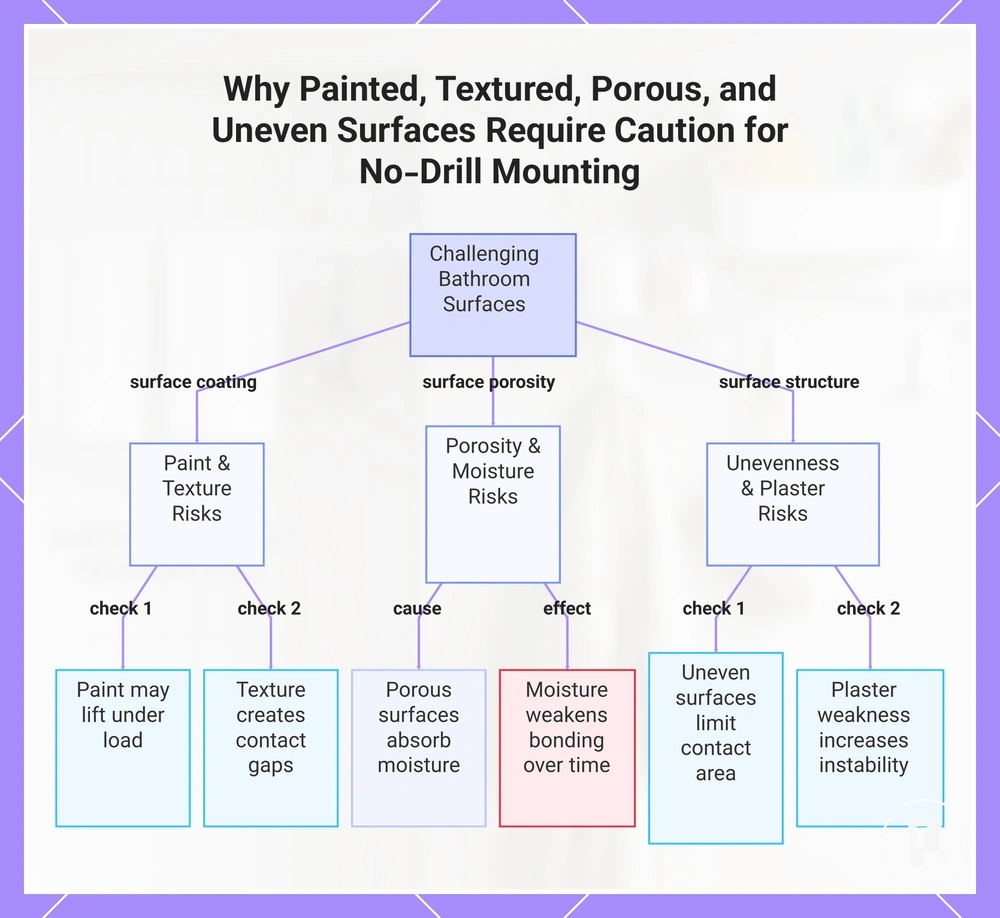
Painted surfaces, textured surfaces, porous surfaces, and uneven surfaces need more caution for no-drill mounting because their wall layers do not always provide stable contact. Paint quality, wall texture, plaster weakness, and surface unevenness can vary significantly across bathroom environments, making adhesion outcomes less predictable. In many cases, stability depends more on surface layer strength than the mounting system itself.
Weak surface layers increase installation uncertainty because contact behavior changes under moisture exposure. Painted surfaces may lift or weaken under load, textured surfaces can create gaps, porous surfaces can absorb moisture and reduce bonding consistency, and uneven surfaces can limit full contact area. Moisture further worsens these conditions by weakening already unstable contact zones and increasing removal risk over time.
Strong adhesive systems do not always guarantee stable performance when the underlying surface is weak. A reliable mount depends on both adhesive strength and the integrity of painted surfaces, textured surfaces, porous surfaces, and uneven surfaces. This distinction helps clarify why failures often occur at the wall layer rather than the adhesive itself.
Painted, Textured, Porous, and Uneven Bathroom Surfaces present different risk signals that should be checked before choosing a no-drill mounting position. These signals help identify where surface-layer weakness may affect adhesion stability and removal risk.
- Paint quality: weak or peeling paint may reduce adhesion stability and increase removal risk
- Wall texture: rough or uneven texture can create gaps that interrupt full surface contact
- Porous surfaces: moisture absorption can weaken bonding strength over time
- Plaster weakness: underlying wall fragility can increase long-term instability
- Uneven surfaces: limited flat contact area can reduce overall mounting reliability
This chart shows the specific risk signals for each surface type that affect no-drill mounting stability, highlighting that surface layer strength is more critical than adhesive strength.
Shower-Wall and Splash-Zone Placement Limits
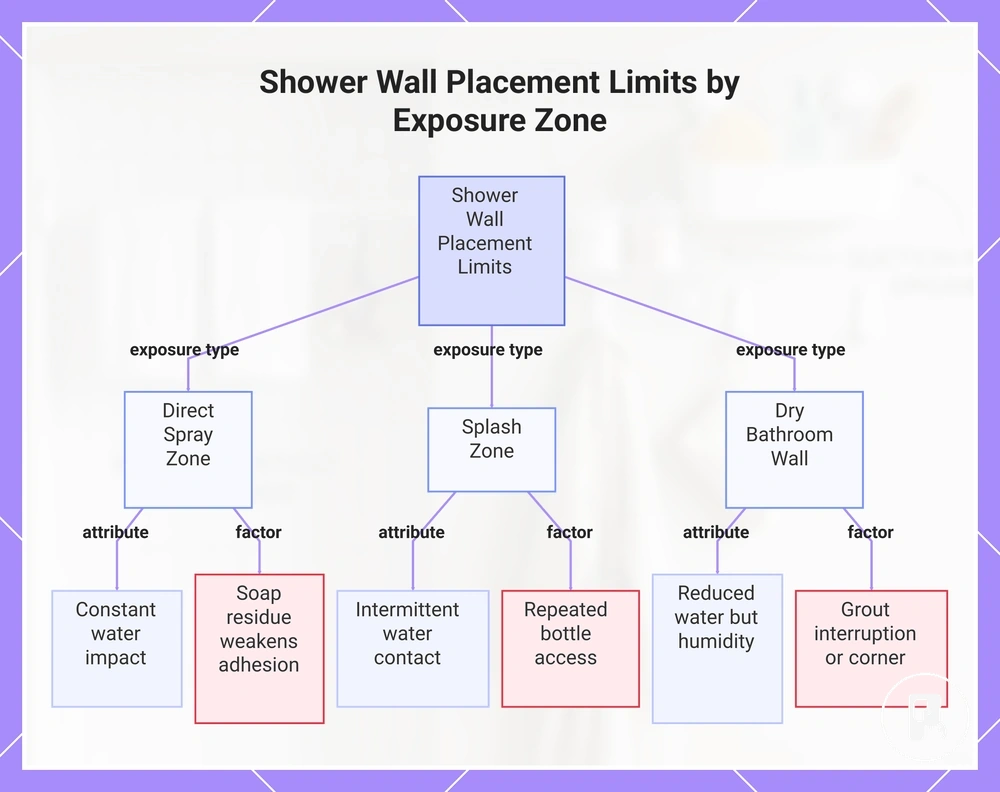
Shower wall and splash zone placement changes compatibility because water exposure and handling frequency vary across bathroom zones. Direct spray on a shower wall increases exposure stress, while splash zones and dry bathroom walls face progressively lower moisture impact. Grout interruption, corner placement, soap residue, and repeated bottle access further shape placement limits across these zones. Zone, exposure, and handling together determine overall placement limits.
A shower wall inside a direct spray zone is continuously exposed to water impact, while a splash zone receives intermittent contact from nearby use. A dry bathroom wall stays outside regular spray but may still experience humidity and nearby movement effects. Corner placement can collect soap residue and concentrate moisture, while repeated bottle access increases physical disturbance in the same area. These zone differences define how placement limits change by exposure type.
Direct spray zones create higher risk because constant water flow and soap residue can interrupt surface contact and weaken adhesion conditions over time. Splash zones introduce moderate variability where occasional moisture and repeated access may still affect stability. Dry bathroom walls reduce direct exposure, but grout interruption or corner placement can still influence contact quality. This separation helps distinguish direct spray from splash or dry-zone compatibility.
Many assume tile alone determines suitability, but placement limits depend more on exposure pattern than surface type. A shower wall tile in a direct spray zone may behave differently from the same tile in a splash or dry zone. This makes fixed placement assumptions unreliable across different bathroom layouts and use conditions.
To evaluate shower-wall and splash-zone placement limits, the checklist below highlights exposure and handling factors that influence compatibility:
- Direct spray exposure: constant water impact increases placement stress on shower wall surfaces
- Splash zone exposure: intermittent water contact creates variable stability conditions
- Dry bathroom wall placement: reduced water exposure but still affected by humidity
- Soap residue: surface film can weaken adhesion and reduce contact quality
- Repeated bottle access: frequent movement increases load and disturbance risk
This chart shows how direct spray, splash, and dry zones affect placement limits, including key factors like soap residue and repeated access.
Adhesive and Suction Mounts for Moisture-Prone Bathrooms
Adhesive mounts and suction mounts behave differently in moisture-prone bathrooms because they depend on distinct contact mechanisms and surface conditions. Adhesive mounts rely on bonded surface contact, while suction mounts depend on airtight pressure against smooth non-porous surfaces. Their performance changes under humidity, direct water exposure, and load changes across different bathroom zones. The stronger fit depends on surface, moisture, load, and removability.
Adhesive mounts use adhesive pads or waterproof adhesive layers to create surface bonding with bathroom walls. Suction mounts use suction cups that require smooth non-porous surfaces to maintain an airtight seal. Both systems respond differently to humidity, surface residue, and repeated load changes over time. The comparison focuses on surface compatibility, moisture response, removal behavior, and failure risk.
Moisture-prone bathrooms create variable conditions where adhesive stability and suction performance diverge based on exposure and surface quality. Adhesive mounts may maintain stronger surface contact when applied correctly, while suction mounts depend heavily on uninterrupted sealing against smooth non-porous surfaces. A deeper breakdown of suction and adhesive mounting methods helps clarify how each system responds under different wet-area constraints.
In humid environments or direct water exposure zones, both adhesive mounts and suction mounts may show reduced performance depending on surface preparation and load conditions. Splash zones and dry bathroom walls create different compatibility outcomes, where either bonding strength or removability becomes more relevant. Selection depends on how often humidity and water exposure affect the mounting area. No single system remains universally superior across all moisture-prone bathrooms.
To compare adhesive mounts and suction mounts in moisture-prone bathrooms, the table below organizes key decision attributes including surface type, moisture response, removability, and failure risk:
| Mount type | Stronger condition | Wet-area caution | Removal behavior | Decision signal |
|---|---|---|---|---|
| Adhesive mounts | Stable smooth surfaces with consistent contact | Humidity and residue can weaken long-term bonding under load changes | May leave residue depending on surface and duration | Suitable when long-term stability is prioritized over repositioning |
| Suction mounts | Smooth non-porous surfaces with airtight seal | Direct water exposure and seal disruption can reduce hold strength | Usually repositionable with minimal surface impact | Suitable when removability and repositioning are more important |
Waterproof Adhesive Mounts for Humidity and Occasional Water Contact
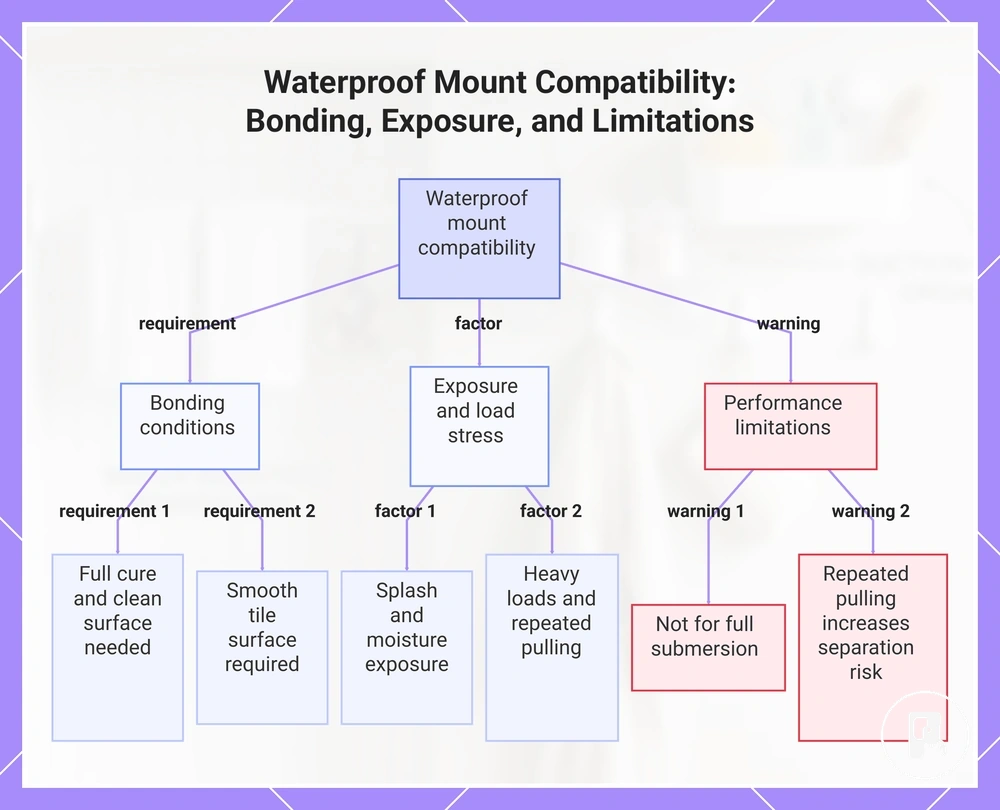
Waterproof adhesive mounts provide conditional compatibility in humidity and occasional water contact areas. Their performance depends on how the waterproof adhesive and adhesive backing interact with tile smoothness and exposure patterns. In many cases, splash frequency and load changes influence how stable the bond remains over time. Surface condition and exposure together determine whether the contact remains reliable.
Performance issues often appear when adhesive backing does not fully cure or when surface residue interrupts bonding. Tile smoothness and moisture presence can also change how consistently the mount holds under repeated humidity exposure. These factors must be evaluated together rather than in isolation. Waterproof labeling does not mean suitability for constant water immersion or full submersion conditions.
Waterproof Adhesive Mounts for Humidity and Occasional Water Contact depend on multiple surface and usage conditions that verify compatibility:
- adhesive backing quality and bonding strength
- curing time required for stable adhesion
- surface residue affecting contact reliability
- tile smoothness for consistent adhesion area
- splash frequency and moisture exposure level
Heavy bottles or frequently pulled items create additional stress on the contact area. In these cases, load distribution and contact area size become as important as adhesive strength. Higher repeated pulling can increase separation risk even when waterproof adhesive is used under suitable conditions.
This chart shows the main factors affecting waterproof adhesive mount compatibility in humidity and occasional water contact areas, including bonding conditions, exposure patterns, and key limitations.
Suction Mounts for Smooth Non-Porous Shower Surfaces
Suction mounts depend on airtight contact with smooth non-porous shower surfaces to function properly. They can hold when glass, glossy tile, or smooth acrylic panels provide a continuous sealed area. This compatibility depends on maintaining uninterrupted surface contact without leakage points. Airtight contact is the key condition that links suction performance to surface quality.
Suction mounts become unreliable when surface curvature, grout gaps, air leaks, or a thin water film interrupt sealing. Even smooth non-porous shower surfaces may lose stability if pressure is uneven or if micro-gaps break the seal. Periodic reseating may be needed when moisture or repeated use weakens the hold. These factors determine whether suction remains stable or gradually releases.
In practical use, suction mounts can support light, removable accessories when the surface remains clean and the load is low. Glass and glossy tile are more suitable when they allow consistent sealing without disturbance. However, stability decreases when conditions shift due to moisture buildup or frequent repositioning needs.
To evaluate suction mounts for smooth non-porous shower surfaces, the following conditions determine compatibility:
- glass or glossy tile supporting airtight contact
- minimal surface curvature to maintain full seal
- absence of grout gaps that interrupt suction zones
- low air leaks during installation and use
- limited water film affecting seal consistency
Rust-Resistant Materials and Finishes for Wet-Area Accessories
Rust-resistant materials define how wet-area accessories respond to humidity, splash exposure, and long-term surface contact in bathrooms. Stainless steel, coated metal, plastic, and aluminum each react differently to moisture, and their behavior changes further based on finish wear, drainage design, exposed joints, and rust-staining risk. These factors influence not only corrosion resistance but also how the accessory looks over time in wet environments.
Rust-Resistant Materials and Finishes for Wet-Area Accessories helps evaluate how material and finish combinations behave under bathroom moisture conditions. The table below organizes material or finish types with their wet-area advantage, watch points, and decision cues. It supports comparing corrosion behavior, finish stability, and exposure sensitivity in a structured way.
| Material or finish | Wet-area advantage | Watch point | Decision cue |
|---|---|---|---|
| Stainless steel | Rust-resistant under humid conditions with stable corrosion resistance | Performance depends on finish quality and exposed joints | Suitable for frequent humidity exposure with controlled drainage |
| Coated metal | Protective coating reduces direct moisture contact | Finish wear may expose base metal and increase rust-staining risk | Works when coating integrity is maintained |
| Plastic | Does not corrode under moisture exposure | Drainage design affects water retention and appearance | Useful for light-load wet-area use |
| Aluminum | Moderate corrosion resistance with lightweight structure | Surface oxidation and exposed joints can affect finish wear | Depends on exposure level and protective finish condition |
| Drainage design | Helps prevent trapped moisture buildup | Poor drainage can increase rust-staining risk over time | Important in splash-prone environments |
| Exposed joints | Allows structural flexibility in design | Water retention at joints may increase long-term corrosion risk | Needs careful placement in wet zones |
| Finish wear | Initial coating provides early surface protection | Degradation can expose underlying material to moisture | Indicator of long-term appearance stability |
Even when materials are rust-resistant, performance depends on finish quality, drainage design, and exposure level, which together shape long-term appearance and rust-staining risk. Understanding these trade-offs helps when you maintain no-drill accessories in wet areas and evaluate how durability and appearance may change over time.
Accessory Types and Fit Checks for Wet-Area Use
Accessory types determine wet-area suitability by how well they match surface conditions, exposure level, material behavior, and expected use. Shower storage, hooks, towel bars, and toilet-area holders behave differently depending on adhesive footprint, suction contact area, bottle weight, drainage, and movement stress. Selection depends on whether the accessory type can stay stable under real wet-area conditions rather than only its mounting method. Type must match surface, exposure, and load conditions.
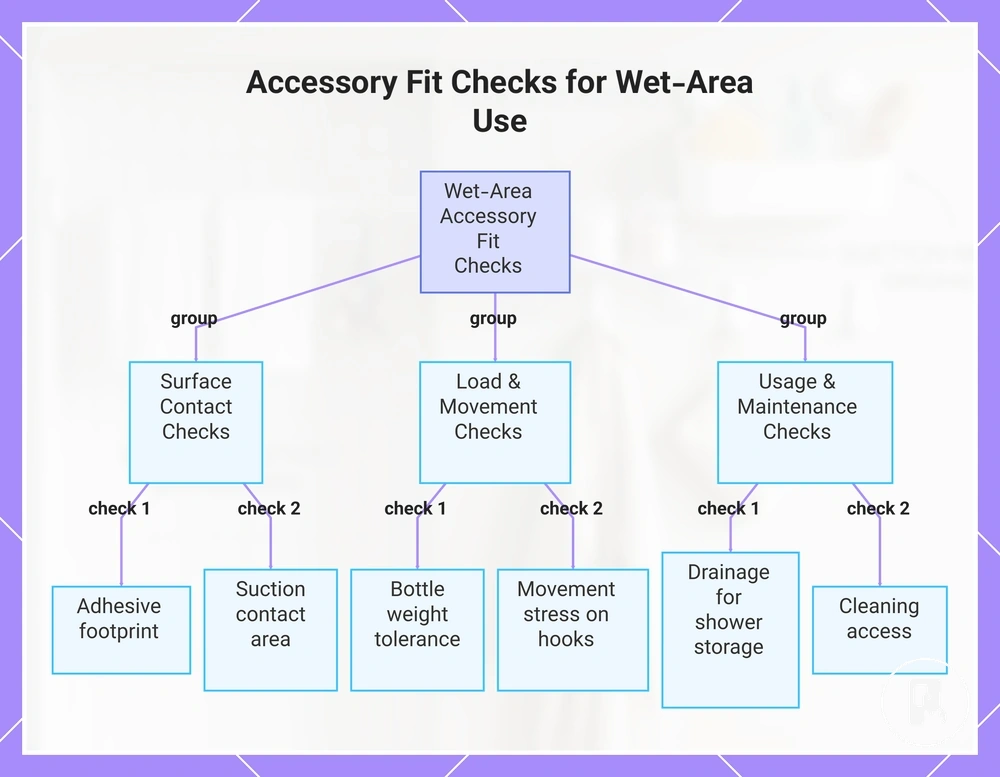
Accessory Types and Fit Checks for Wet-Area Use should be evaluated through structured fit checks that compare type, surface compatibility, and usage intensity. The checklist below organizes these checks so selection stays focused on fit conditions rather than product ranking or preference. It helps clarify whether an accessory type aligns with the intended bathroom environment before any installation decision.
In real bathroom use, shower storage often carries variable bottle weight and depends on drainage to prevent water buildup. Hooks and towel bars introduce pulling force that increases load sensitivity during repeated use. Toilet-area holders may experience intermittent interaction but still rely on a stable adhesive footprint or suction contact area. These differences separate light convenience accessories from load-sensitive accessories.
Many users assume all no-drill accessories behave similarly, but performance depends on how each type interacts with surface, exposure, and load conditions. The decision is not about choosing a best item but about matching fit checks to real usage constraints. This keeps selection grounded in compatibility rather than assumption.
- Accessory type match: shower storage, hooks, towel bars, toilet-area holders aligned with use case
- Adhesive footprint: sufficient surface contact for stable bonding under load
- Suction contact area: adequate sealed surface for smooth wall stability
- Bottle weight: must match storage load tolerance
- Drainage: prevents water retention in shower storage setups
- Movement stress: evaluates pulling force on hooks and towel bars
- Cleaning access: ensures wet handling does not disturb placement
This chart organizes the key fit checks for wet-area accessories, grouped by surface contact, load and movement, and usage maintenance.
Shower Caddies, Shelves, and Soap Holders
Shower caddies, shelves, and soap holders are storage accessories that must carry bottle load while staying stable under constant water exposure. Their fit changes based on how adhesive footprint, suction count, and placement interact with wet handling conditions. Higher bottle load increases stress on mounting points, especially in shower storage zones exposed to splash and movement. :contentReference[oaicite:0]{index=0}
Shower caddies, shelves, and soap holders behave differently depending on shelf depth, drainage holes, and corner placement. Deeper shelves may retain water if drainage holes are insufficient, while shallow shelves reduce water retention but may limit storage stability. Adhesive footprint and suction count determine how load spreads across the surface under repeated wet handling.
When full bottles are placed on a shower caddy, uneven bottle load can increase pulling stress on one side of the adhesive footprint. Adjusting placement or reducing corner placement pressure can improve stability under repeated wet handling conditions. This shows how real usage patterns directly affect fit more than static installation conditions.
Towel Bars, Hooks, and Toilet-Area Holders
Towel bars, hooks, and toilet-area holders are dry-zone accessories that are judged more by pulling force and placement than by constant water exposure. These items hang and support everyday use through repeated tugging, so their stability depends on how the adhesive footprint distributes stress across the wall. Even damp towel weight can increase removal risk when force direction is sideways or repeatedly applied. In these cases, pulling force becomes the primary factor in suitability rather than moisture exposure alone.
Towel bars, hooks, and toilet-area holders differ in how they handle hanging, pulling, and static holding. Hooks usually manage lighter hanging with intermittent pull, while towel bars experience continuous sideways force from damp towel weight and repeated tugging. Toilet-area holders stay mostly static but still depend on alignment in dry zone placement to avoid uneven stress. These differences separate static support from repeated tugging and force-driven loading conditions.
A wall hook with a light hanging item may remain stable under low pulling force, while a towel bar holding a damp towel can experience ongoing sideways stress that increases removal risk on the adhesive footprint. This contrast shows how force direction changes performance even when both are installed in dry zone areas. It reinforces that dry-zone accessories are not interchangeable with shower-wall storage systems.
Load, Bottle Weight, and Daily-Use Movement
Load, Bottle Weight, and Daily-Use Movement define real-use stress in no-drill bathroom setups. Load is not only static weight. Movement and wet handling change how pressure builds on adhesive footprint and suction contact. Load changes during use.
Load refers to carried weight from filled bottles and wet towels during everyday bathroom use. Bottle weight changes when items are lifted, refilled, or replaced. Daily-use movement adds repeated force on adhesive footprint and suction contact through lifting and placing actions. Manufacturer-stated capacity connects to real load only when surface condition and movement are considered together.
A shelf holding filled bottles behaves differently when bottles are frequently removed during daily-use movement. Wet towels introduce pulling force that adds dynamic stress beyond static load. Vibration and repeated handling increase movement stress on mounting points. This is why manufacturer-stated capacity alone may not reflect real-use conditions.
To evaluate load correctly, real use must be separated into static weight, movement stress, and surface interaction. This clarifies how filled bottles, wet towels, pulling force, and repeated removal affect stability. The checklist below organizes load type, movement pattern, surface condition, and risk outcome.
- filled bottles | shelf load | adhesive footprint | risk
- wet towels | pulling force | towel bar | suitability
- suction contact | surface condition | movement | failure risk
- manufacturer-stated capacity | real use | qualification | decision
- bottle weight variation | daily-use movement | load shift | stability
A heavy shampoo bottle increases shelf load when combined with repeated removal during daily-use movement. Wet towels on towel bars increase pulling force and change how adhesive footprint behaves over time. These scenarios complete the criteria for evaluating load, bottle weight, and daily-use movement before product selection.
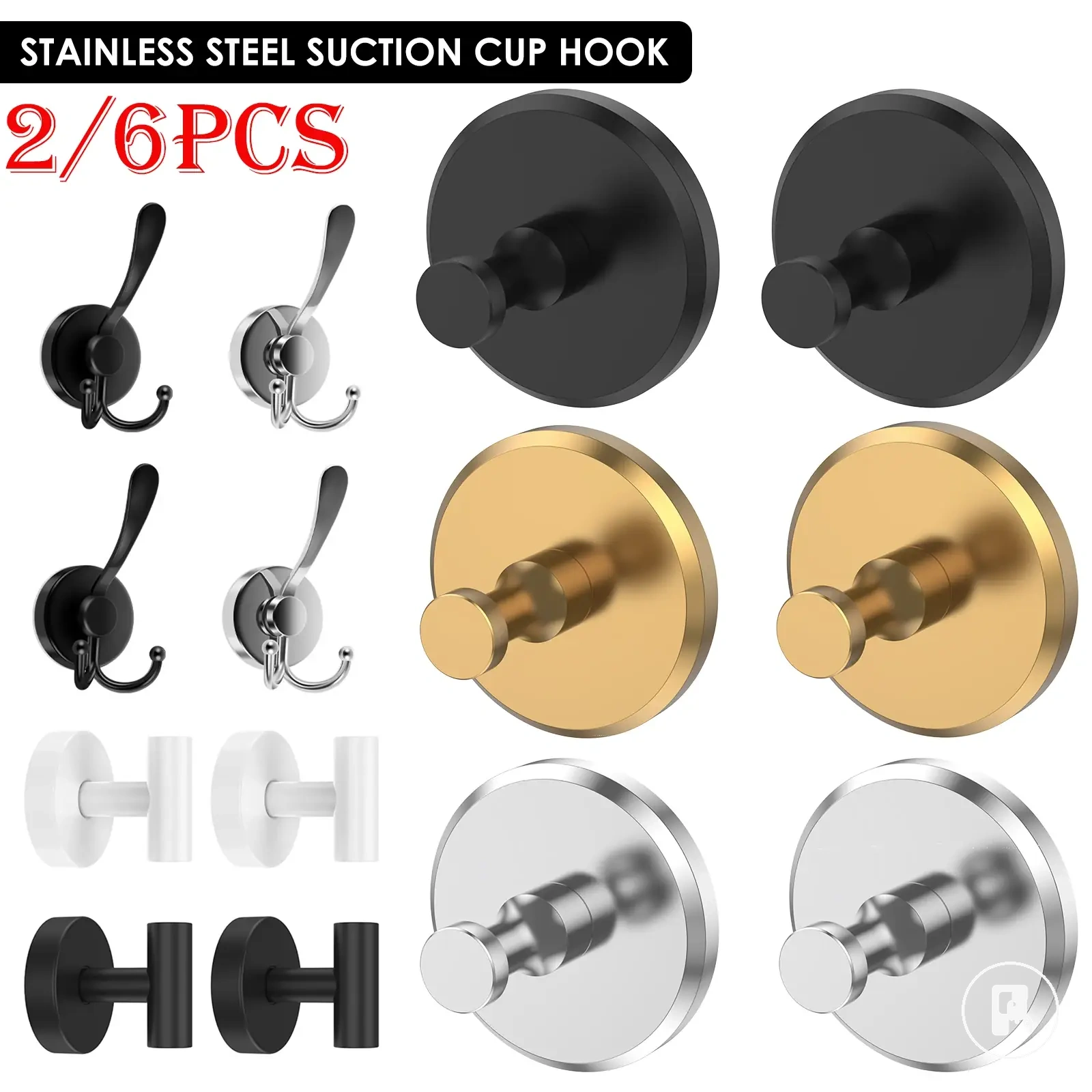
Here are product examples that may make comparison easier. Before buying, always review the compatibility criteria, essential features, and product details.
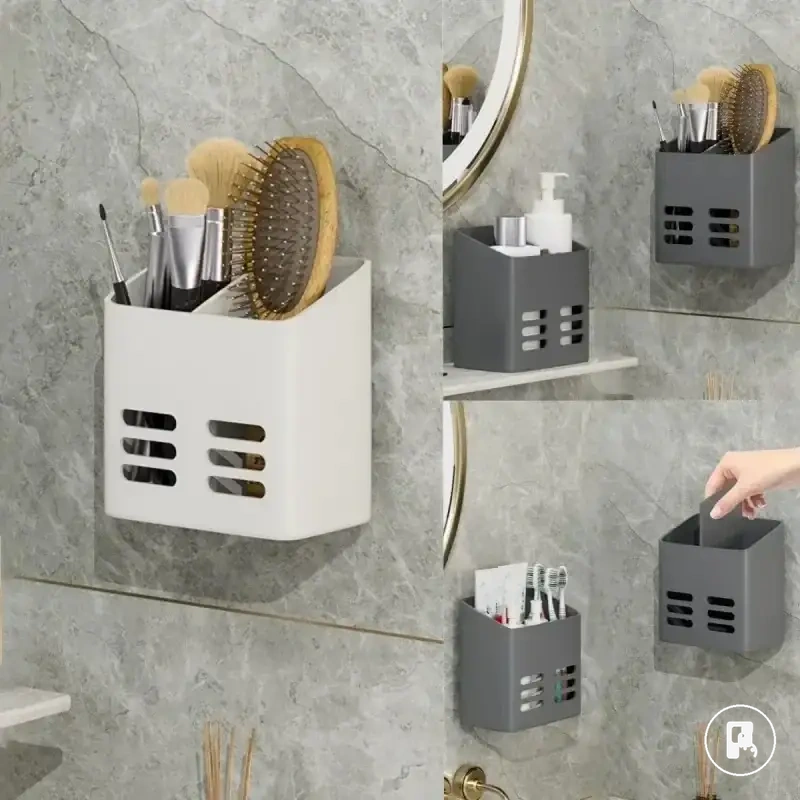
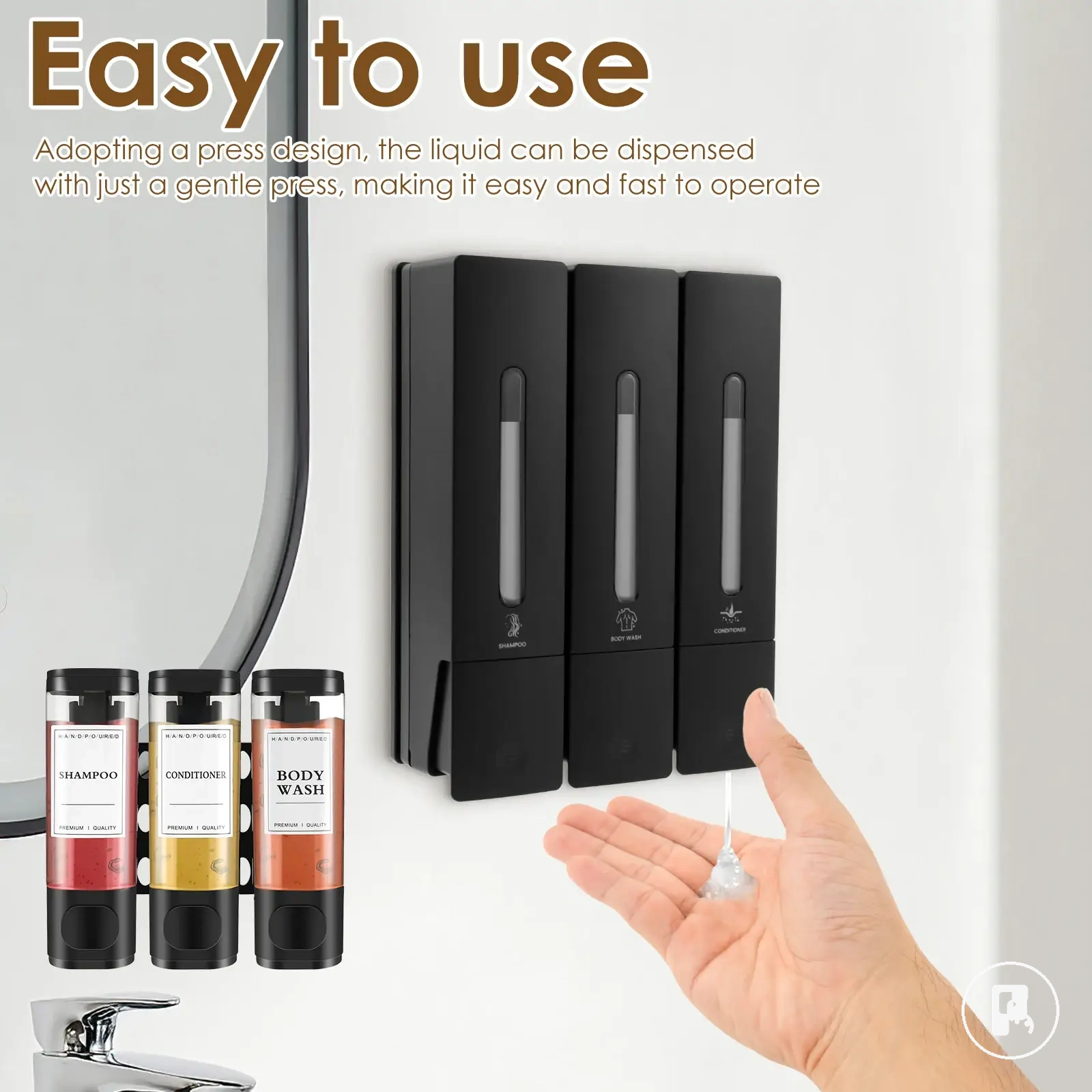
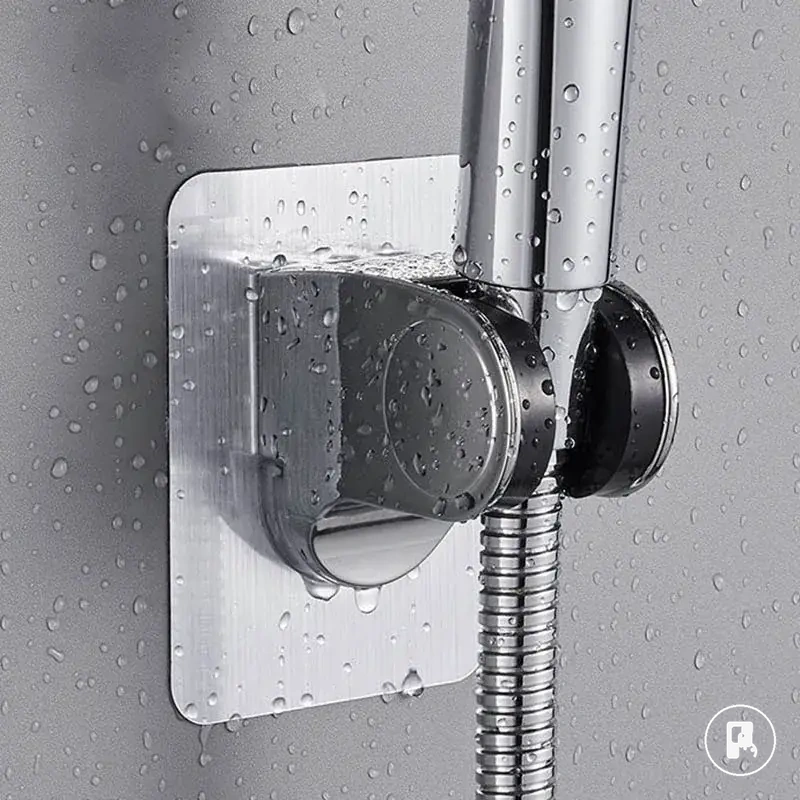
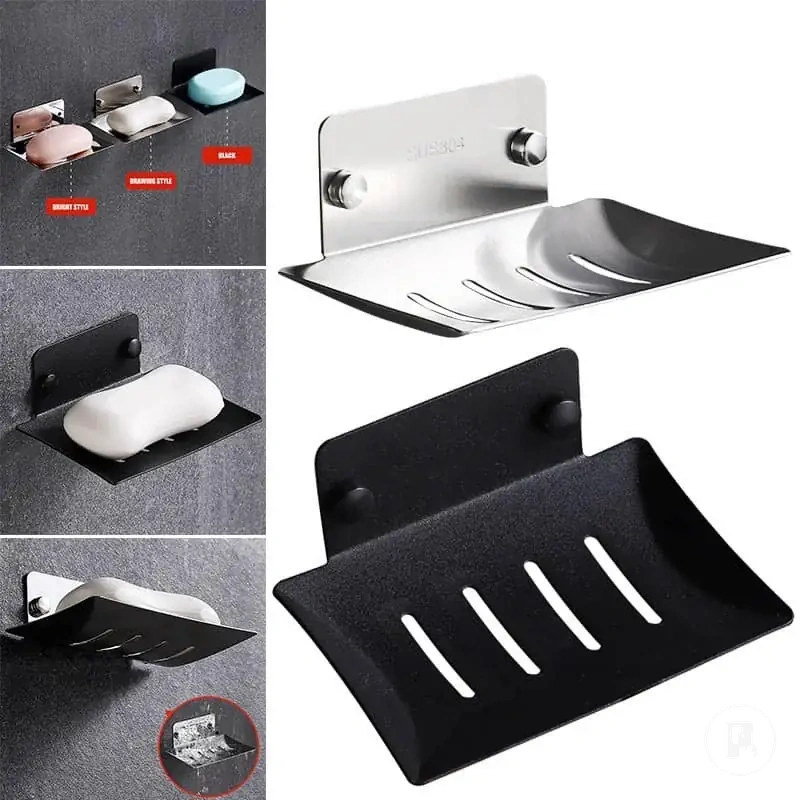
When No-Drill Bathroom Accessories Are a Poor Fit
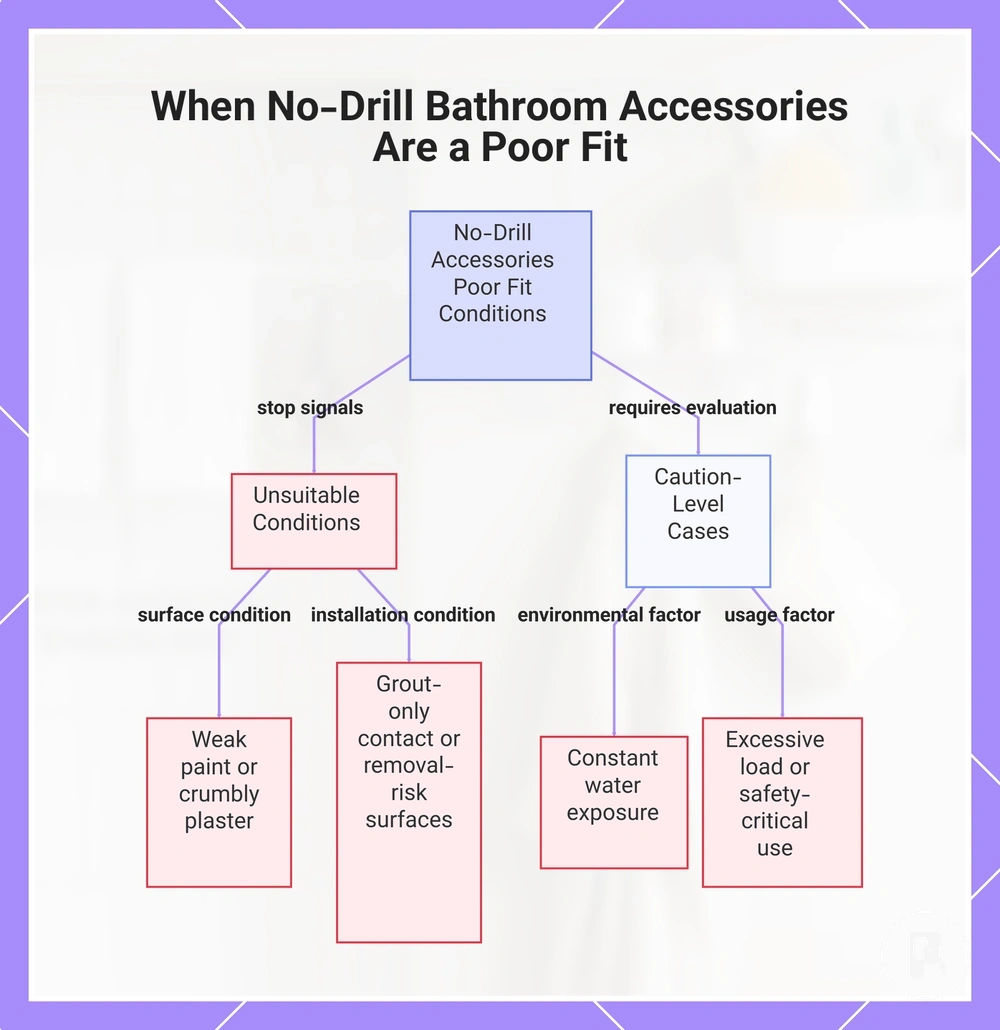
Direct answer first: no-drill bathroom accessories are a poor fit when weak surfaces, constant water exposure, excessive load, or safety-critical use conditions are present. These conditions reduce stable adhesion and increase removal risk in wet-area installations. Weak paint, crumbly plaster, grout-only contact, and removal-risk surfaces act as clear stop signals for use.
When No-Drill Bathroom Accessories Are a Poor Fit, boundary conditions should be divided into unsuitable and caution-level cases. Some situations require avoiding use entirely, while others may only allow temporary or limited application depending on surface stability. The checklist below separates unsuitable conditions from manageable caution conditions.
- weak paint creating unstable adhesion layers
- crumbly plaster reducing structural surface support
- grout-only contact leading to uneven load distribution
- constant water exposure weakening bond stability
- excessive load from heavy bathroom accessories
- safety-critical use where failure risk is unacceptable
- removal-risk surfaces with unreliable adhesion behavior
Weak paint and crumbly plaster reduce bonding reliability because the surface layer cannot maintain consistent load transfer. Constant water exposure in wet zones increases long-term failure risk, especially under repeated use conditions. Excessive load combined with grout-only contact increases instability, which keeps evaluation focused on no-drill bathroom compatibility rather than installation alternatives. This is why users often need to prevent no-drill accessories from falling when these conditions appear.
Myth to truth: no-drill bathroom accessories are not universally unsuitable, but their use depends on surface quality, load level, and exposure conditions. In controlled dry zones, limited use may still be possible with caution. However, high-risk wet-area conditions should be evaluated carefully to avoid failure scenarios such as those described in prevent no-drill accessories from falling.
This chart shows the boundary conditions that make no-drill bathroom accessories unsuitable or caution-level, based on surface quality, load, and exposure.
Constant Water Exposure, Weak Surfaces, and Heavy Safety Loads
Constant water exposure, weak surfaces, and heavy safety loads define a high-risk boundary for no-drill bathroom accessories. These conditions reduce stable adhesion and increase failure impact in wet environments. Weak paint, deteriorating paint, porous walls, and direct spray act as stop signals when combined with overloaded shelves or grab-bar misuse, especially under safety-critical load expectations.
Constant water exposure, weak surfaces, and heavy safety loads must be treated as a combined risk cluster when evaluating bathroom safety boundaries. When these conditions overlap, convenience storage behavior can turn unstable and unpredictable under wet stress. The checklist below highlights conditions where high-risk safety boundaries are most likely to appear in no-drill use cases.
- weak surfaces including deteriorating paint reducing adhesion stability
- porous walls weakening load retention under moisture exposure
- constant water exposure from direct spray increasing failure risk
- overloaded shelves creating unsafe stress under heavy safety loads
- grab-bar misuse leading to unsafe load-bearing behavior
In bathrooms with direct spray and porous walls, even light convenience storage can shift under repeated moisture exposure and increase failure impact over time. When heavy glass items or overloaded shelves are added, stress increases beyond intended no-drill limits. This reinforces that grab-bar misuse and heavy safety loads should remain outside no-drill bathroom accessory use conditions.