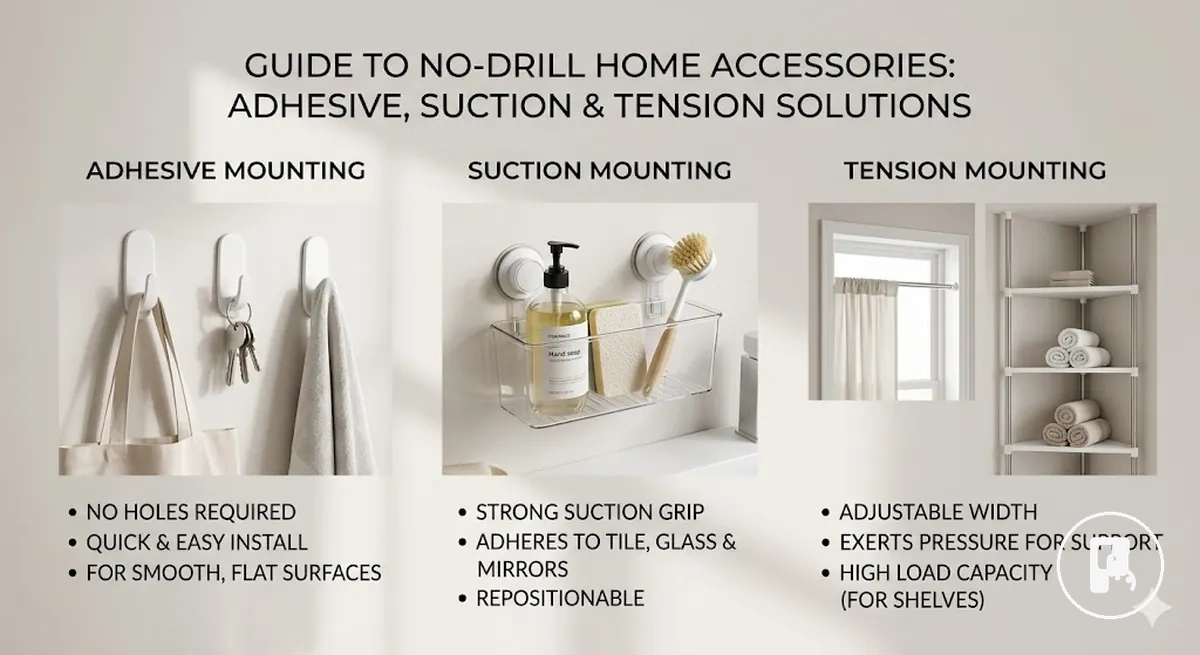
No-drill mounting methods for home accessories compared
No-drill mounting methods for home accessories are mainly chosen through a trade-off between surface fit, holding strength, and removability, rather than a single universal best option. Understanding this helps you match the right approach to the actual conditions of use. A broader view of selection logic is covered in no-drill home accessories guide before comparing adhesive mounting, suction mounting, tension mounting, and clip-on mounting as distinct option groups.
In practice, users often look for solutions for bathroom hooks, wall storage, or removable setups in rented spaces, where surface type and load direction directly affect performance. A smooth surface like tile or glass may behave differently from painted or porous walls, especially when moisture or repeated movement is involved. These differences also influence how stable or reusable each mounting method can be over time. As a result, comparison needs to stay tied to real surface and usage conditions rather than general assumptions.
There is no consistent “strongest” or “damage-free for all surfaces” option across no-drill mounting methods, since outcomes depend on installation quality, material design, and environmental conditions. Each method behaves differently under specific loads and surface interactions, which means suitability changes by context rather than ranking. This section moves into how each mounting approach differs in structure and use logic.
How adhesive, suction, tension, and clip-on mounting differ
Each no-drill mounting method for home accessories differs by its mounting mechanism, which defines how adhesive, suction, tension, and clip-on systems create holding force through bond, airtight seal, pressure, or grip. Adhesive mounting relies on a bonding layer with surface contact, suction mounting depends on an airtight seal against a smooth surface, tension mounting uses opposing pressure between fixed sides, and clip-on mounting creates grip along an edge or rail.
The image below shows how each no-drill mounting method for home accessories differs by its holding mechanism, making it easier to separate bonding, sealing, pressure, and grip at a structural level before evaluating surface fit or load conditions.
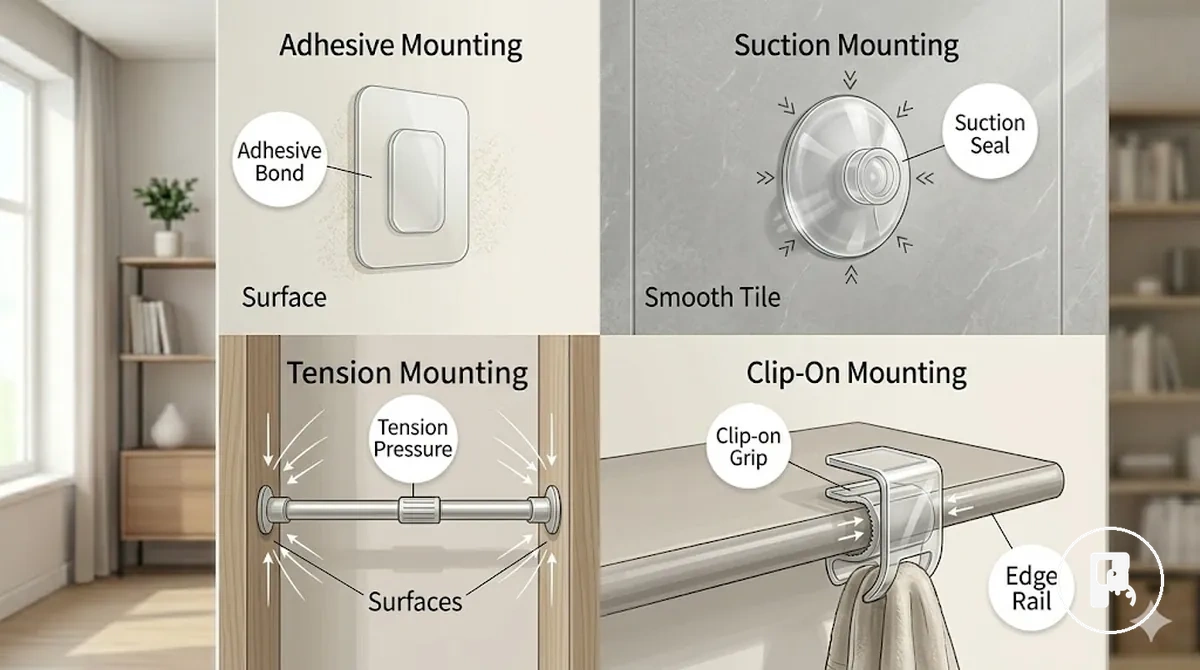
These mounting mechanics affect how surface contact behaves under load, which later influences fit, stability, and removability depending on installation conditions. Adhesive systems depend on bond quality with the surface, suction systems depend on seal integrity on smooth non-porous areas, tension systems depend on balanced pressure between opposing sides, and clip-on systems depend on secure edge or rail alignment. The comparison below summarizes how each mechanism translates into usage conditions and decision outcomes.
| Method | What holds it | Best contact condition | Main decision effect |
|---|---|---|---|
| Adhesive mounting | Bonding layer on surface contact | Clean, smooth surfaces | Depends on bond stability and surface compatibility |
| Suction mounting | Airtight seal | Smooth, non-porous surfaces | Depends on seal quality and surface smoothness |
| Tension mounting | Opposing pressure between fixed points | Two stable opposing surfaces | Depends on structural spacing and pressure balance |
| Clip-on mounting | Mechanical grip on edge or rail | Accessible edges or rails | Depends on edge compatibility and grip alignment |
Adhesive mounting bonds the accessory to the surface
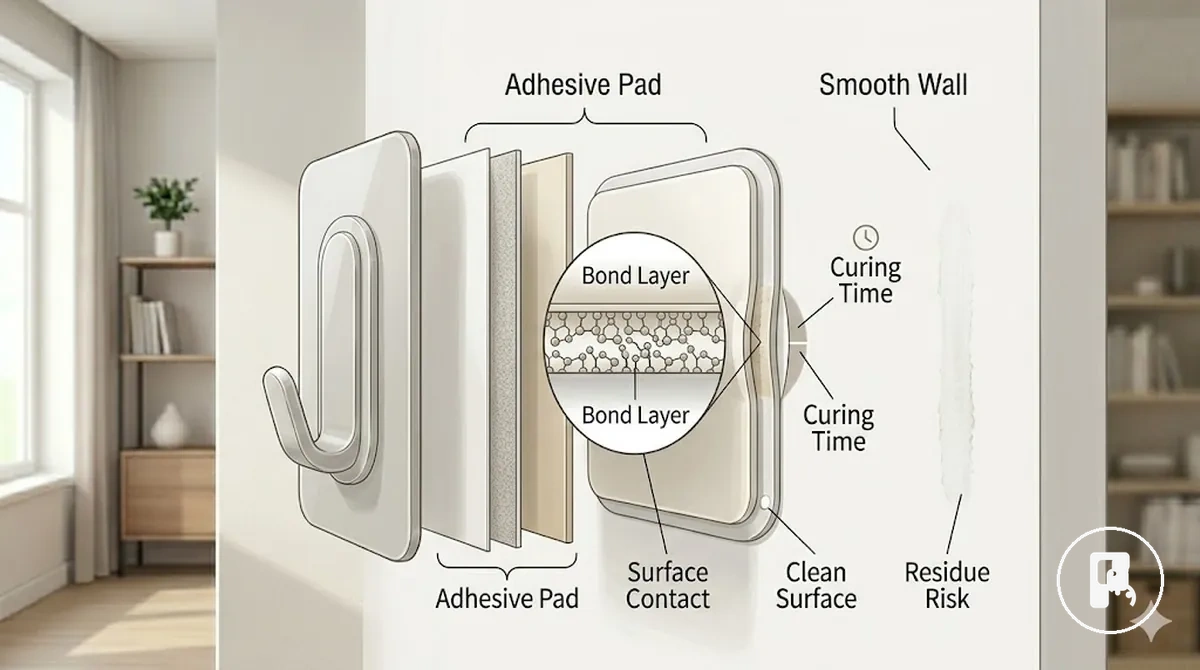
Adhesive mounting is a bond-based no-drill method where an adhesive pad creates surface contact between the accessory and a wall or tile. It forms a bond layer between the accessory and a clean surface such as a smooth wall. Performance depends on surface condition, curing time, and installation quality. Residue, paint lift, and removal risk may appear during removal depending on wall finish and bond behavior.
Adhesive mounting bonds the accessory to the surface through a direct bond layer between the adhesive pad and the wall. The visual below highlights how the bond layer connects surface contact points in this system.
Suction mounting depends on an airtight seal
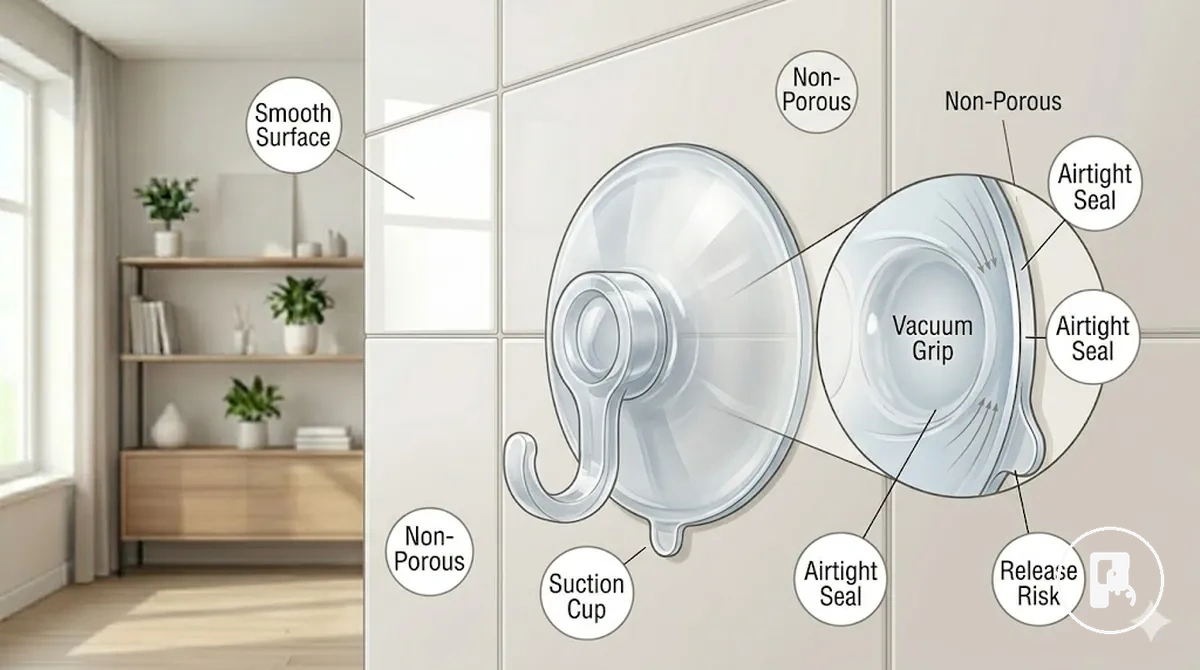
Suction mounting is a no-drill method where a suction cup creates a vacuum grip through an airtight seal against a smooth non-porous surface such as tile or glass. The suction cup holds by removing air from the contact zone, which allows suction mounting to stay attached without adhesives. Grip quality depends on seal integrity, surface smoothness, and moisture conditions on the contact area. In many cases, reusability is possible, but release risk increases when the airtight seal weakens or the surface is not fully compatible.
Tension mounting holds by pressure between fixed sides
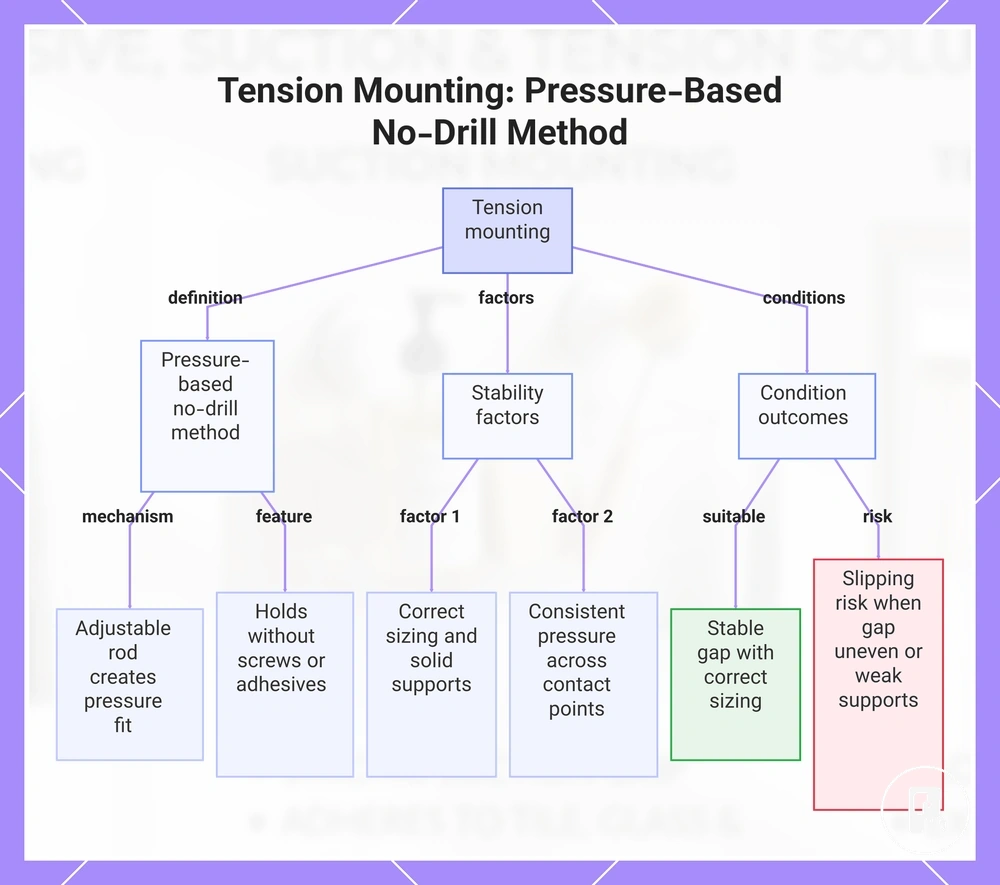
Tension mounting is a pressure-based no-drill method where an adjustable rod creates a pressure fit between two fixed sides or opposing supports. It holds by pressure between two fixed sides through a stable gap where the rod expands to stay in place without screws or adhesives. Stability depends on correct sizing, the strength of the fixed sides, and consistent pressure across the contact points. When the gap width is mismatched or supports are weak, slipping risk can increase under load or movement.
- Suitable condition: stable gap between fixed sides with correct sizing and solid opposing supports
- Risk condition: slipping risk increases when the gap is uneven or supports cannot hold consistent pressure
This chart explains how tension mounting works, what affects its stability, and the conditions for safe use.
Clip-on mounting grips an existing edge, rail, or frame
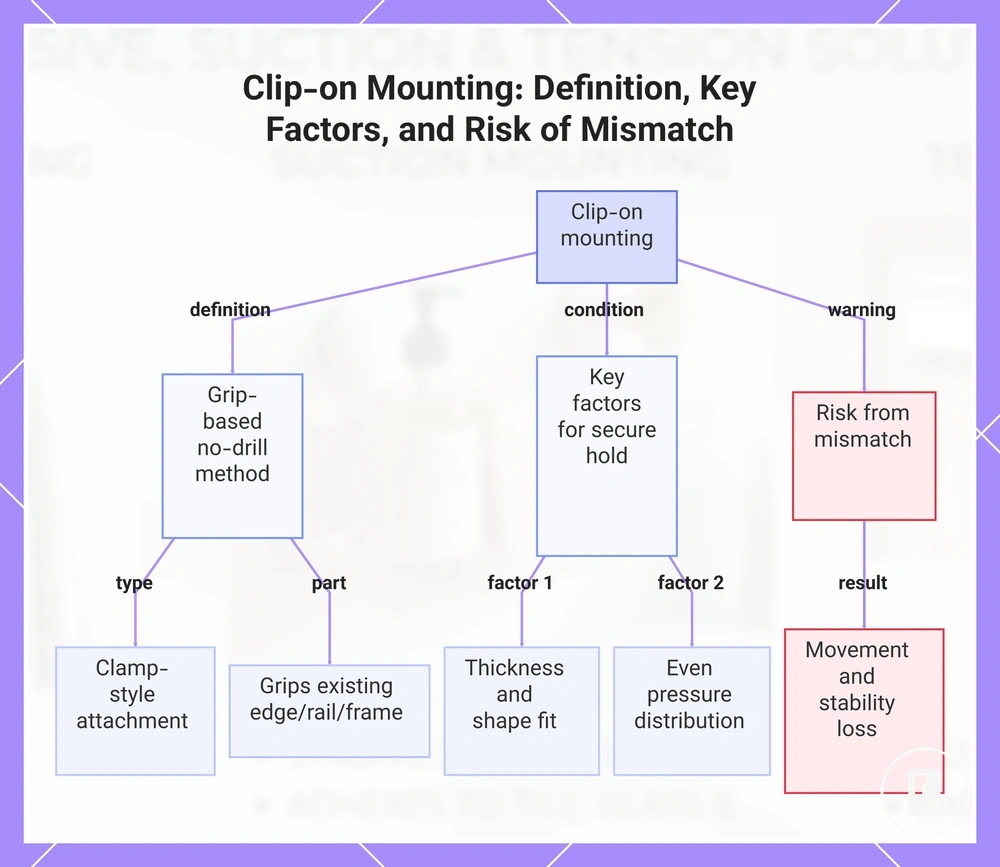
Clip-on mounting is a grip-based no-drill method that grips an existing edge, rail, or frame using a clamp-style attachment point. It relies on grip compatibility where thickness and shape fit decide how securely it holds on the edge or rail. Surface contact is limited to the clip interface and depends on how evenly pressure is distributed across the contact area. When shape fit or thickness mismatch occurs, movement can increase and stability may reduce under load.
This chart explains what clip-on mounting is, the key factors that determine its hold, and the risk when a shape or thickness mismatch occurs.
Surface and location fit by mounting method
Surface and location fit depends on surface texture, shape, moisture exposure, and available support points for each mounting method. Smooth or sealed surfaces behave differently from porous or uneven finishes, and location conditions can change how stable a mounting method remains over time. These combined factors determine surface fit and location fit before any strength evaluation, which leads to the table below.
Smooth tile and glass often support suction-based mounting because they provide consistent contact conditions, while painted wall surfaces may create variable adhesive performance due to coating and texture differences. Porous surfaces tend to reduce stable bonding, and cabinet edges or frames introduce shape-dependent grip conditions instead of flat surface contact. In moisture-heavy locations like shower areas, seal and grip behavior can shift depending on exposure and drainage. Fit decisions depend on how each mounting method interacts with surface contact or structural support points such as smooth tile, glass, painted wall, porous surface, cabinet edge, shower area, and gap conditions.
For deeper evaluation of how each surface aligns with specific mounting types, refer to surfaces for each mounting method after reviewing the comparison logic below.
| Mounting method | Best surface or location condition | Weak fit condition | Decision cue |
|---|---|---|---|
| Adhesive | Smooth, clean surfaces like tile or finished walls | Porous or dusty wall finishes | Surface bonding and coating stability |
| Suction | Glass or smooth tile with low texture | Rough or uneven surfaces | Airtight seal reliability |
| Tension | Stable gaps between fixed opposing sides | Weak or uneven support points | Pressure balance between sides |
| Clip-on | Edges, rails, or frames with defined shape | Inconsistent thickness or unstable edges | Grip fit and edge alignment |
Holding strength and stability trade-offs
Holding strength and stability depend on surface fit, load direction, and how force spreads across each mounting method. The strongest option changes because static weight, outward pull, vibration, and daily handling affect stability in different ways. These factors shape real performance more than any single ranking, which leads to the comparison below.
Static weight places steady load on the mounting point, while outward pull and vibration introduce dynamic stress that can reduce stability. Adhesive and suction methods often respond differently under movement, while tension and clip-on systems depend more on support points, alignment, and surface fit. Daily handling can gradually affect grip stability depending on how force is applied over time. Strength comparison remains conditional because each method reacts differently to force direction and usage patterns.
General holding strength discussion is not enough without considering actual load capacity, surface condition, and installation quality together. Published weight rating values may vary in real use when surface fit or environmental stress changes. For more structured reference on this topic, see holding strength and load capacity.
Heavy or fragile items require extra caution because vibration and outward pull can increase failure risk even when static weight appears supported.
| Method | Strength condition | Stability weakness | Better use case |
|---|---|---|---|
| Adhesive | Strong on smooth surfaces under static load | Weakens under moisture or outward pull | Fixed light to moderate items |
| Suction | Stable on smooth non-porous surfaces with good seal | Loses grip with vibration or air leakage | Temporary smooth-surface mounting |
| Tension | Depends on balanced pressure between fixed supports | Shifts if support points are uneven | Gap-based installations with stable sides |
| Clip-on | Stable when edge grip and thickness fit align | Movement risk with poor edge match | Edge or rail attachment setups |
Weight ratings depend on surface, load direction, and movement
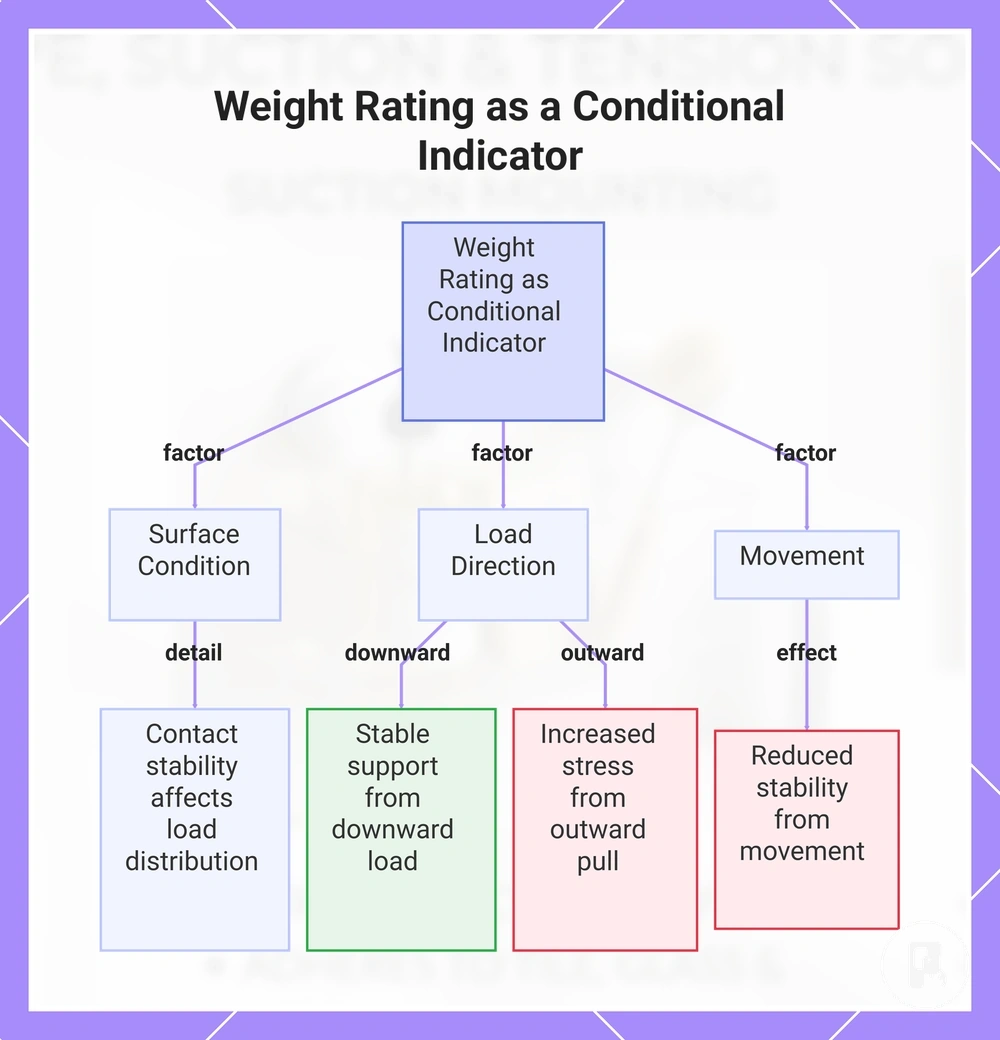
A weight rating is a reference value that indicates rated load under controlled conditions, but real performance depends on surface condition, load direction, and movement. The accessory design and safety margin also influence how the load is distributed in actual use. This means a weight rating should be treated as a conditional indicator rather than a fixed performance guarantee.
The same rated load can behave differently depending on how force is applied. A downward load usually creates more stable support, while outward pull can increase stress on the mounting point. Movement during use may further reduce stability depending on how the accessory interacts with the surface condition and mounting setup.
- Surface condition and contact stability
- Load direction including downward load and outward pull
- Movement or repeated handling over time
- Accessory design and built-in safety margin
This chart shows the key factors that determine real-world performance of a weight rating, explaining why it is not a fixed guarantee.
Moisture and temperature can change adhesive and suction performance
Moisture and temperature can change adhesive bond behavior and suction seal performance in no-drill mounting methods. When humidity increases, the adhesive bond may soften or lose grip stability, while temperature changes can influence how the adhesive layer expands or contracts. For suction systems, moisture and thermal variation can affect the suction seal, increasing the chance of release when surface conditions shift. These effects mainly influence adhesive and suction methods rather than mechanical mounting types.
In wet area conditions such as bathrooms or kitchens, humidity and repeated wet-dry cycles can gradually affect smooth tile contact performance. Heat from sun-warmed surfaces may also alter adhesive response, while ventilation changes can shift moisture levels and indirectly impact suction seal stability. These effects depend on exposure conditions rather than a fixed outcome, so performance varies with environment and usage context.
Removability, reusability, and surface-risk trade-offs
Removability and reusability are not the same as zero surface risk. A mounting method can be removable but still create residue, paint lift, seal loss, or grip wear depending on how it interacts with the surface condition and usage. Reusability also varies because adhesive bond, suction seal, tension adjustment, and clip-on grip can degrade after removal or repeated use. These differences create a trade-off between removability, reusability, and surface risk rather than a guaranteed clean outcome.
| Method | Removal behavior | Reuse potential | Surface-risk note |
|---|---|---|---|
| Adhesive | Detaches by breaking adhesive bond | Often limited after removal | May cause residue or paint lift |
| Suction | Releases by breaking suction seal | Reusable if seal remains intact | Seal loss may reduce performance over time |
| Tension | Released by reducing adjustment pressure | Reusable with re-adjustment | Possible grip wear with repeated use |
| Clip-on | Unclips from edge or frame | Reusable if fit remains stable | Edge contact may lead to gradual wear |
Removability does not always guarantee reusability without performance change. Some suction systems may remain reusable under stable conditions, while adhesive systems may lose effectiveness after removal. Tension and clip-on systems may also shift in stability due to repeated adjustment or mechanical wear. Removal methods and detailed surface protection steps are outside the scope of this section.
Best use cases for each no-drill mounting method
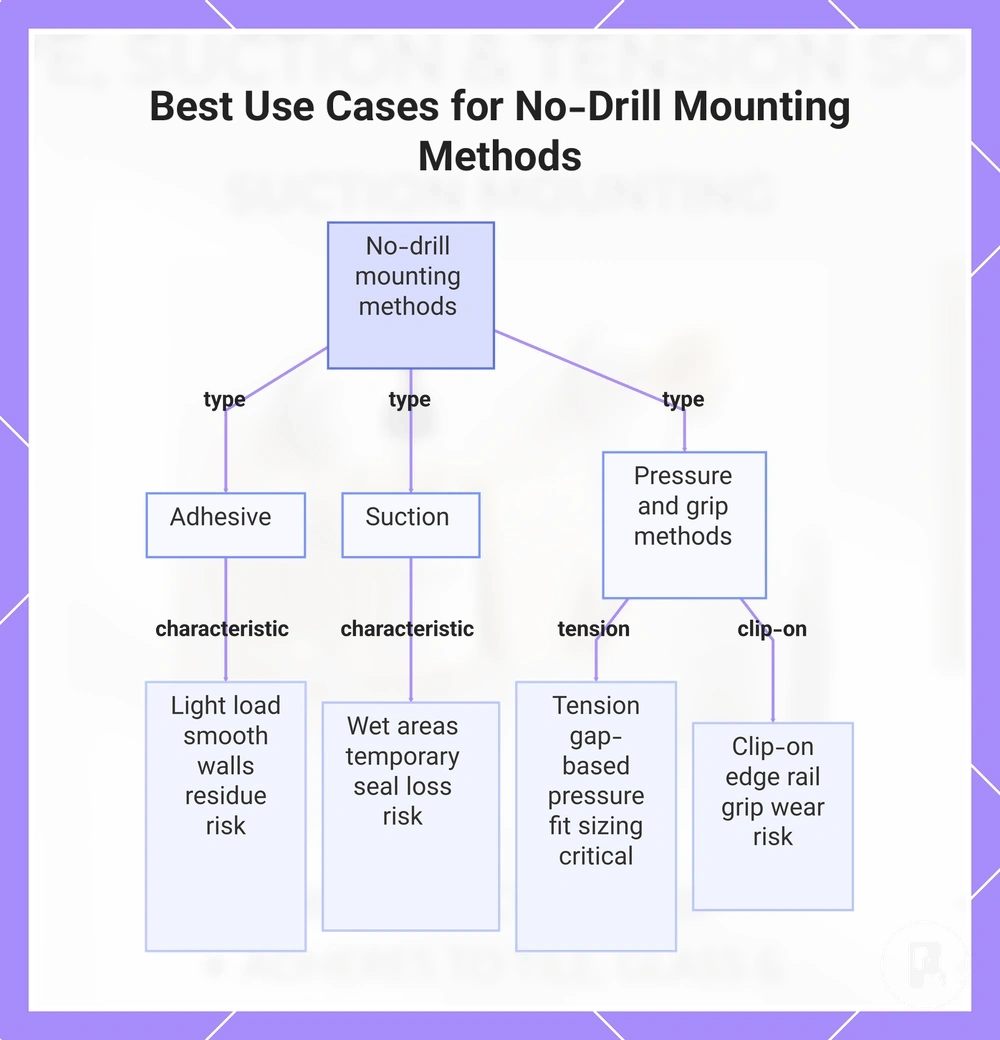
Best use cases for each no-drill mounting method depend on surface type, load level, location, and removability needs. Each method matches a different installation condition, so adhesive, suction, tension, and clip-on options work best when aligned with specific surface and usage constraints.
Adhesive no-drill accessories are suitable for light load wall setups on smooth surface finishes such as painted walls or tile-compatible areas. They provide stable fixed placement where removability is not frequent, but misapplication on weak or uneven surfaces can increase removal risk such as residue or paint lift.
Suction no-drill accessories work best on smooth surface wet area conditions like tiles or glass where temporary or repositionable use is needed. They support reusable suction when the seal remains stable, but performance depends heavily on seal condition and surface smoothness, and seal loss can reduce holding stability.
Tension mounted accessories are suitable for gap-based setups such as corners, rods, or enclosed storage spaces where pressure fit supports the load. They are effective when the gap is correctly measured for consistent pressure, but incorrect sizing can reduce stability and affect load handling over time.
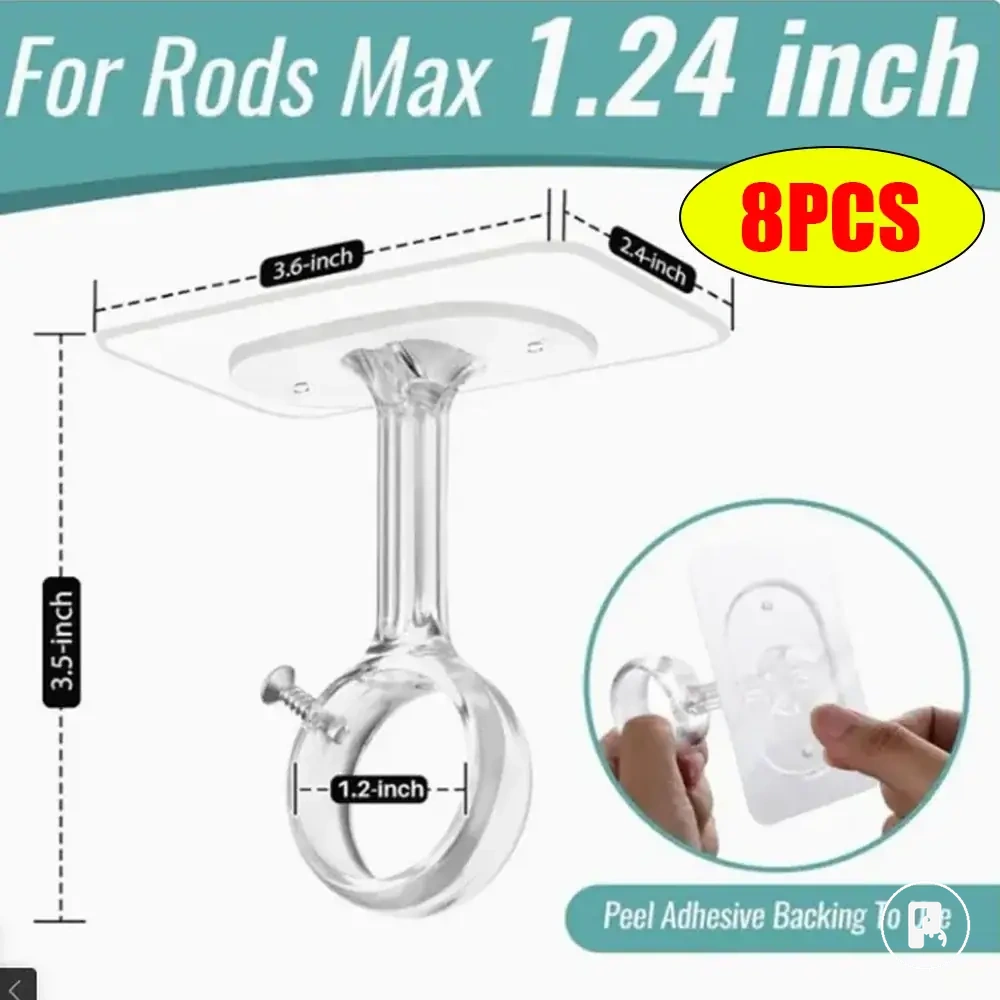
Here are product examples that may make comparison easier. Before buying, always review the compatibility criteria, essential features, and product details.
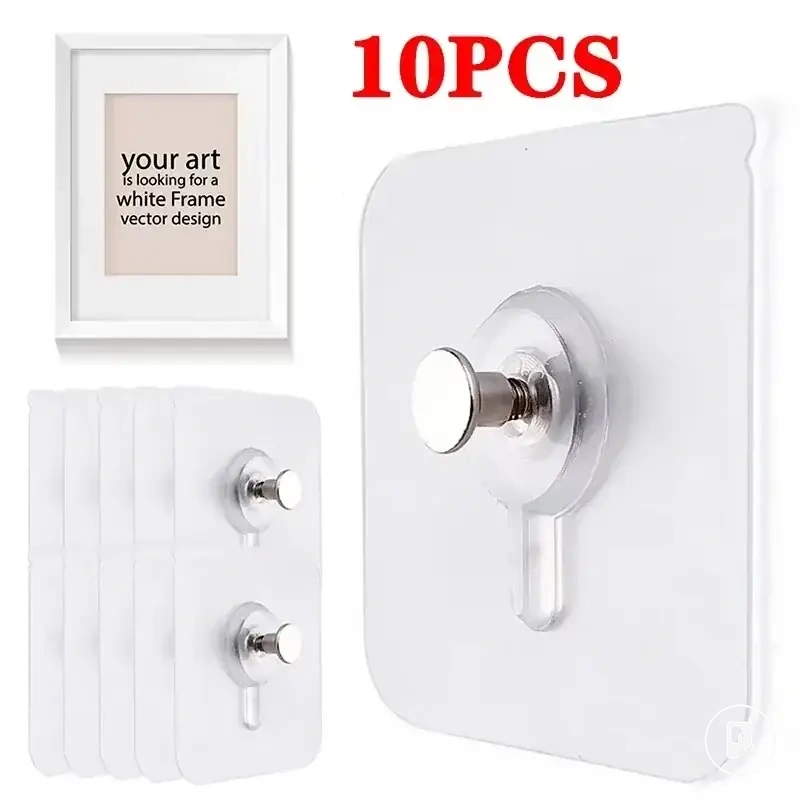
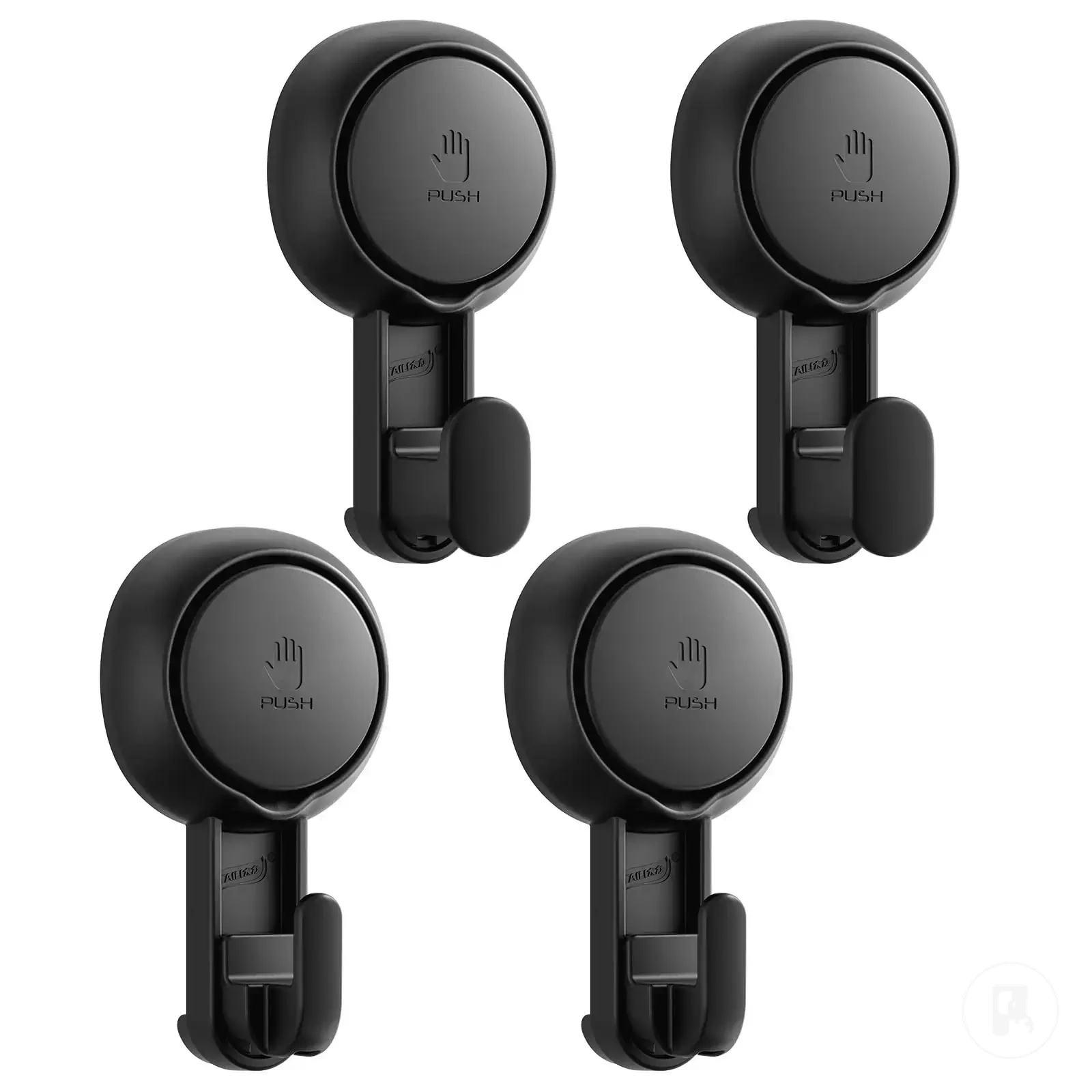
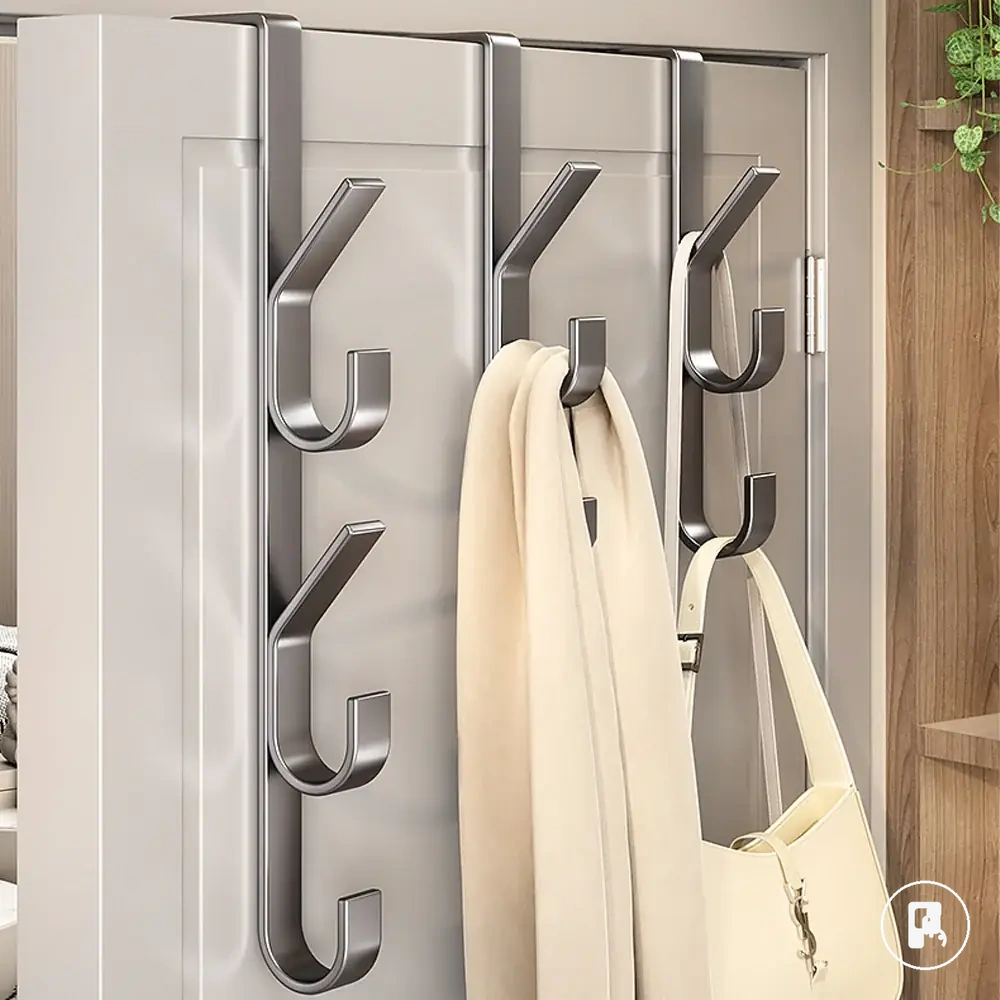
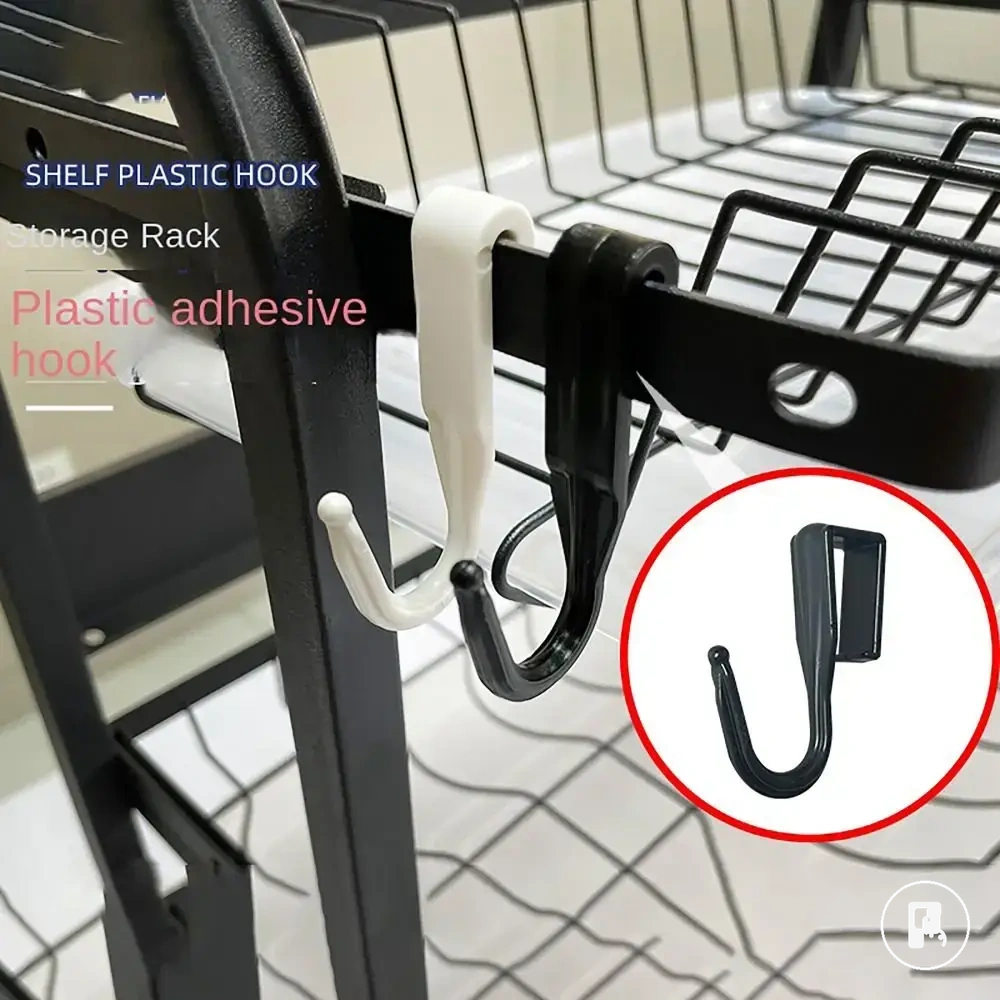
Clip-on home accessories are best for edge or rail-based installations such as shelves, frames, and structured supports where grip-based attachment is required. They offer practical removability and repositioning, but grip wear can occur if edge compatibility is inconsistent, making fit and rail condition important selection factors.
This chart shows the best use cases and key warnings for each no-drill mounting method based on surface type and load conditions.
When no-drill mounting methods should be limited or avoided
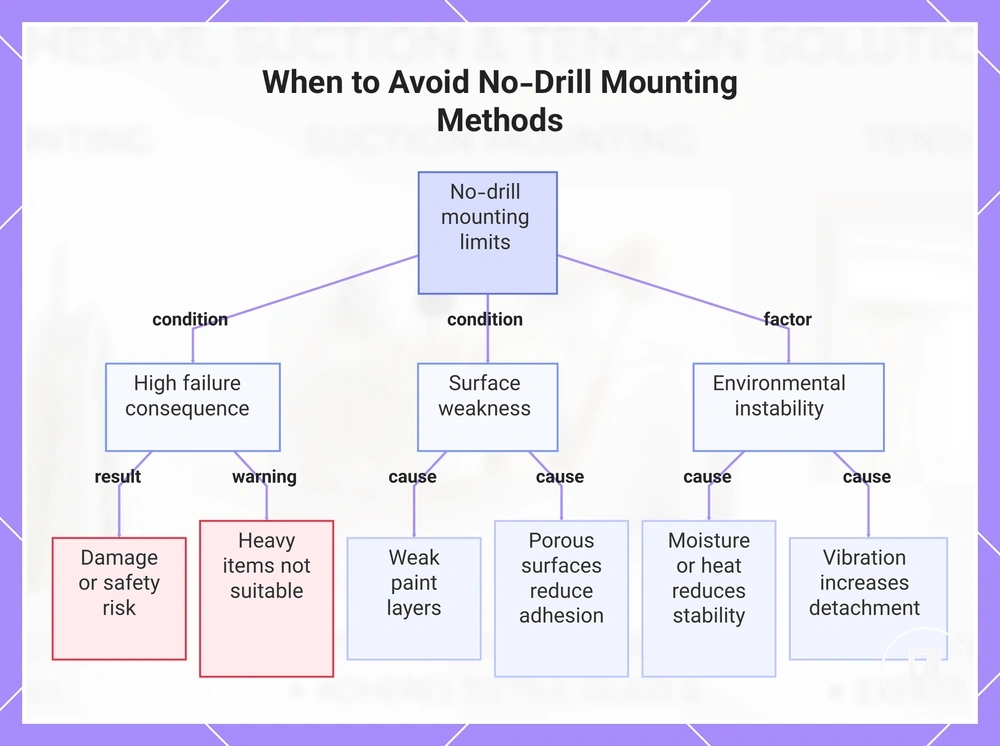
No-drill mounting methods should be limited or avoided when surface weakness or failure consequence becomes high. These methods work in normal light-load conditions, but become unreliable when the surface cannot support stable adhesion, suction, or pressure. In such cases, removability is less important than stability, and the setup becomes a poor fit for the condition.
- Load consequence: risk increases when falling items can cause damage or safety impact
- Surface weakness: weak paint layers or unstable finishes reduce holding reliability
- Moisture or heat: environmental changes can reduce adhesive or suction stability
- Movement: vibration or repeated handling increases detachment risk
- Repeated failure: accessories that fall again indicate method mismatch
Heavy items and valuable breakables are not suitable when surface support is uncertain. A porous surface can weaken adhesive no-drill accessories and suction no-drill accessories, while weak paint may detach under load and increase residue or paint lift risk. Repeated falling often signals a mismatch between mounting method and surface condition rather than a one-time installation issue.
When repeated falling continues, the setup should be reassessed instead of repeatedly reapplying the same method. This usually indicates a compatibility issue between surface, load, and mounting type, which is further explained in why no-drill accessories fail through diagnostic patterns and causes.
For safety-sensitive or high-value items, a more stable mounting approach may be required depending on load and surface condition. No-drill options can still work in controlled conditions, but they should not be used where failure consequences are significant.
This chart shows the key conditions that make no-drill mounting methods unreliable and when they should be limited or avoided.