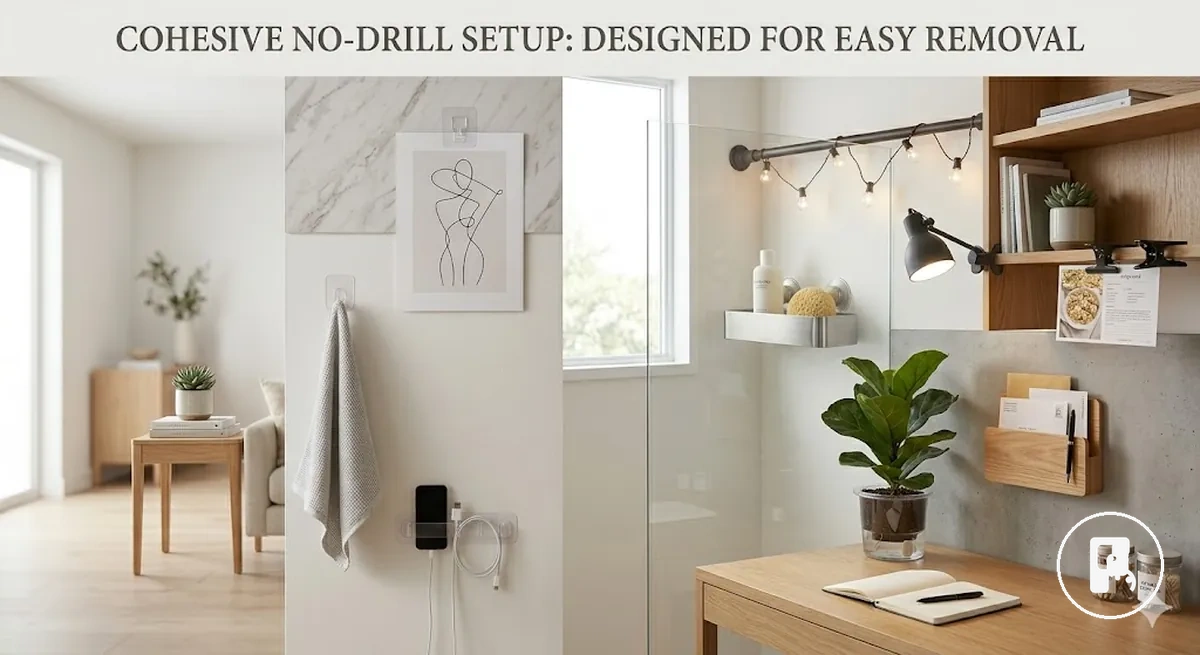
Renter-Friendly No-Drill Home Accessories for Temporary Homes and Apartments
No-drill home accessories are removable mounting solutions that support organizing and using wall space without creating wall holes through drilling. They are commonly used in renter-friendly setups across temporary homes and apartments where surface condition and move-out needs require non-permanent adjustments. These systems often involve adhesive, suction, or tension-based attachment to support flexible storage without altering the structure of the space.
In apartments and short-term living spaces, people often need to add storage or wall usage without leaving permanent marks. no-drill home accessories help address this need by enabling removable organization through adhesive, suction, and tension methods that reduce reliance on wall holes. This approach supports flexible storage in compact environments where surface condition and move-out requirements must be considered.
These solutions are often associated with reduced damage risk, but they do not eliminate it entirely. Performance can vary based on adhesive type, suction strength, tension fit, and the condition of the wall surface. Factors like humidity, paint quality, and load also influence how securely these removable systems behave over time.
When space constraints and rental rules limit permanent installation, these accessories provide a practical alternative for temporary use. They allow users to organize and adapt interiors without committing to fixed structural changes, while still requiring attention to surface condition and proper application choices.
What Makes No-Drill Accessories Renter-Friendly
Renter-friendly no-drill accessories are home accessories that can be mounted, used, adjusted, or removed without permanent drilling when conditions are suitable. They are removable and non-permanent, designed for no drilling use in apartments, temporary homes, and other temporary setup environments. Their suitability depends on surface condition, adhesive type, load limits, deposit considerations, and whether removal remains surface-safe under specific conditions.
They are considered renter-friendly because they rely on removable mounting methods such as adhesive strips, suction, and tension systems that reduce wall holes and support flexible storage in temporary homes and apartments. These qualities support surface-safe usage in many apartment setups while helping reduce risks related to deposit loss due to wall damage. What Makes No-Drill Accessories Renter-Friendly can be better understood by looking at how they behave across different surfaces and temporary setup conditions.
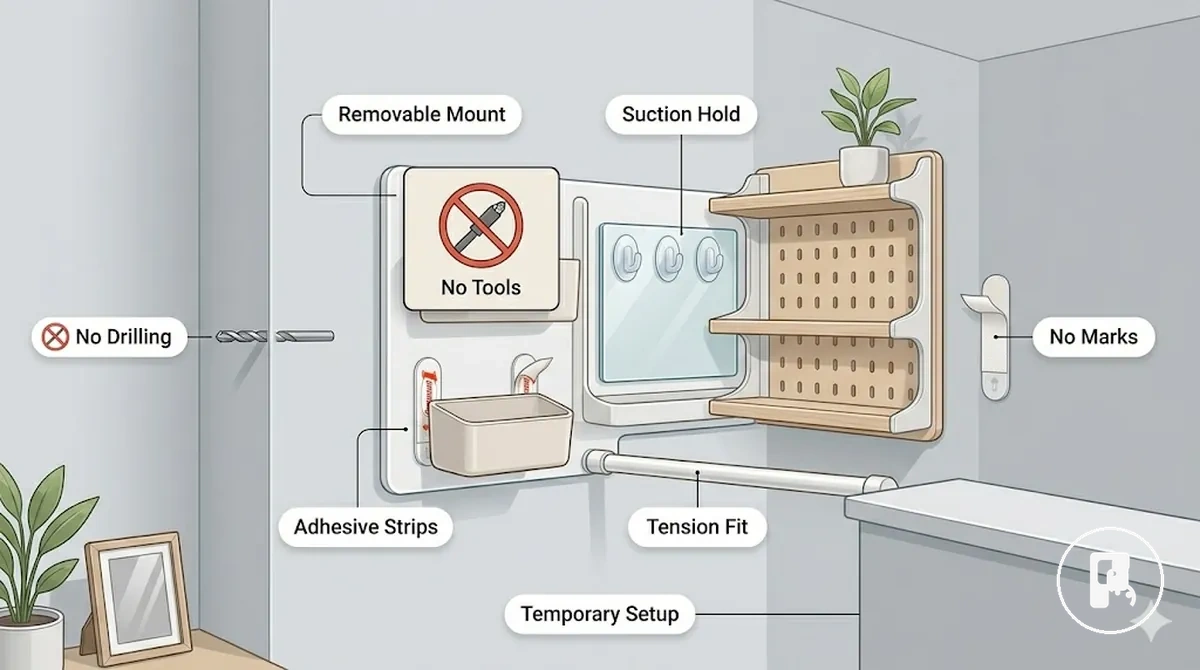
- Removability through non-permanent attachment designed for temporary use
- No drilling installation using adhesive strips, suction, or tension-based support
- Tool-light setup that reduces the need for permanent fixtures or hardware changes
- Surface awareness that considers paint, tile, and wall conditions before application
- Load caution based on weight and stability limits in flexible storage setups
- Move-out practicality that supports reduced wall holes in rental environments
A common misconception is that renter-friendly always means damage-free under all conditions. These systems reduce risk but outcomes still depend on surface quality, adhesive behavior, and removal method. You can review limits and use conditions in what no-drill accessories can and cannot do to understand how removable setups behave across different environments.
Temporary Home Problems No-Drill Accessories Can Solve
Temporary home problems no-drill accessories can solve include limited storage, blank walls, and rental restrictions in apartments where drilling is not allowed. These issues are common in a temporary home where apartment walls cannot be modified and small-space organization depends on non-permanent storage methods. In many cases, they affect how hooks, shelves, baskets, and wall hanging solutions can be used for daily temporary mounting needs.
In short-term living setups, these problems appear in different room contexts where layout and space are constrained. Rental rooms often lack built-in storage, and users rely on movable setup solutions to organize essentials. Entry areas, kitchens, bathrooms, and compact workspaces frequently show the strongest need for flexible organization.
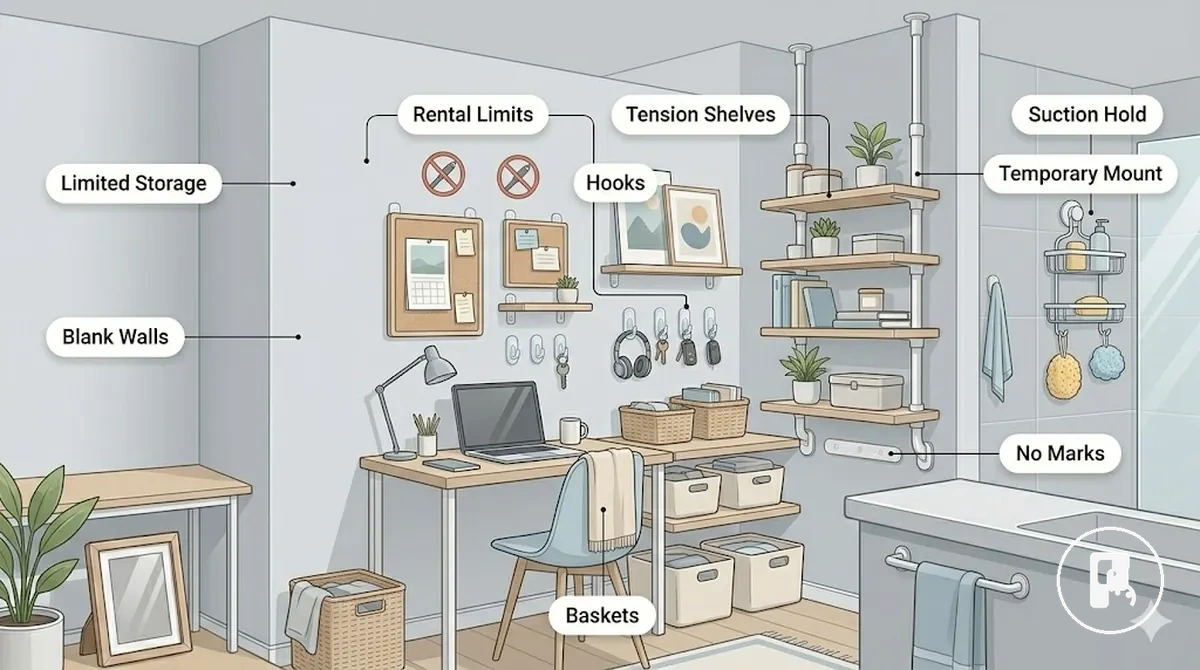
Temporary Home Problems No-Drill Accessories Can Solve become clearer when each issue is linked to a specific mounting condition and room use case. The checklist below connects common renter challenges with realistic temporary mounting outcomes.
- Limited storage in small apartments addressed using hooks and baskets on smooth apartment walls with adhesive strips
- Blank walls used for wall hanging and lightweight decor applied through temporary mounting on painted surfaces
- Rental restrictions managed with no drilling setups using suction systems on tile or glass surfaces
- Small-space organization improved using shelves supported by tension systems in compact rooms
- Entry area clutter reduced with hook-based storage using removable adhesive mounting
- Kitchen organization supported with baskets and hooks applied to moisture-aware surfaces under temporary setup conditions
- Bathroom storage improved using suction-based accessories on smooth, non-porous walls
These temporary home problems are not fully solvable in all cases, especially when heavy loads or structural storage is required. No-drill accessories support flexible organization in rental restrictions, but their effectiveness depends on surface condition, weight limits, and frequency of use.
Wall Hanging Without Holes
Wall hanging without holes refers to wall hanging methods that allow lightweight decor to be placed on apartment surfaces without drilling. It is commonly used for lightweight decor such as posters, photo frames, and temporary wall accents using adhesive hooks and picture strips. This approach works within limits and is best suited for non-permanent setups where damage-free removal is needed and paint lift risk must be considered during removal direction changes.
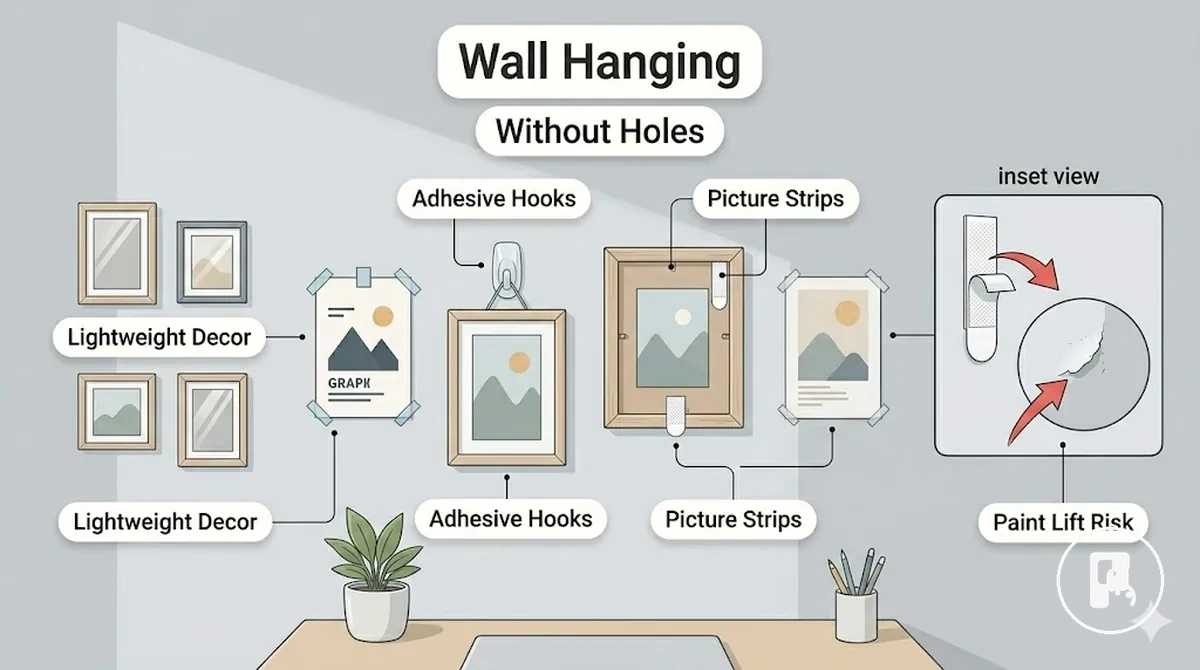
These wall hanging setups help reduce surface damage when applied correctly, but performance depends on weight, wall finish, adhesive contact area, and removal direction. Poor alignment or overstressed adhesive contact can increase paint lift risk, especially on delicate painted surfaces. Reference context for these limitations is aligned with observed usage constraints in rental environments :contentReference[oaicite:0]{index=0} :contentReference[oaicite:1]{index=1}.
A common misconception is that wall hanging without holes works equally for all objects. In reality, it is suitable mainly for lightweight decor, while heavier items require different support considerations. This separation helps maintain safer use between decorative wall hanging and heavier storage-focused mounting needs.
Flexible Storage and Organization
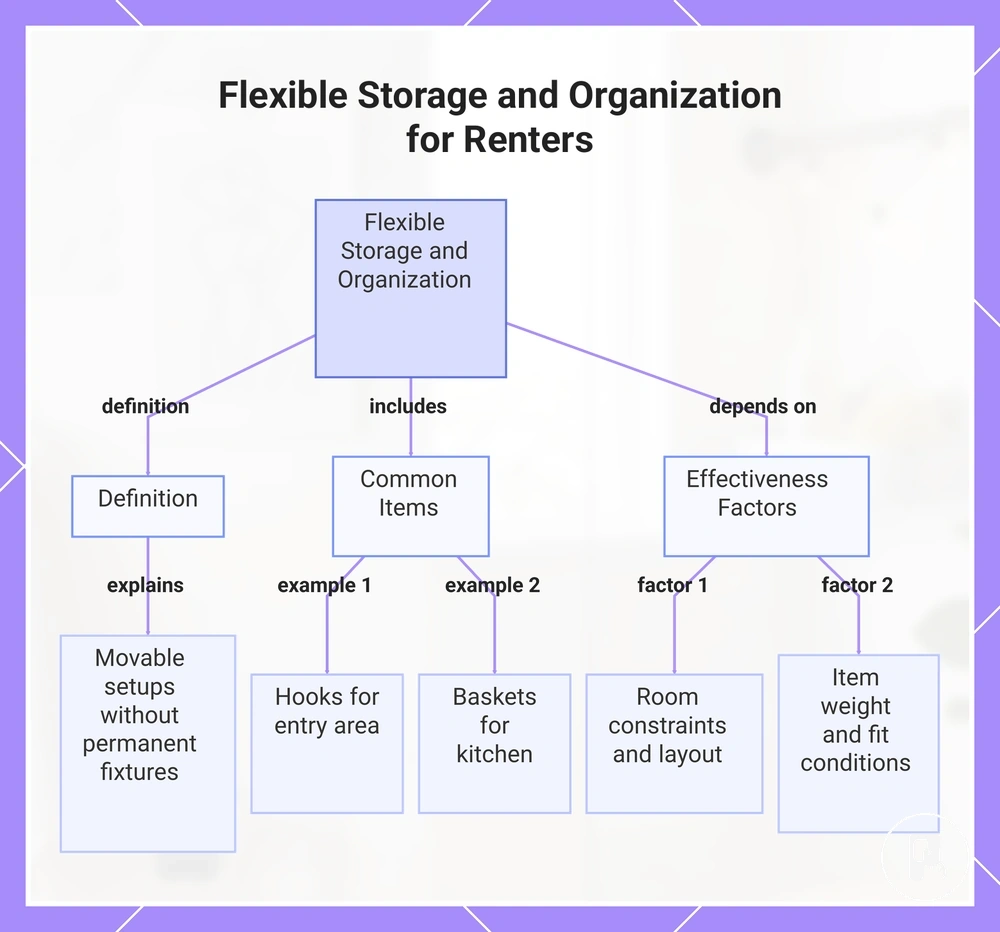
Flexible storage and organization refers to movable setups in a temporary home that help manage space without permanent fixtures. It supports flexible storage needs in areas where layout changes and space limits are common, making movable organization the main purpose for renters who need adaptable solutions.
In rental spaces, limited storage and compact layouts often require adaptable organization across different rooms. Hooks, baskets, over-door organizers, tension rods, and movable shelves are commonly used to match specific room constraints, such as kitchen counters with little space, bathroom corners with moisture limits, closet doors with clearance needs, and entry area walls that need quick-access storage.
- Hooks for entry area use where lightweight items need accessible placement under simple wall conditions
- Baskets for kitchen organization where counter space is limited and flexible storage is needed
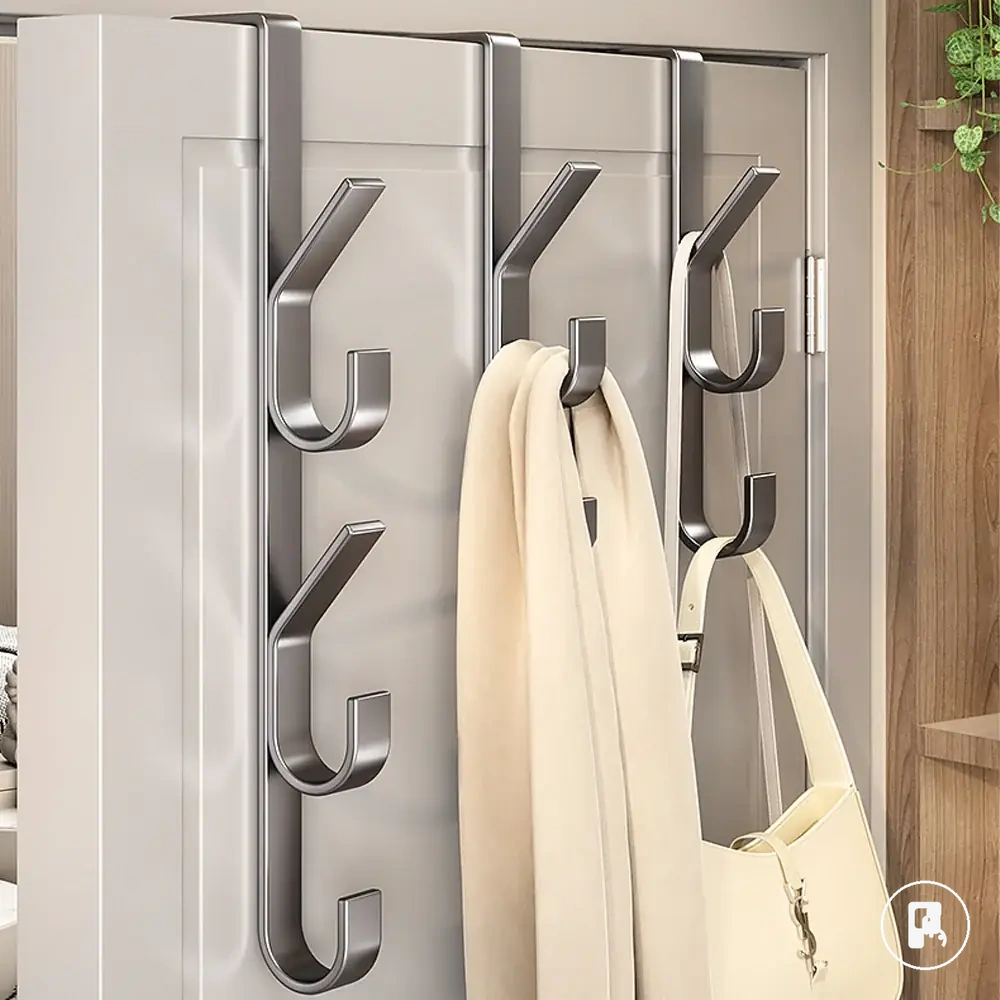
- Over-door organizers for closet use when internal storage is limited and door clearance allows fit
- Tension rods for bathroom or kitchen setups where pressure-fit installation depends on surface stability
- Movable shelves for closet or room use where lightweight items require adjustable organization based on space conditions
Flexible storage and organization helps renters manage everyday items in a movable way without permanent installation. Its effectiveness depends on room constraints, item weight, and fit conditions across kitchen, bathroom, closet, and entry area use cases.
This chart shows the definition, common items, and effectiveness factors of flexible storage and organization in rental spaces.
Mounting Options for Non-Permanent Home Setups
Mounting options for non-permanent home setups refer to different attachment method choices used in rental environments where drilling is avoided. These mounting options include adhesive, suction, tension, over-door, hook-on, and freestanding-adjacent systems, and they are compared based on attachment method, suitable surface, removal concern, and practical limitation. The comparison focuses on how each option behaves in temporary home conditions rather than treating them as equal in performance or use. :contentReference[oaicite:0]{index=0}
The table below organizes these mounting options to clarify differences in how each attachment method works, where it fits, and what limitations may appear during use. It helps translate abstract mounting decisions into practical renter scenarios without turning the comparison into a product-style ranking.
Choice between mounting options depends on surface condition, load expectations, moisture exposure, and removal needs. Adhesive typically depends on wall surface compatibility and may raise removal concern on painted walls, while suction depends on smooth surfaces like tile or glass and can be influenced by moisture. Tension systems rely on pressure fit and available clearance, while over-door and hook-on options depend on structural edges and door compatibility in temporary setups.
A common misconception is that all mounting options perform similarly across surfaces and room conditions. In practice, each attachment method has distinct practical limitation factors, and suitability changes based on context rather than universal strength. Keeping decisions tied to non-permanent mounting logic ensures more reliable use in renter environments.
| Option | How it attaches | Suitable surface or fit | Typical temporary use | Main caution |
|---|---|---|---|---|
| Adhesive | Bonding strips or pads | Smooth painted walls | Light wall storage or decor | Removal concern and paint impact risk |
| Suction | Vacuum seal grip | Glass or tile surfaces | Bathroom or kitchen use | Moisture and seal stability changes |
| Tension | Pressure between surfaces | Wall-to-wall or frame gaps | Light shelving or dividers | Fit stability and load limits |
| Over-door | Hook over door edge | Door clearance compatible | Closet or entry storage | Door movement and clearance friction |
| Hook-on | Edge or rail hooking | Bars, rails, or ledges | Entry or kitchen hanging use | Load distribution limits |
| Freestanding-adjacent | Floor-supported placement | Open floor space | Movable organization setups | Space usage and stability balance |
Removable Adhesive Hooks, Strips, and Tabs
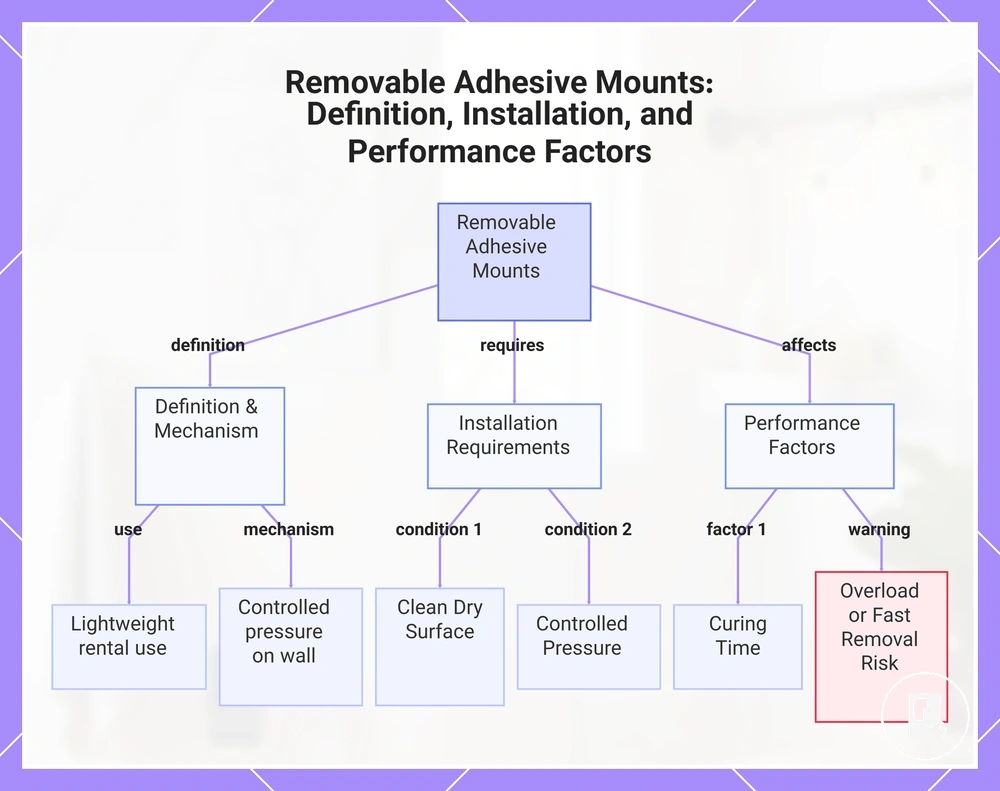
Removable adhesive hooks, strips, and tabs refer to adhesive-based mounting accessories used for lightweight use in rental spaces where non-permanent attachment is required. They work through controlled pressure on a wall surface and are commonly used for lightweight use and limited medium-light organization tasks. Their suitability depends on surface condition, making them suitable only when the setup supports stable contact rather than unstable or overloaded use. :contentReference[oaicite:0]{index=0}
These removable adhesive hooks, strips, and tabs depend on multiple conditions that affect performance. The wall surface must be clean and dry, and correct pressure must be applied during installation. Curing time influences bonding stability, while paint quality and humidity can change how the adhesive behaves over time. Item load also affects whether the hold remains stable or begins to weaken under stress.
- Clean surface requirement for proper adhesive contact
- Dry surface condition to reduce early failure risk
- Controlled pressure during application for bonding consistency
- Curing time needed for adhesive stabilization
- Item weight limit affecting long-term hold
- Slow removal method to reduce damage risk or residue
In many cases, removable adhesive hooks, strips, and tabs perform differently across surfaces even when installation steps are followed correctly. Paint quality, humidity, and removal method can increase or reduce surface impact depending on conditions. A key caution is that overloaded hooks or fast removal may increase paint lift or residue risk, especially on weaker wall finishes.
This chart explains what removable adhesive mounts are, the key installation requirements, and the factors that affect their performance and risk.
Suction, Tension, and Over-Door Options
Suction, tension, and over-door options are non-permanent alternatives used in rental setups where adhesive-based mounting is not suitable or where residue risk needs to be reduced. These suction, tension, and over-door options rely on physical contact, pressure fit, or structural hooks instead of bonding to a wall surface, which helps reduce direct adhesive-related residue concerns in temporary use cases. :contentReference[oaicite:0]{index=0}
These non-permanent alternatives differ based on how they attach and what surface or structure they depend on. Suction works through contact with smooth tile and glass, tension relies on pressure fit between fixed points, and over-door options depend on available door clearance. The choice depends on how each mechanism interacts with load awareness and surface conditions rather than a universal fit approach.
| Option | Needs | Works better when | Main caution |
|---|---|---|---|
| Suction | Smooth tile or glass | Surface is clean and non-porous | May weaken with moisture or air leakage |
| Tension | Frame-to-frame pressure fit | Stable spacing and aligned support points | Load limits and pressure imbalance |
| Over-door | Door clearance and edge support | Standard door gap allows free movement | Interference with door movement or load imbalance |
A common misconception is that these options are completely risk-free compared to adhesive mounting. In reality, suction, tension, and over-door systems still depend on correct fit conditions, load awareness, and structural limits. If these factors are ignored, stability can reduce even without adhesive use.
Rental Surface and Weight Conditions That Affect Hold
Rental surface and weight conditions define how well a no-drill accessory maintains hold in a temporary setup. The interaction between surface type, texture, moisture, paint condition, load, and accessory type determines stability in real use. In most renter environments, these variables decide whether the attachment remains stable or becomes unreliable, and hold depends on surface and weight conditions. :contentReference[oaicite:0]{index=0}
The checklist below organizes key rental surface and weight conditions that influence hold performance and potential damage risk. It groups surface type, texture, moisture exposure, paint condition, load level, and accessory type into observable signals. These conditions help identify when a setup supports temporary use and when it may require caution or a different approach.
Good temporary-fit conditions typically include smooth surface type, low texture, stable paint condition, and controlled moisture exposure, which support more consistent hold under lighter load. Caution conditions appear when surfaces are highly textured, paint condition is weak, moisture is frequent, or load increases beyond typical lightweight use. These differences separate reliable holding conditions from setups that increase damage risk or reduce stability.
A common misconception is that surface compatibility alone determines hold strength. In reality, both rental surface and weight conditions must align, including texture, moisture, and load behavior. Even when one factor seems suitable, imbalance in another can still reduce stability, so outcomes should be evaluated condition by condition rather than assumed as fixed.
| Surface or mount type | Condition or attribute | Warning value or sign | Effect on hold or removal |
|---|---|---|---|
| Painted wall | Paint condition and finish quality | Chipping, weak coating, or uneven paint | Increases damage risk and reduces stable hold |
| Tile or glass | Smooth surface type with low texture | Moisture buildup or poor contact area | Can reduce suction-based hold stability |
| Textured surface | High surface irregularity | Uneven contact points | Weakens grip and increases failure risk |
| Humid area | Moisture exposure level | Condensation or frequent wetness | Affects adhesion and increases slippage risk |
| Heavier item | Load intensity relative to accessory type | Visible strain or pull stress | Raises detachment and damage risk |
| Frequent pulling | Repeated force application | Continuous movement or tugging | Reduces long-term hold and stability |
When Temporary Accessories Are Enough and When They Are Not
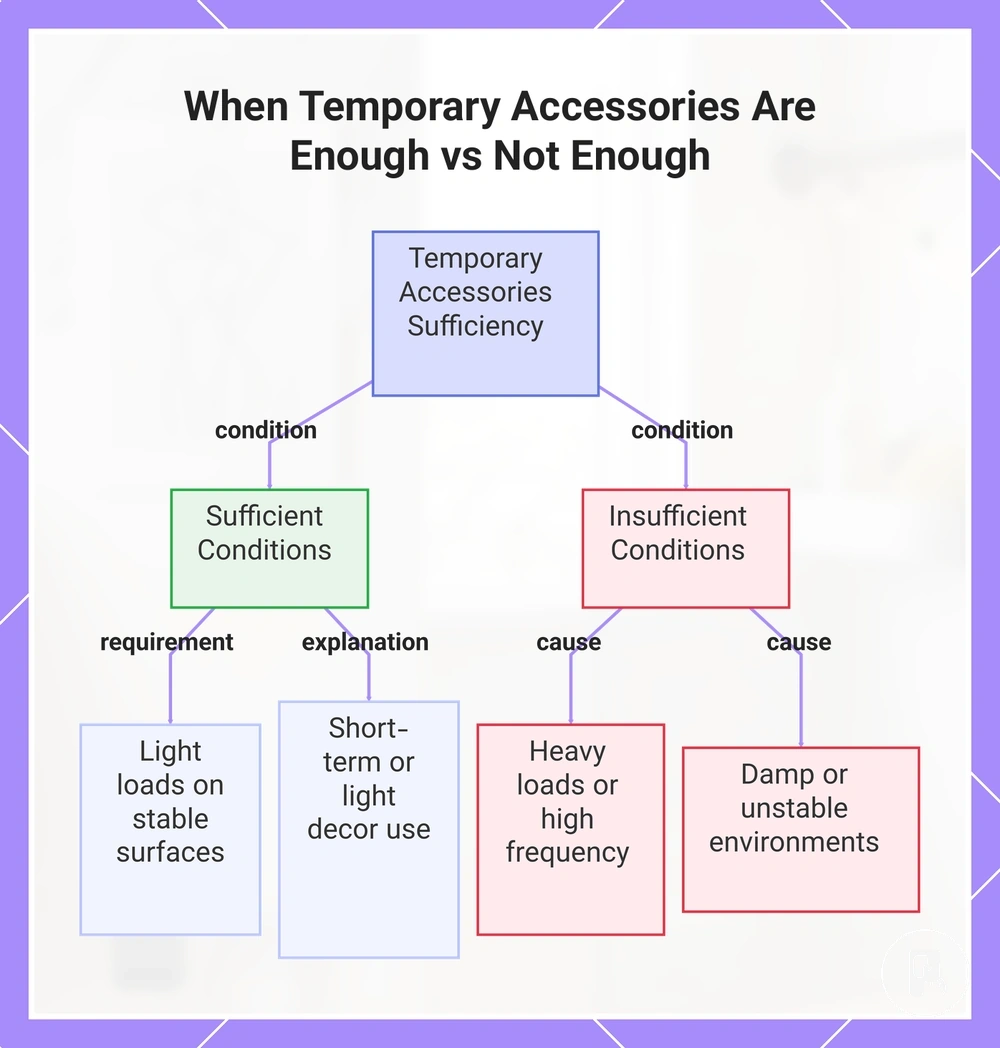
Temporary accessories are non-permanent solutions that may be enough for some renter needs but not enough for others. Their performance depends mainly on load, surface condition, use frequency, room environment, and move-out expectations. The decision is about balancing everyday safety and practical limits rather than assuming one outcome. :contentReference[oaicite:0]{index=0}
Selection depends on load level, use frequency, surface condition, room environment, and move-out expectations. Low load setups on stable surfaces usually perform within expected limits. Higher frequency use or unstable surfaces can reduce reliability. In most cases, light decor and everyday organization are likely fits.
A common assumption is that temporary accessories can handle every household need. In reality, they are better suited to controlled conditions and lighter use patterns. Heavier storage, repeated pulling, damp areas, and child or pet contact are caution cases where not enough becomes more likely.
To decide more accurately, a simple condition-based checklist helps separate enough from not enough. The checklist focuses on real use factors that affect stability and safety in rental setups.
- Load level and whether it stays within light or moderate limits
- Use frequency and how often items are handled or pulled
- Surface condition including smoothness, texture, and stability
- Moisture and overall room environment exposure
- Move-out expectations and potential removal impact
- Child or pet contact and interaction risk
- Lease or rental constraints affecting allowed modifications
- Whether a non-permanent accessory is enough for the intended use
Temporary accessories can be enough when conditions stay within light use and stable surface limits, especially for short-term organization. When load, frequency, or environment increase beyond that range, not enough becomes more likely and a different setup may be required.
Here are product examples that may make comparison easier. Before buying, always review the compatibility criteria, essential features, and product details.
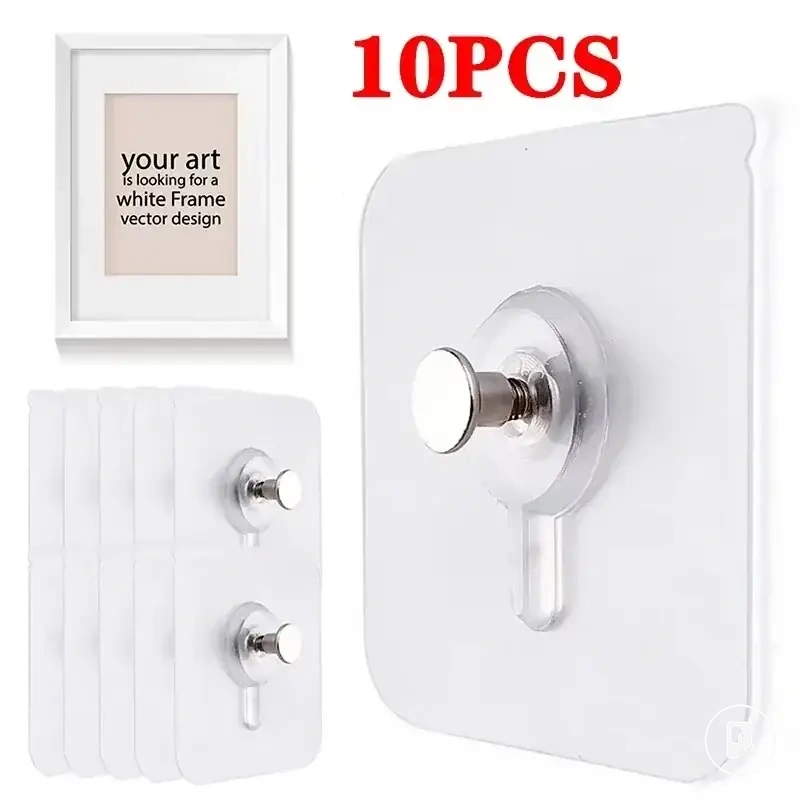
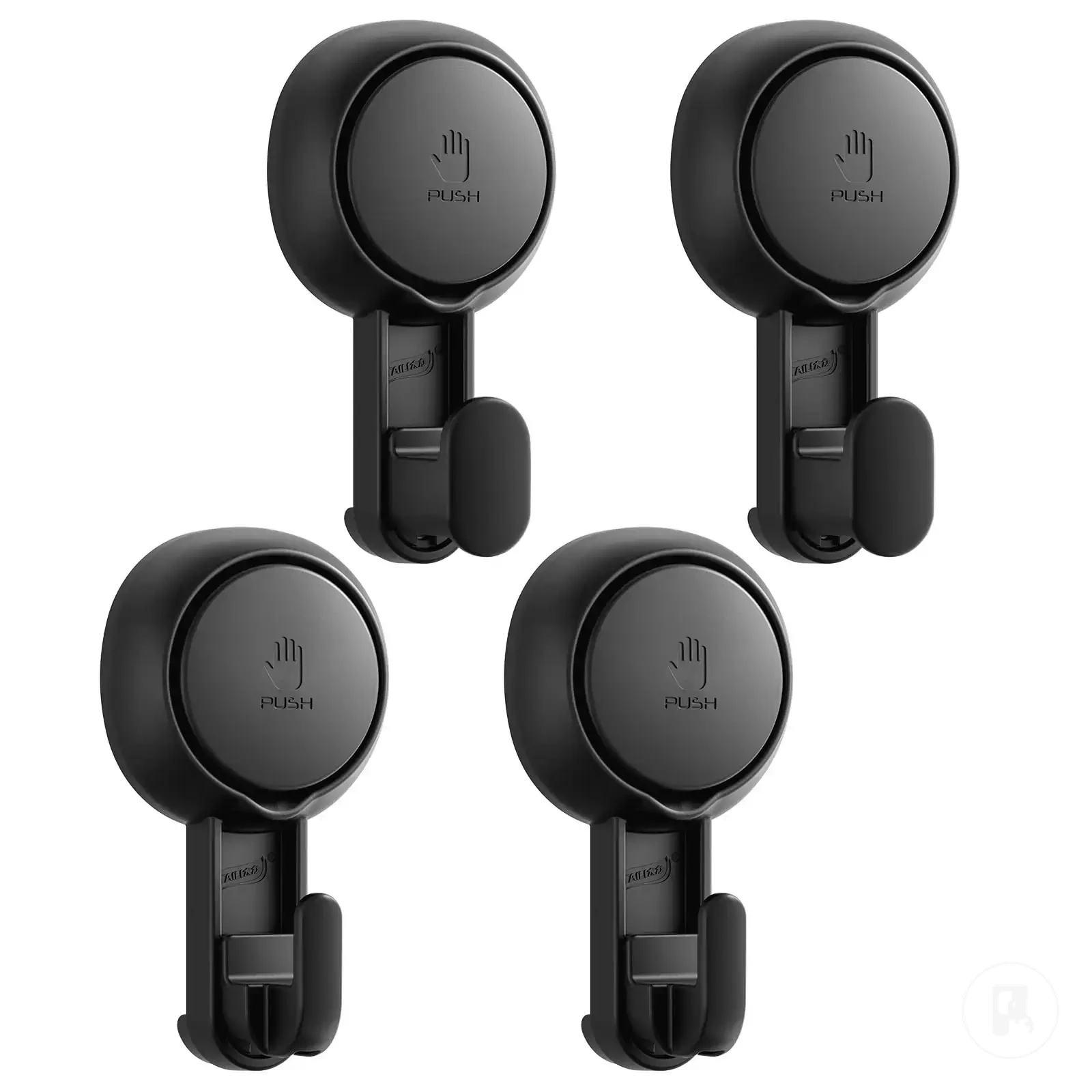
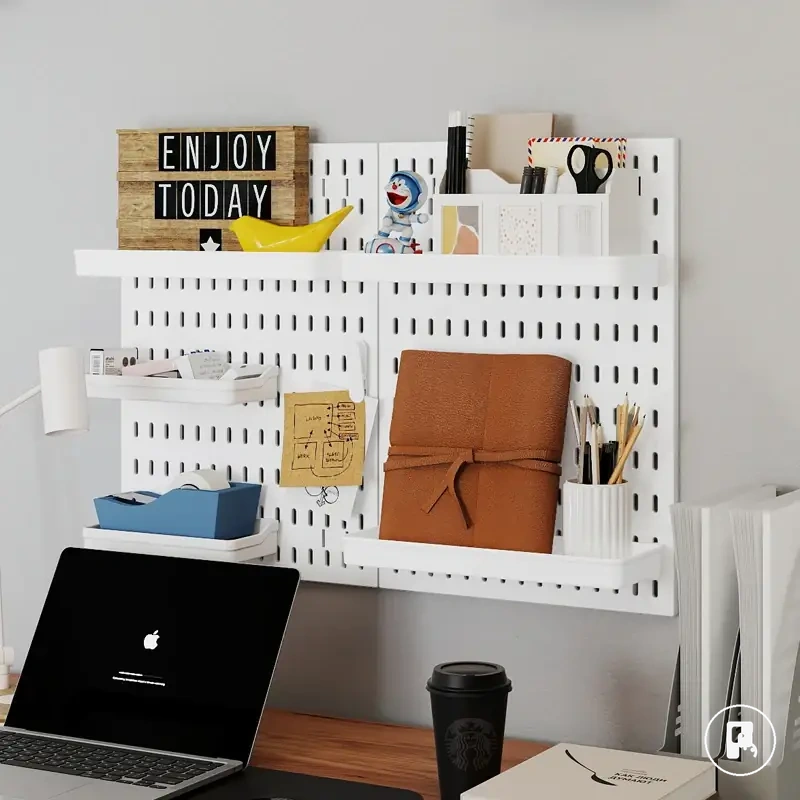
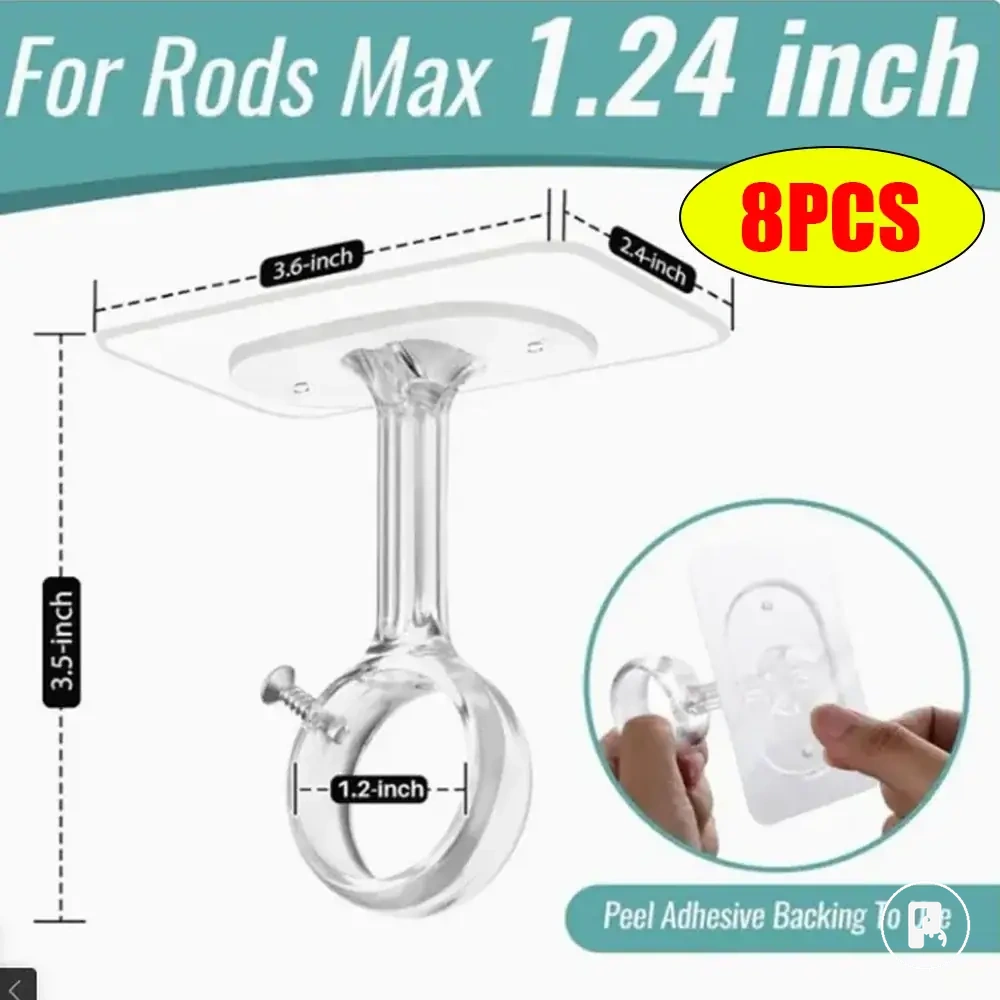
This chart shows the conditions that determine whether temporary accessories are sufficient for rental use, based on load, surface, and environment factors.
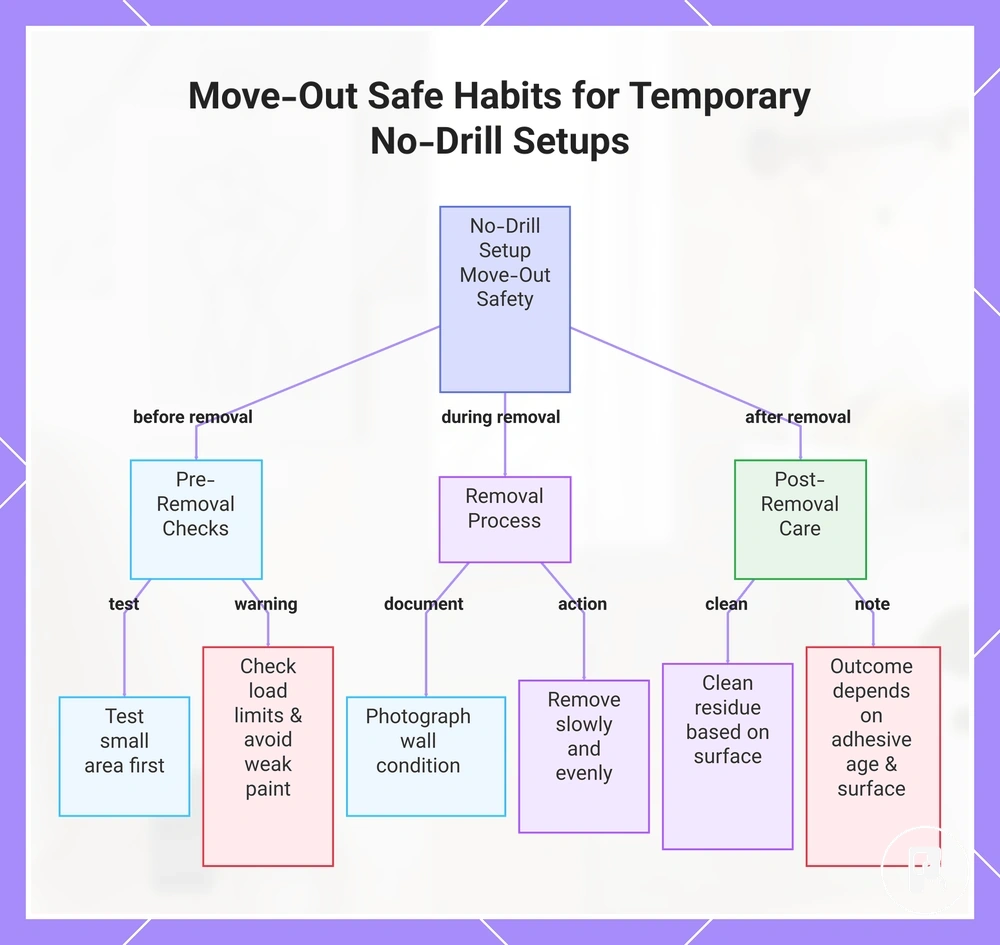
Move-Out Safe Habits for Temporary No-Drill Setups
Move-out safe habits for temporary no-drill setups are practices that reduce damage, residue, and paint lift during removal. These habits matter because outcomes depend not only on removal, but also on how temporary no-drill setups are used over time. Clean results are influenced by adhesive age, surface condition, and usage behavior, so move-out safety depends on setup, use, and removal.
These habits focus on reducing risk before and during removal rather than treating removal as a single action. Using damage-free home setup helps establish safer conditions during installation and everyday use. This preparation supports more controlled handling when removal becomes necessary in rental environments.
Move-out safe habits are best applied as a structured sequence that reduces stress on surfaces and adhesive points. Attention to load limits, weak paint, and damp walls helps reduce avoidable damage. The steps below focus on practical removal behavior and surface tolerance during the process.
- Test a small area before full removal to understand surface reaction, especially when adhesive age is unknown or paint is weak.
- Check load limits and reduce stress on attachments before starting removal to minimize sudden force on the wall.
- Avoid damp or weak paint areas, as moisture and fragile surfaces increase paint lift risk during removal.
- Photograph wall condition before removal to document surface state in case residue or damage patterns need review.
- Remove slowly and evenly to reduce sudden tension that can increase damage or residue on sensitive surfaces.
- Clean residue carefully based on surface tolerance, using methods appropriate to the wall finish and adhesive age.
Move-out safety depends on how temporary no-drill setups were installed, used, and removed under real conditions. Clean removal is not guaranteed in all cases, as adhesive age, surface finish, wall preparation, and removal method all influence outcomes. For detailed guidance on post-use handling, refer to remove no-drill accessories cleanly.
This chart shows the key habits to reduce damage and residue during removal of temporary no-drill setups, covering pre-removal checks, removal actions, and post-removal care.