No-Drill Home Accessories Price and Value Comparison
No-drill home accessories price depends on fit, surface, load, and material conditions. Price is not the main factor when evaluating no-drill home accessories. A lower price only matters when these conditions align, so price must be filtered through fit and use conditions.
In small apartments, rented rooms, or moisture-prone bathrooms, no-drill home accessories behave differently depending on where they are installed. A low-cost set may still fail if the surface is unsuitable or the load is too high for the mounting method. In these scenarios, the decision depends on surface type, load demand, material quality, bundle composition, and replacement risk rather than price alone.
No-drill home accessories refer to removable or damage-free mounting solutions that do not require drilling into walls or permanent fixtures. Their value is shaped by how they interact with different surfaces, weights, and environmental conditions. Understanding these conditions helps separate simple price comparison from real cost evaluation based on usage reality.
Price, Value, and Real Cost for No-Drill Home Accessories
Price, value, and real cost for no-drill home accessories refer to three connected but different ways of evaluating no-drill home accessories. Price is the listed amount for a set, while value reflects how usable that set is in real conditions. Real cost includes replacement parts, surface fit, and mounting method outcomes over time.
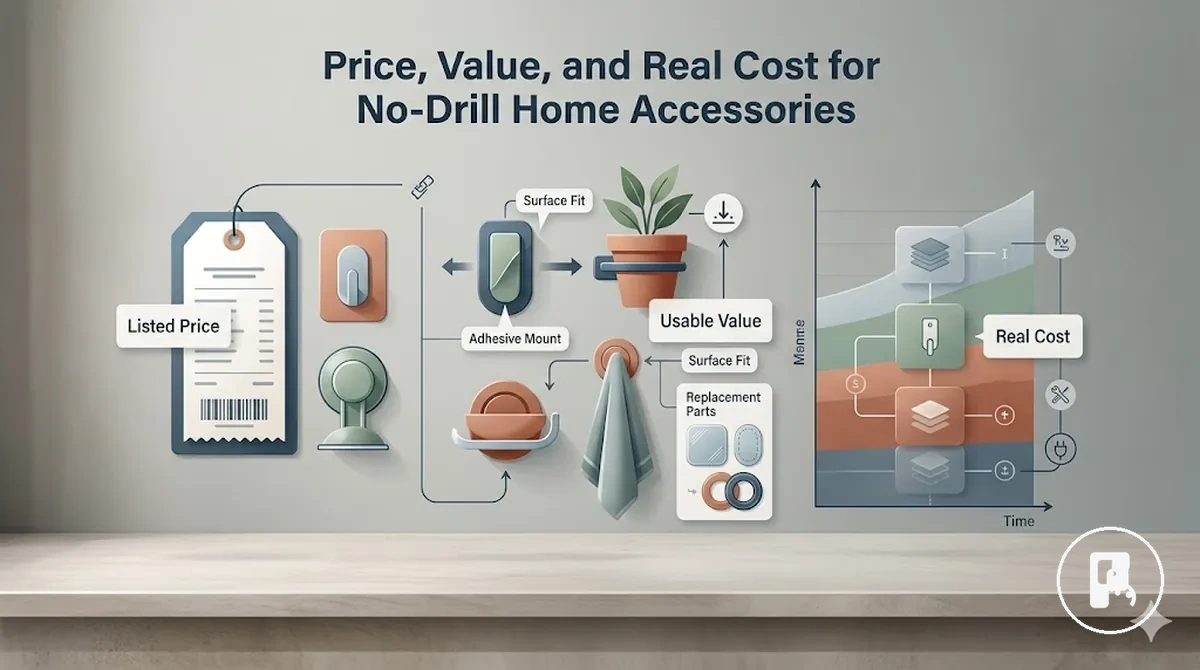
In practical use, a no-drill accessory set may show a low listed price but include fewer usable pieces or weaker mounting support depending on material and design. Surface fit also changes how adhesive or suction parts perform, which can increase replacement parts needs over time. Expected service conditions such as humidity, load, and repositioning frequency directly influence how value converts into real cost beyond the initial purchase.
The idea that price alone reflects quality is often misleading for no-drill home accessories because mounting method and surface compatibility can shift performance outcomes. A lower listed price does not always reduce real cost if the set requires frequent replacement or additional components. Boundary cases also appear when comparing unrelated installation systems, so the focus should remain on no-drill home accessories only.
Before comparing values, it helps to separate listed price from real cost clearly. The block below clarifies this distinction.
| Listed price | Real cost |
| Initial purchase amount for the accessory set | Total cost influenced by usable pieces, surface fit, mounting method, and replacement parts over time |
:contentReference[oaicite:0]{index=0}
Price Bands and Cost Signals for No-Drill Accessory Sets
Price bands for no-drill accessory sets act as interpretation signals for cost rather than fixed proof of quality. These no-drill accessory sets depend on mounting type, material, bundle quantity, and included parts, so listed price must be read as a signal instead of a final decision marker. Price bands are signals, not proof of quality or usable value.
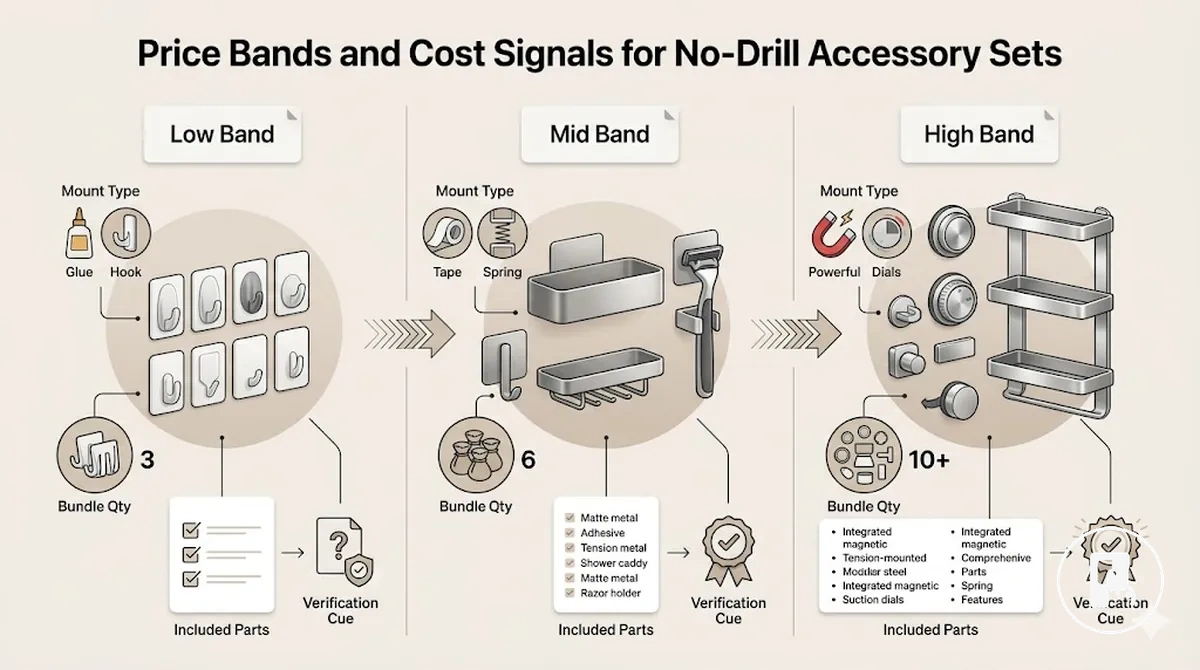
Price Bands and Cost Signals for No-Drill Accessory Sets can be visually organized to show how different cost signals relate to practical evaluation rather than raw pricing. The image below clarifies how listed price connects to mounting type, bundle quantity, included parts, and verification cues before judging usable value.
In real usage, no-drill accessory sets may appear more or less expensive depending on bundle quantity and included parts, even when material or mounting hardware quality changes usability. A set with fewer usable pieces may look cheaper at first but require additional replacement parts over time, which changes the overall cost signal. These variations make mounting type, material quality, and included components key factors in interpreting price bands and usable value.
Price bands refer to grouped ranges of listed price that help categorize no-drill accessory sets into interpretive levels, while cost signals describe the underlying attributes that influence those ranges. These signals often include bundle quantity, mounting hardware type, material finish, and included parts, all of which affect usable value. The table below organizes how these signals should be evaluated rather than assumed.
| Price signal | What it may indicate | What to verify before valuing it |
|---|---|---|
| Bundle quantity | Number of usable components included in the set | Check usable pieces and missing mounting hardware |
| Material | Possible durability and finish variation | Verify surface compatibility and wear conditions |
| Mounting type | Adhesive or suction-based stability differences | Check surface fit and load suitability |
| Included parts | Completeness of the accessory set | Confirm replacement parts availability and usability |
Mounting Method, Material, and Finish
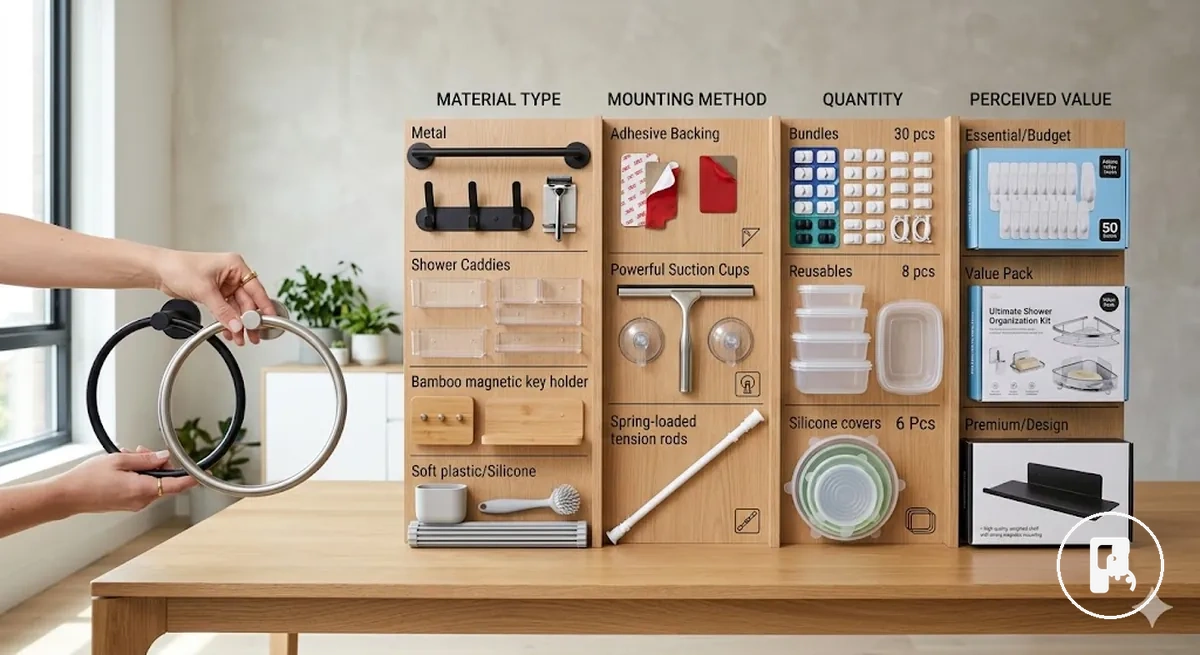
Mounting method, material, and finish refer to the visible construction elements that shape how a no-drill accessory performs and how its price signal should be interpreted. The mounting method—such as adhesive pads or suction cups—directly influences stability and reuse potential, while material and finish affect durability under different conditions. Together, these elements help explain why similar-looking no-drill accessory sets may reflect different cost signals.
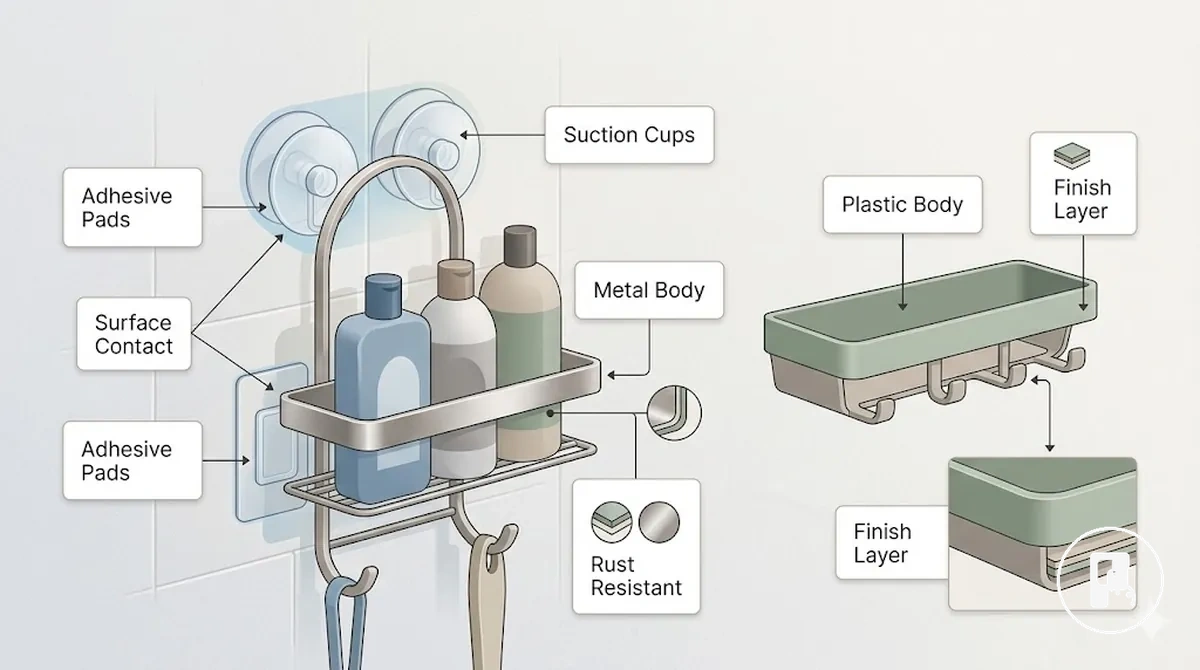
In practical use, mounting method and material determine how reliable a no-drill accessory set feels under different surface and environmental conditions. Key components that influence this interpretation include:
- Adhesive pads – depend on surface fit and may require replacement over time
- Suction cups – perform better on smooth surfaces and may need periodic reseating
- Metal or plastic body – affects structural stability and long-term usability
- Rust-resistant finish – helps maintain performance in moisture-prone environments
- Surface-facing parts – determine direct contact quality and wear behavior
Lower-grade finishes may reduce upfront cost signals but can show faster wear under moisture or repeated use, while more durable finishes and stronger mounting combinations typically support more stable long-term usability. These differences do not define absolute quality but instead shift how value is interpreted within no-drill accessory sets.
Set Size, Bundle Quantity, and Included Mounting Parts
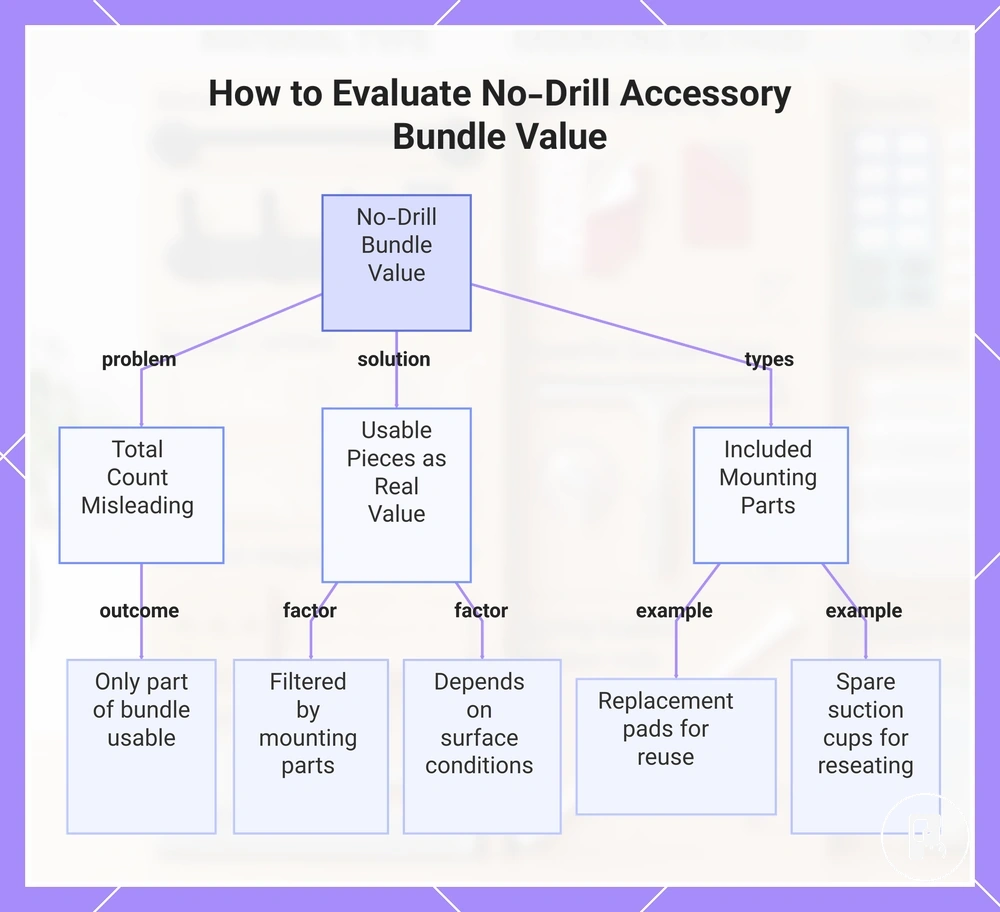
Set size and bundle quantity influence how no-drill accessory value is interpreted because the included count does not always match what can be practically used in a specific room or surface setup. In many cases, only part of a bundle becomes relevant after matching installation needs and surface conditions. This shifts attention from total count to usable pieces as the real value indicator.
Set size and bundle quantity depend on how many items actually match the intended surface and use case, rather than the total number of items in the multipack. The included mounting parts often determine functional value more accurately than the visible set size. These parts act as filters for usability based on installation needs.
- Number of accessories – reflects total items, but only some may fit the intended setup
- Replacement pads – support reuse when adhesive performance weakens over time
- Spare suction cups – useful for reseating on smooth surfaces, depending on usage
- Adhesive films – matter when surface requires additional mounting support layers
- Installation aids – help setup but may not contribute to long-term function
A larger bundle may include more parts, but some items can remain unused if they do not match the surface or mounting method requirements. In such cases, bundle quantity should be evaluated through usable pieces rather than total included count.
This chart explains why total bundle count is misleading and how to assess real value based on usable pieces and included mounting parts.
Durability Signals That Affect Long-Term Value
Durability signals refer to the visible and material-based indicators that influence how long a no-drill accessory may remain functional under real use. These signals directly affect long-term value because they shape how often replacement risk occurs in different environments. Load behavior, moisture exposure, material quality, and surface condition all interact to define durability as a cost variable rather than a fixed outcome.
Durability signals depend on how no-drill accessories are used under specific conditions rather than a universal performance level. Light-load setups usually place less stress on adhesive pads or suction cups, while higher load or uneven surface conditions may increase replacement risk over time. Moisture exposure, material type, surface condition, and maintenance conditions together determine how durability signals translate into replacement risk.
| Accessory condition | Durability attribute | Value risk | Decision cue |
|---|---|---|---|
| Light load use | Basic adhesion or suction stability | Lower replacement risk | Suitable for low-stress setups |
| Moisture exposure | Material and finish response | Moderate replacement risk | Check surface and environment fit |
| Heavier storage use | Load resistance and surface grip | Higher replacement risk | Evaluate stability before use |
The idea of a heavy-duty claim does not apply uniformly across no-drill accessories because durability changes with load, material, and surface conditions. Instead of assuming fixed lifespan behavior, durability signals should be interpreted as context-dependent indicators that influence long-term value through varying replacement risk patterns, rather than relying on any heavy-duty claim.
Load Suitability and Heavy-Duty Claims
Load suitability and heavy-duty claims are durability signals that describe how no-drill accessories are expected to perform under different weight and usage conditions. These signals depend on stated load capacity, adhesive area, surface smoothness, object weight, and use frequency. They affect long-term value because mismatch between claimed load and real conditions can increase replacement risk.
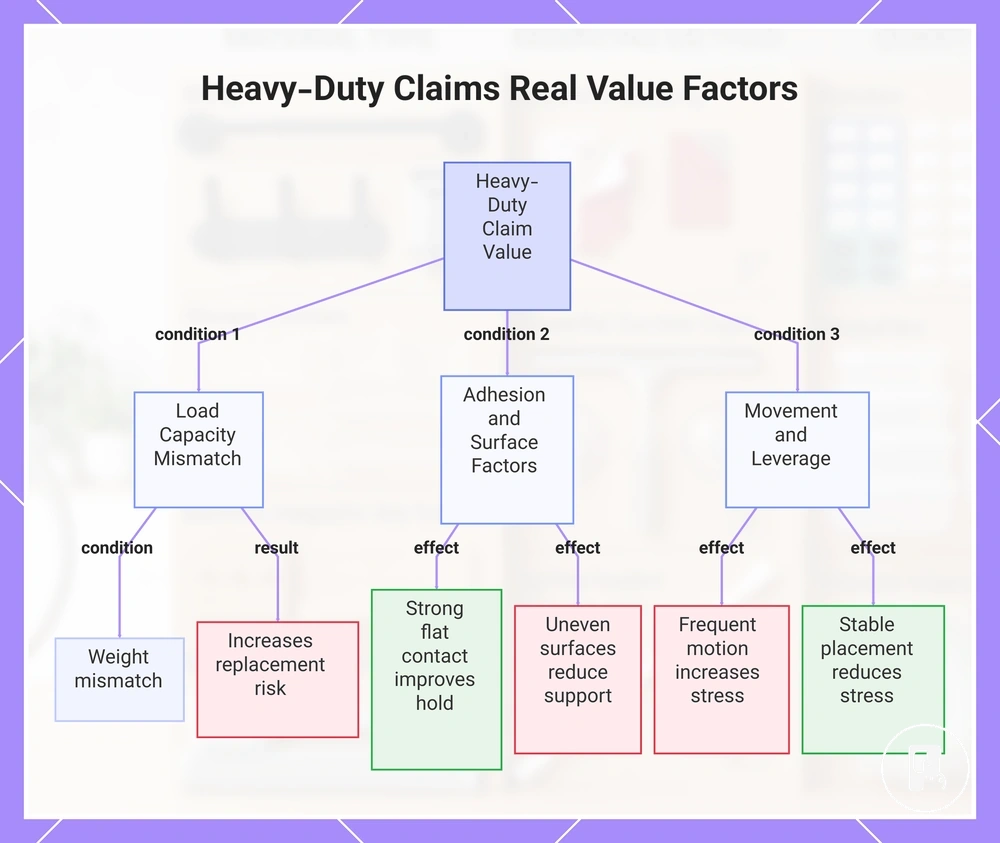
Load suitability changes depending on how conditions interact in real use rather than only the stated load capacity. Light movement and stable placement may reduce stress on adhesive contact, while frequent movement or uneven surfaces can increase leverage effects and weaken holding performance. The following conditions typically influence how heavy-duty claims translate into actual value:
- Stated load capacity vs actual stored weight – mismatch can increase failure risk under real usage
- Adhesive area and surface smoothness – stronger, flatter contact improves hold stability
- Leverage and movement – frequent motion increases stress on mounting points
- Surface condition variability – uneven or textured surfaces reduce reliable load support
Heavy-duty claims should therefore be treated as conditional indicators rather than fixed guarantees. When surface conditions are unsuitable or stored weight exceeds practical adhesion limits, even higher-rated claims may lose value due to increased replacement risk over time.
This chart identifies the key conditions that influence whether heavy-duty claims translate into actual durability for no-drill accessories.
Waterproof, Rust-Resistant, and Removable Claims
Waterproof claim, rust-resistant finish, and removable claim function as wet-area use filters that shape value expectations based on moisture exposure, adhesive exposure, and surface condition. These claims are not fixed guarantees but conditional indicators influenced by humidity, suction seal behavior, and cleaning contact. In long-term value terms, they help assess risk rather than define absolute performance.
Wet-area use conditions such as humidity levels, adhesive exposure, surface smoothness, and material quality determine how these claims behave in practice. A waterproof claim may reduce perceived risk under moisture exposure, while suction seal stability still depends on surface smoothness. Rust-resistant finishes relate to metal body response over time, especially under repeated cleaning contact, and removable claims depend on whether clean removal is possible under specific surface conditions.
Claim interpretation can be summarized through key contrasts:
| Claimed feature | What to verify |
| Waterproof claim | Humidity exposure and adhesive exposure behavior |
| Rust-resistant finish | Metal body response under moisture and cleaning contact |
| Removable claim | Surface condition and likelihood of clean removal |
These claims should be read as conditional value filters because suction seal quality, adhesive exposure, and surface smoothness can significantly change outcomes. In cases where drainage is poor or surfaces retain moisture for extended periods, even rust-resistant or removable positioning may not align with expected long-term value.
Comparison Logic for Similar No-Drill Accessory Sets
Similar no-drill accessory sets are compared through matching decision criteria such as mounting type, usable quantity, material, load suitability, wet-area suitability, and replacement parts. Price alone is not enough because comparison logic depends on how each attribute performs under real use conditions. This ensures value comparison stays tied to functional differences rather than surface-level similarity.
When similar sets appear close in design or pricing, differences usually emerge in mounting type stability, usable quantity per set, and how material and finish behave under moisture or load stress. Wet-area suitability and replacement parts also affect long-term usability when adhesive performance changes. The comparison criteria below organize these differences into a structured view for clearer decision-making.
| Criteria | What to compare | Value signal | Risk if ignored |
| Mounting type | Adhesive, suction, or hybrid system | Surface stability and grip consistency | Higher failure risk on incompatible surfaces |
| Usable quantity | Actual usable installation pieces | Real coverage of intended use area | Overestimating functional capacity |
| Material / finish | Plastic or metal quality and coating | Durability under moisture and stress | Faster wear and reduced lifespan |
| Load suitability | Stated load vs real usage weight | Practical holding reliability | Increased detachment or failure risk |
| Wet-area suitability | Humidity and moisture exposure tolerance | Stability in wet conditions | Adhesion weakening over time |
| Removability | Clean removal behavior | Surface safety after removal | Residue or surface damage risk |
| Replacement parts | Availability of spare adhesive or mounts | Extended usability cycle | Higher long-term replacement cost |
These criteria show that similar no-drill accessory sets are differentiated by functional trade-offs rather than appearance or price. Small variations in mounting type or wet-area suitability can significantly change long-term value outcomes.
A common misconception is that similar sets differ mainly by branding or minor features. In reality, comparison logic is based on measurable criteria differences, while broader installation choices may involve compare no-drill and drilled options depending on permanence and flexibility needs.
Adhesive Bundles, Suction Multipacks, and Mixed Sets
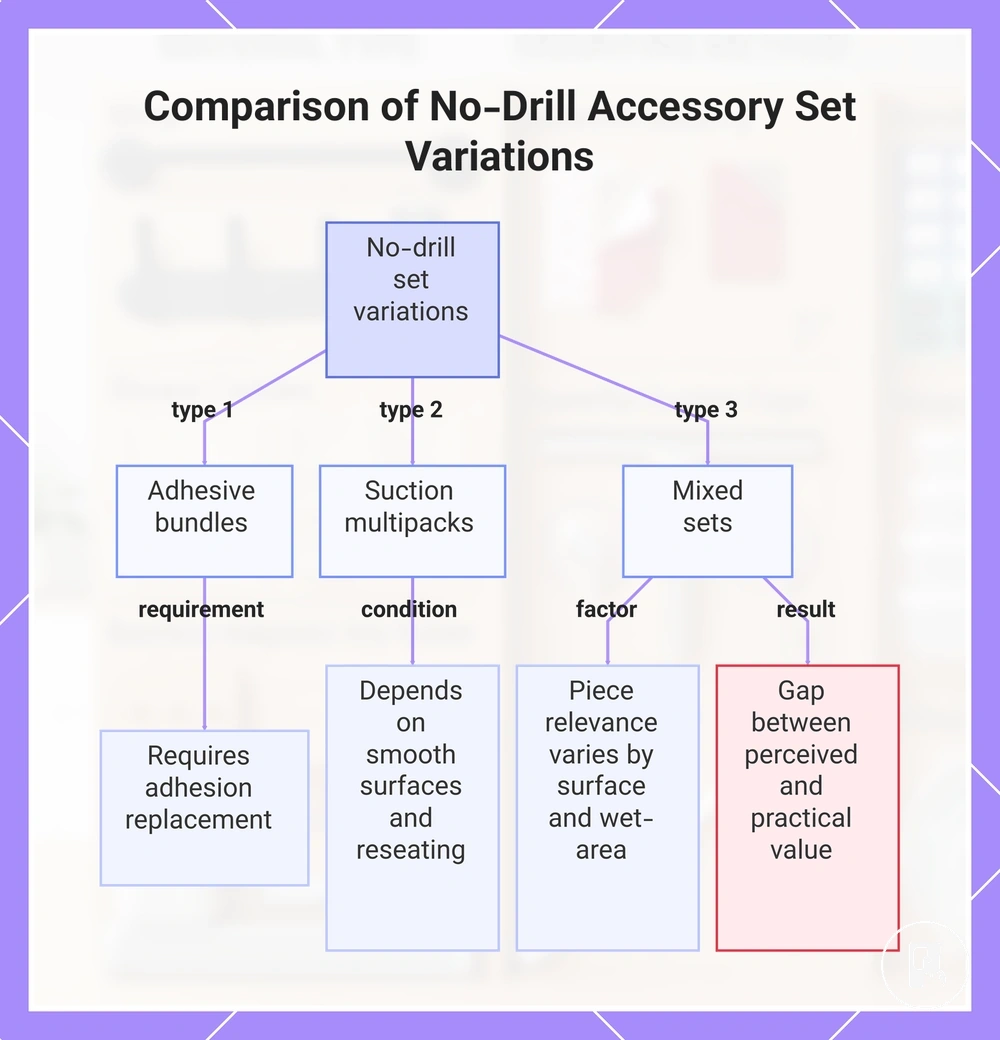
Adhesive bundles, suction multipacks, and mixed sets are three variations within similar no-drill accessory sets that differ in how they manage attachment, reuse, and surface dependency. Adhesive bundles rely on replacement-based sticking performance, suction multipacks depend on reseating cycles on smooth surfaces, and mixed sets combine multiple attachment approaches in one package. These differences define how value is interpreted across set types.
In real use conditions, adhesive bundles may require adhesion replacement when surface exposure or dust reduces bonding strength, while suction multipacks depend heavily on surface smoothness and periodic suction reseating to maintain stability. Mixed sets introduce flexibility by combining different mounting approaches, but their piece relevance can vary depending on wet-area use and surface type.
- Adhesion replacement – required when adhesive bonding weakens over time or due to surface exposure
- Suction reseating – needed to restore grip on smooth surfaces after air loss or movement
- Surface smoothness – directly affects suction stability and adhesion consistency
- Wet-area use – can reduce reliability depending on humidity and moisture exposure
- Mixed-piece relevance – varies based on whether included components match the actual setup
These variations can shift overall usable performance even when sets appear similar at first glance, leading to different usable-value risk levels.
A mixed set may appear more valuable because it includes multiple attachment options, but it can still deliver lower usable output if most components do not match the same surface conditions or usage pattern. This creates a gap between perceived flexibility and practical application in specific environments.
:contentReference[oaicite:0]{index=0}
This chart compares three types of no-drill accessory sets—adhesive bundles, suction multipacks, and mixed sets—and their key characteristics that affect usable performance.
Price Per Usable Piece
Price per usable piece is calculated by dividing the total price by only the usable pieces that remain after filtering out excluded pieces, incompatible items, and non-functional components in a multipack. It converts total cost into real unit cost based on actual usability rather than total quantity. This makes comparison more accurate when sets include mixed relevance components.
The calculation starts by identifying usable pieces and separating them from excluded pieces that do not match the intended surface or installation needs. Required mounting parts are treated as necessary inputs that support usability, while spares are counted only if they contribute to repeat use. The formula can be expressed as: price per usable piece = total price ÷ usable pieces.
| Input | How to count it | Why it changes value |
| Total price | Full cost of the multipack before filtering | Baseline cost for calculation |
| Usable pieces | Items that match surface and function requirements | Defines actual usable output |
| Required mounting parts | Essential components needed for installation | Enable usability but are not optional output |
| Spares | Extra adhesive or suction replacements included in set | Extend usage but may not be immediately used |
| Excluded pieces | Items incompatible with surface or intended setup | Reduce effective value of the multipack |
In many cases, a smaller multipack with higher alignment to usable needs can deliver better price per usable piece than a larger set with many excluded components. This outcome depends on surface compatibility, mounting type requirements, and how many items remain functional after filtering, so the result is always context-dependent.
Fit Conditions as Value Filters
Fit conditions depend on room, surface, weight, and moisture as primary value filters that determine whether a no-drill accessory set converts general price into usable value. These conditions shape real-world performance by narrowing when and where a set can function as intended. Fit converts price into personal value only when these conditions align with actual use.
- Room type – filters value based on how and where the accessory will be used in daily activity
- Surface texture – affects adhesion or suction behavior and limits usable performance
- Surface cleanliness – influences bonding strength and stability under load
- Expected load – determines whether the accessory can remain stable in real conditions
- Moisture level – impacts hold reliability in humid or wet-area use
- Removability needs – defines how important clean removal is for the surface condition
- Visual finish – affects whether the accessory fits the intended interior appearance
In practical evaluation, room, surface, weight, and moisture act as the core filters that decide whether a set remains usable or becomes unsuitable despite its general pricing. These conditions can be checked early through choose by room and surface, which helps align selection with real installation context.
A lower-cost set does not represent good value if it fails the primary fit condition such as surface compatibility or load expectation, since unusable configurations reduce practical benefit regardless of initial price level.
When No-Drill Accessories Are Worth the Price
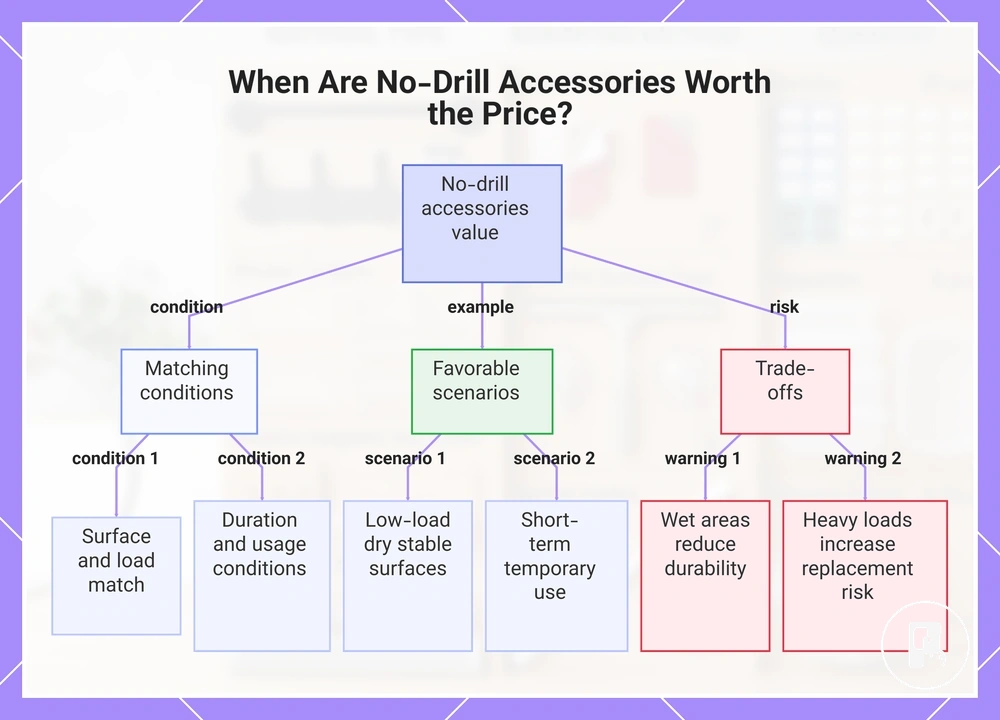
No-drill accessories are worth the price when they match surface match, load match, expected duration, and usage conditions. This alignment determines whether the setup delivers practical value or becomes a short-lived convenience. In most cases, worth the price depends on how these conditions interact rather than the upfront cost alone.
Temporary use scenarios, renter needs, and surface protection requirements often make no-drill accessories a rational option. They reduce installation effort and avoid permanent surface changes while still supporting functional use. However, replacement risk, durability trade-offs, and expected duration must be considered together, since mismatched conditions can reduce long-term practicality even when initial convenience is high.
The idea that no-drill accessories are either always good value or always limited in value is inaccurate. In low-load, dry, and stable surface environments, they may provide efficient short-term solutions. In contrast, wet areas or heavier load conditions increase durability trade-offs and may raise replacement risk, which affects overall value over time.
Final evaluation should focus on whether fit conditions such as surface match, load match, expected duration, and room conditions align with intended use. A structured check of renter needs, temporary use, surface protection, and durability trade-offs helps determine whether no-drill accessories are worth the price in a specific context. :contentReference[oaicite:0]{index=0}
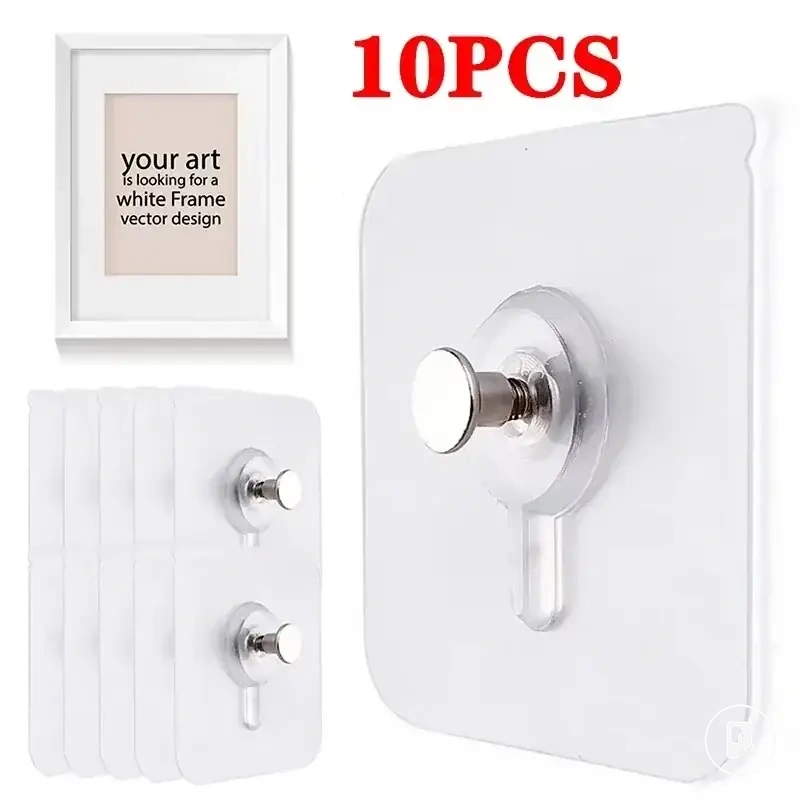
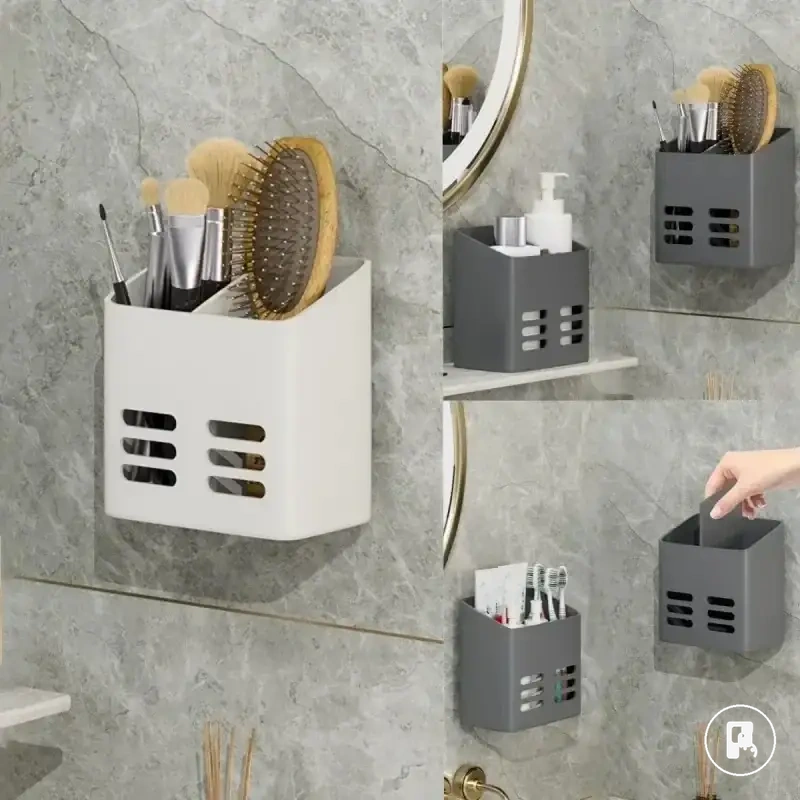
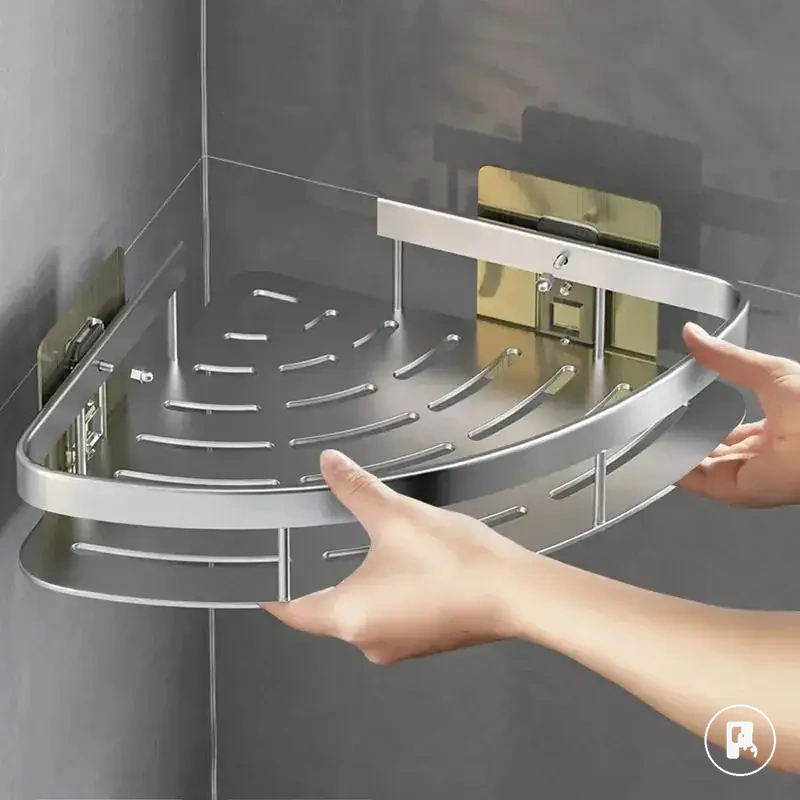
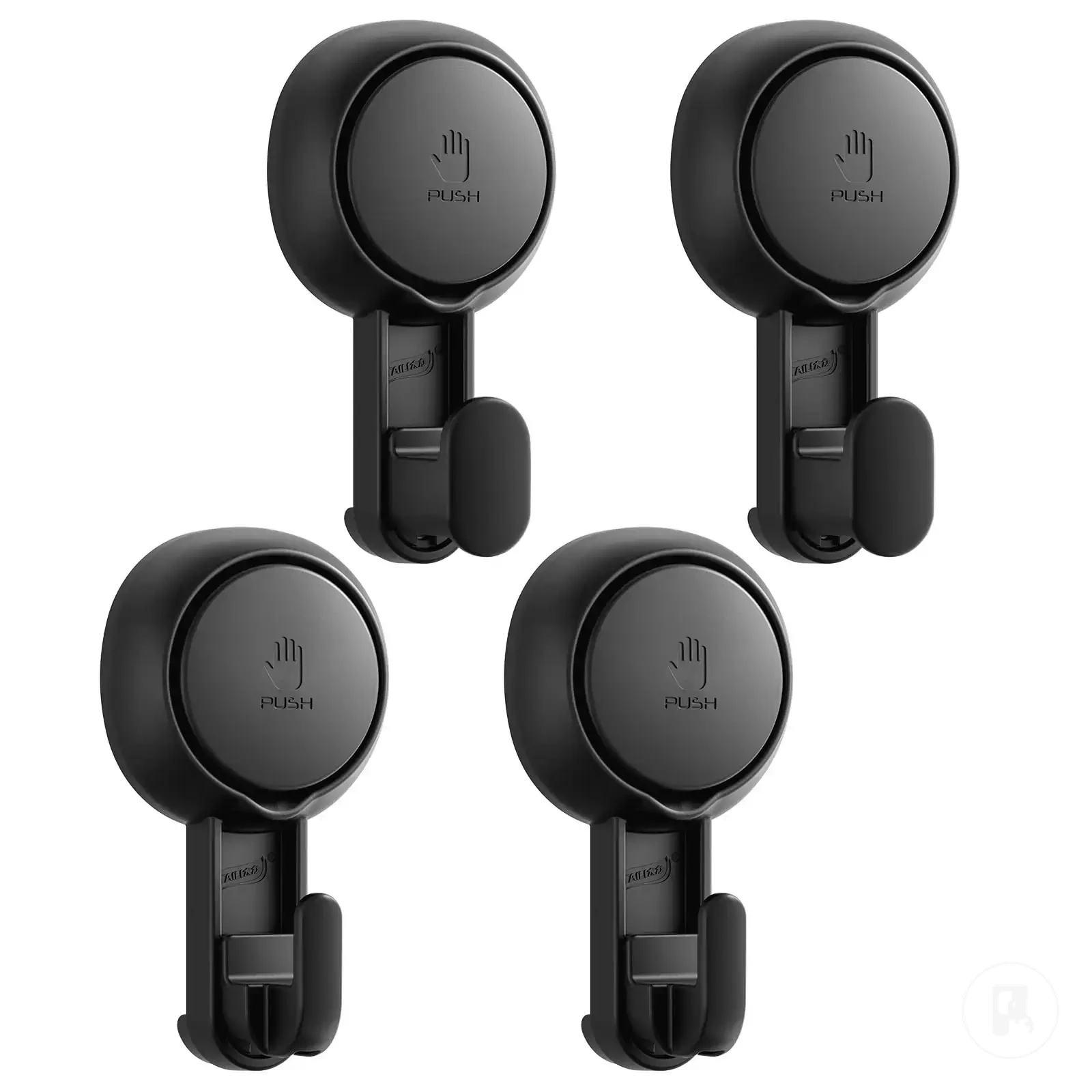
The products below are useful examples for comparing available options. Before buying, check that the compatibility criteria, key features, and product details match your needs.
This chart shows the key conditions, favorable scenarios, and trade-offs that determine whether no-drill accessories provide value.
When a Lower-Priced Set Is Enough
A lower-priced set is enough when it matches low-risk use conditions such as light items, smooth dry surfaces, and short-term use. In these situations, the lower-priced set can still deliver adequate function because load stress and environmental pressure remain limited. This makes it suitable for controlled low-risk use cases rather than demanding setups.
These conditions typically define when a lower-priced set can be considered adequate:
- Light items – reduced load keeps mounting stress minimal and improves basic stability
- Smooth dry surfaces – stable contact supports consistent adhesion or placement
- Short-term use – limits wear and reduces long-term degradation risk
- Simple hooks – low complexity reduces failure points in basic installations
- Low replacement cost – reduces impact when occasional wear or detachment occurs
In practice, a lower-priced set may perform adequately in simple indoor setups where conditions remain stable and predictable. However, when incompatible pieces are included or the surface does not match the intended mounting method, value can drop quickly. In such cases, lower price does not guarantee usable performance, especially when mismatch leads to early failure or repeated replacement needs. :contentReference[oaicite:0]{index=0}
When Paying More Reduces Replacement Risk
Paying more reduces replacement risk when higher cost aligns with stronger mounting area, better adhesive pads, corrosion-resistant material, higher load margin, and availability of spare parts. This does not guarantee durability, but it can reduce failure likelihood when these factors match the use conditions. In such cases, paying more can lower replacement risk in a controlled and conditional way.
In practical scenarios, paying more may help when the mounting area is structurally stronger, adhesive pads maintain better long-term bonding, and corrosion-resistant material supports wet-area exposure. A higher load margin can reduce stress under heavier use, while spare parts can extend usability without full replacement. However, paying more may not help when surface conditions are incompatible, installation is incorrect, or the product is used outside its intended load or environment range. In those cases, the price difference does not translate into reduced replacement risk, and the added cost may not justify the outcome.
Premium pricing should therefore be treated as a risk-reduction signal rather than proof of performance. Its value depends on whether the added features directly address the actual failure risks present in the specific use case.
Price-Check Cues for No-Drill Accessory Bundles
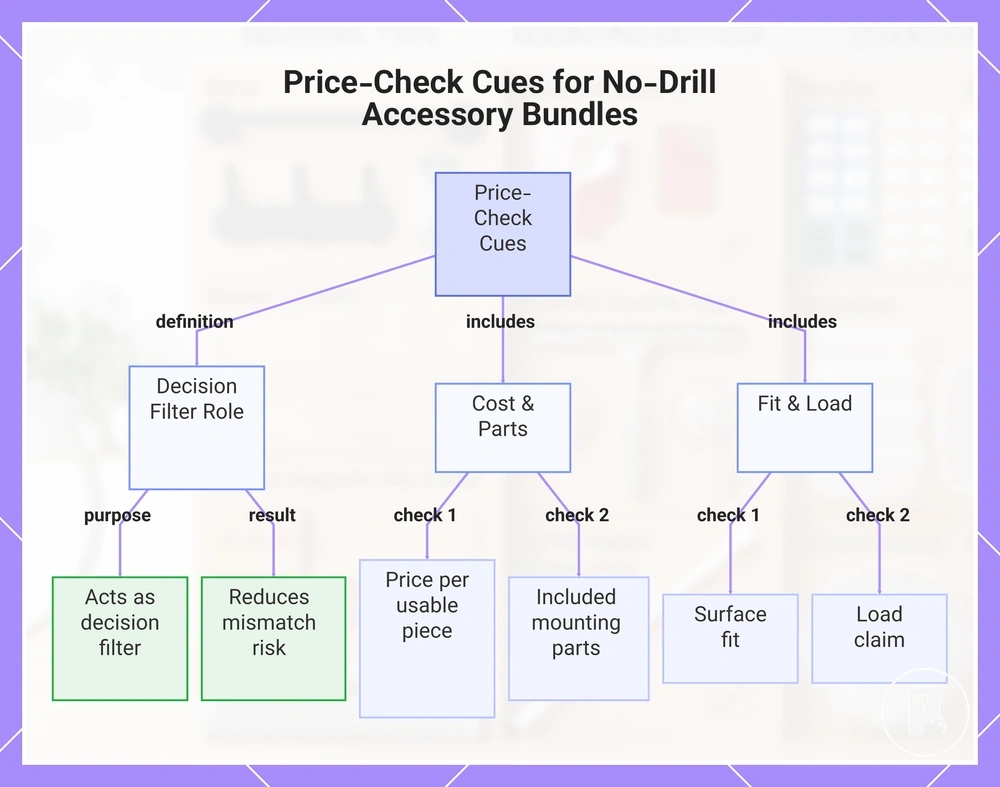
Price-check cues for no-drill accessory bundles are a final verification method used after understanding core value criteria. They focus on price per usable piece, included mounting parts, surface fit, load claim, replacement parts, and return clarity. This step helps confirm whether a bundle fits real use conditions before moving toward an external availability path.
In practical selection, no-drill accessory bundles depend on how well stated features align with actual installation conditions and expected use. A mismatch between claims and real surface or load requirements can change value even if the bundle appears complete. This is where the buying checklist supports structured validation before final evaluation.
- Price per usable piece – verifies real cost based on functional items, not total count
- Included mounting parts – checks whether essential installation components are sufficient
- Surface fit – confirms compatibility with intended wall or base material
- Load claim – evaluates whether stated capacity matches expected usage weight
- Wet-area claim – checks suitability for humidity or moisture exposure conditions
- Replacement parts – identifies long-term usability support for adhesive or mounts
- Return clarity – verifies how clearly replacement or return conditions are defined
- Realistic use duration – assesses whether expected usage period matches design limits
Price-check cues should be treated as decision filters rather than promotional signals, since bundle value depends on how accurately claims match real conditions. Product examples may help illustrate differences, but they should not replace criteria-based evaluation or surface-specific judgment.
Final verification ensures that the selected no-drill accessory bundle aligns with functional requirements instead of relying on appearance or listing completeness. This reduces mismatch risk between expectations and real-world performance. :contentReference[oaicite:0]{index=0}
The products below are useful examples for comparing available options. Before buying, check that the compatibility criteria, key features, and product details match your needs.
This chart shows the role of price-check cues as decision filters and the key categories of checks for verifying no-drill accessory bundles against real conditions.