
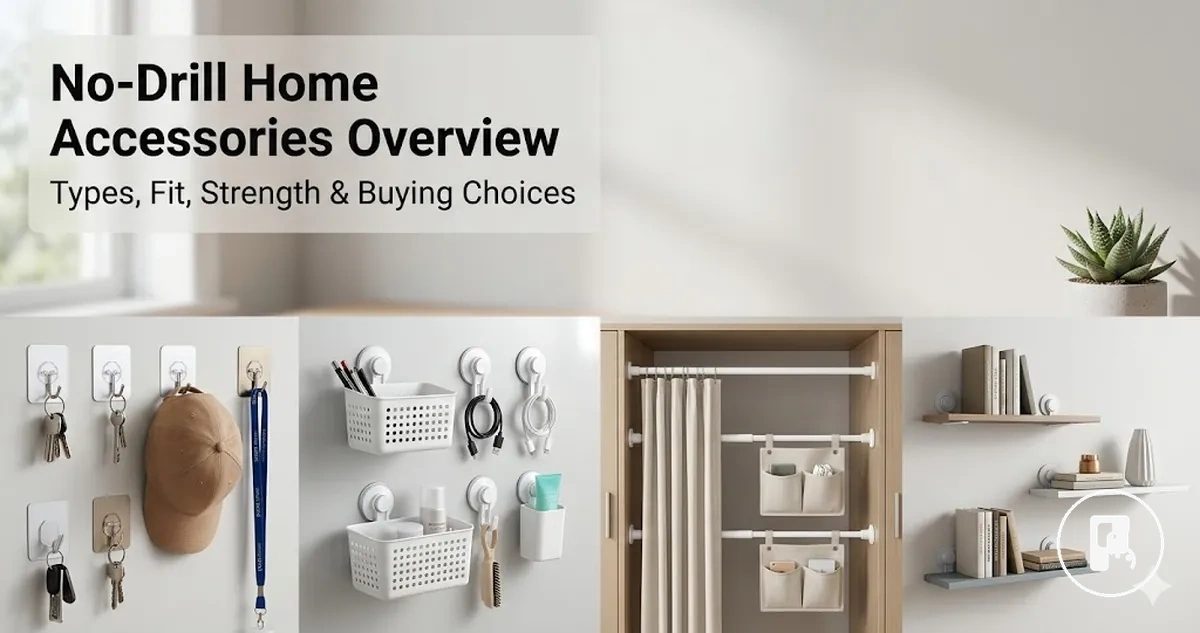
No-Drill Home Accessories for Damage-Free Home Setup
No-drill home accessories are wall accessories designed for installation without drilling holes into the surface. They typically use adhesive, suction, or tension-based mounting methods to stay in place while supporting everyday household use. This category focuses on removable solutions that aim to reduce surface alteration, but no-drill simply means no drilling, not automatic compatibility with every surface or load condition. These products are referred to as no-drill home accessories.
In many living situations, no-drill home accessories are used in renter-friendly environments such as apartments, temporary homes, and shared spaces where surface changes are limited. They are commonly applied for organizing storage, hanging items, or adding functional wall setups in areas like bathrooms, kitchens, and living spaces. Their practical value depends on how well the surface, weight, and fit align with the mounting method, especially when dealing with different levels of moisture or surface stability.
No-drill home accessories should be understood as a category where performance varies based on adhesive strength, suction conditions, tension balance, surface type, and expected load. These factors influence how securely the accessory holds and how easily it can be removed when needed. As a result, selecting and using these solutions requires attention to surface compatibility, weight expectations, and removal considerations before moving into specific mounting choices and use cases.
What counts as a no-drill home accessory
A no-drill home accessory is a home-use item that is mounted or positioned on a wall or surface without drilling holes, using adhesive, suction, or tension systems, and it is classified as a no-drill home accessory with clear inclusion rules for household use and surface interaction. This includes understanding what no-drill home accessories mean in terms of how they attach and remain removable while in use.
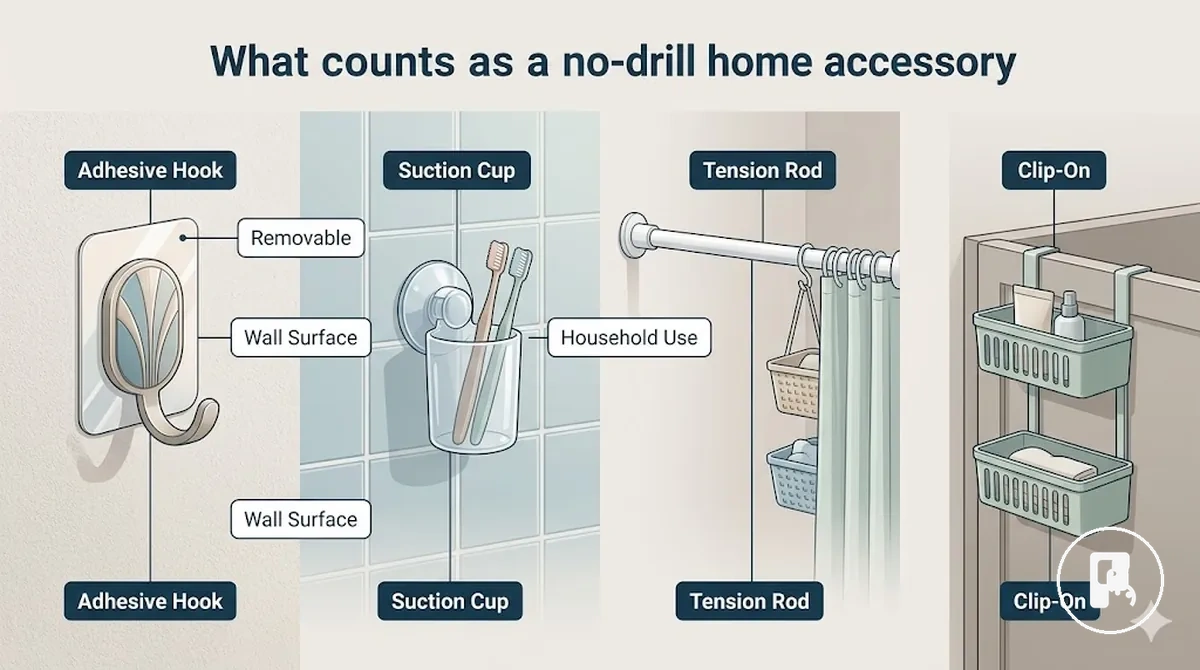
What counts as a no-drill home accessory is determined by how the item is mounted and how it interacts with the surface during household use. These accessories are typically positioned using adhesive pads, suction cups, tension rods, or clip-on mechanisms, and they are intended for removable, temporary, or renter-friendly setups rather than permanent fixtures.
Common examples help clarify the category boundary without expanding it into a full catalog. Examples include adhesive wall hooks, suction holders for smooth surfaces, tension rods between walls or frames, clip-on organizers, and removable shelves used for light household storage.
- Adhesive wall hooks for light hanging use
- Suction-based holders for tiles or glass surfaces
- Tension rods placed between two surfaces
- Clip-on organizers attached to edges or fixtures
- Removable shelves for temporary storage setups
Not every item without drilling is automatically safe or residue-free in all conditions. Some no-drill home accessories may still leave residue or show reduced holding strength depending on surface type, moisture exposure, and load, so fit and performance depend on use conditions rather than a universal rule.
Wall hooks, shelves, holders, rods, and organizers
Wall hooks, shelves, holders, rods, and organizers are no-drill accessory forms defined by how they support function, load, and mounting choice on a wall or surface. Each form is designed for different household use needs, where the structure of the accessory influences how weight is distributed and how it interacts with the surface during use.
Wall hooks, shelves, holders, rods, and organizers differ by function and mounting point, and this grouping helps clarify how each form behaves under different load conditions. The image below organizes these accessory types by their primary use and attachment style.
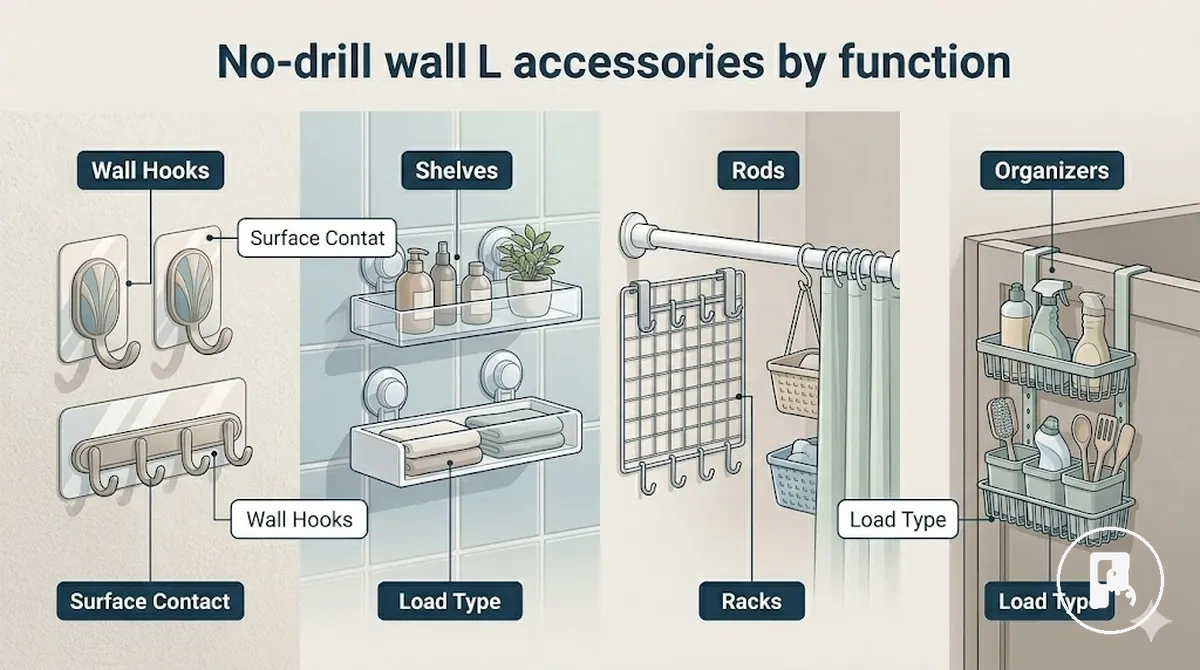
- Wall hooks: Used for hanging light items like keys or towels, typically suited for low load and smooth surfaces.
- Shelves: Support small storage or display use, often requiring stable surface contact and moderate load distribution.
- Holders: Designed for items like toiletries or kitchen tools, depending on adhesive or suction mounting and surface type.
- Rods: Used for curtains or temporary hanging setups, relying on tension or edge support between surfaces.
- Racks: Provide structured support for multiple items, usually requiring balanced load handling and firm surface grip.
- Organizers: Multi-compartment storage solutions that vary in load capacity based on mounting method and wall condition.
No-drill accessories versus general drill alternatives
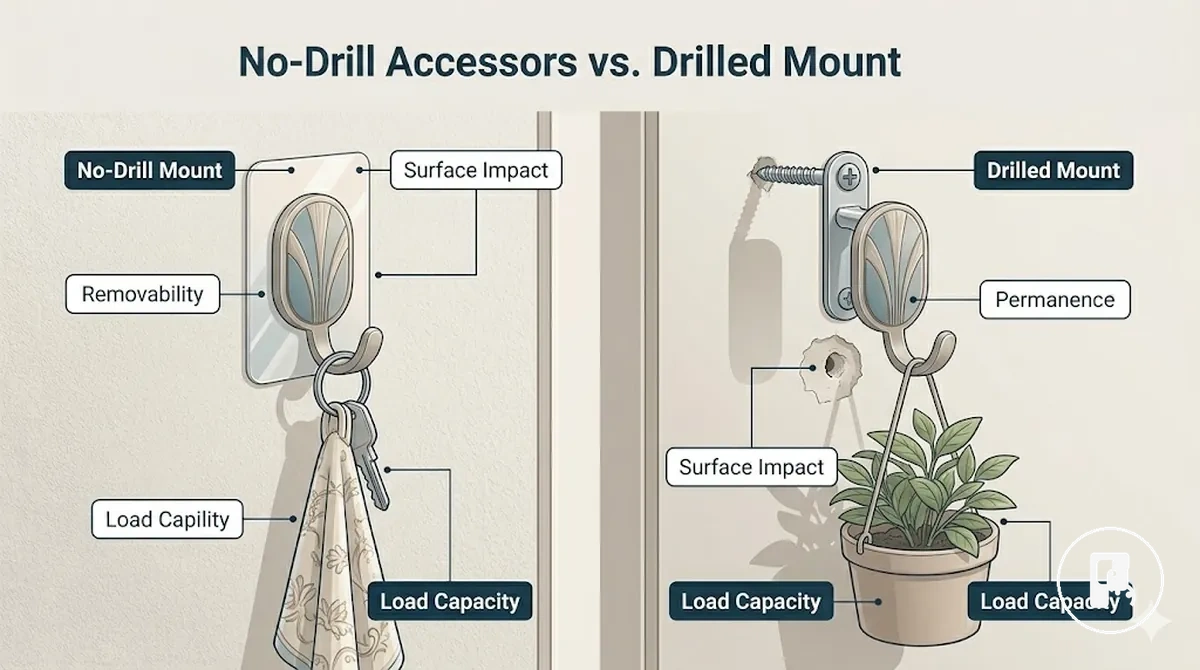
No-drill accessories and drilled alternatives differ mainly based on permanence, load handling, surface damage, and removability. No-drill accessories are typically used for temporary setup needs with lower surface impact, while drilled alternatives are chosen when higher holding strength and long-term stability are required. The core trade-off is between easier removal with lower surface impact and stronger permanent fixation with greater surface alteration.
Myth suggests no-drill accessories and drilled alternatives serve the same level of load and durability needs, but in practice their suitability depends on use conditions. Drilled alternatives generally provide higher holding strength and better support for permanent installations, especially where weight or stability demands are higher. However, this does not make them universally better, as no-drill options may still be more suitable for temporary setups or renter-friendly use cases.
No-drill accessories versus general drill alternatives can be better understood by comparing how each approach affects permanence, surface interaction, and use-case fit.
| Choice | Typical advantage | Main limitation | Better fit |
|---|---|---|---|
| No-drill accessories | Lower surface damage and easier removal | May have lower load capacity depending on surface and mounting method | Temporary setup and renter-friendly use |
| Drilled alternatives | Higher holding strength for fixed installations | Requires wall drilling and causes permanent surface alteration | Long-term or higher load installations |
Main mounting methods behind no-drill accessories
Main mounting methods behind no-drill accessories refer to the core systems that allow wall accessories to attach without drilling holes. These systems include adhesive, suction, tension, clip-on, and removable strip mounting method families.
In real household use, these mounting method families behave differently depending on surface condition and expected load. For example, smooth tile or glass surfaces may support suction or adhesive systems more effectively, while frame-based spaces or enclosed gaps may rely more on tension or clip-on setups. This relationship between mounting method, surface condition, and load directly influences removability and limitation in daily use.
Myth suggests all no-drill systems perform similarly across rooms, but in practice each mounting method responds differently to pressure, moisture, and surface texture. Understanding these differences is essential before choosing a solution, and more detail is available in no-drill mounting methods.
Method selection affects surface fit, load tolerance, removability, and risk of failure, so comparing them helps clarify usage boundaries before installation.
| Method | Works best on | Watch for | Typical use |
|---|---|---|---|
| Adhesive | Clean, smooth surfaces | Residue and moisture sensitivity | Light wall hooks and organizers |
| Suction | Glass, tile, glossy surfaces | Air leaks and uneven texture | Bathroom holders and temporary fixtures |
| Tension | Frames, enclosed spaces | Pressure balance and alignment | Curtain rods and temporary barriers |
| Clip-on | Rails, edges, door frames | Fit stability and movement | Edge-mounted hooks and storage |
| Removable strip | Painted or smooth indoor walls | Load limits and removal technique | Hooks and light storage units |
Adhesive strips, pads, hooks, and tapes
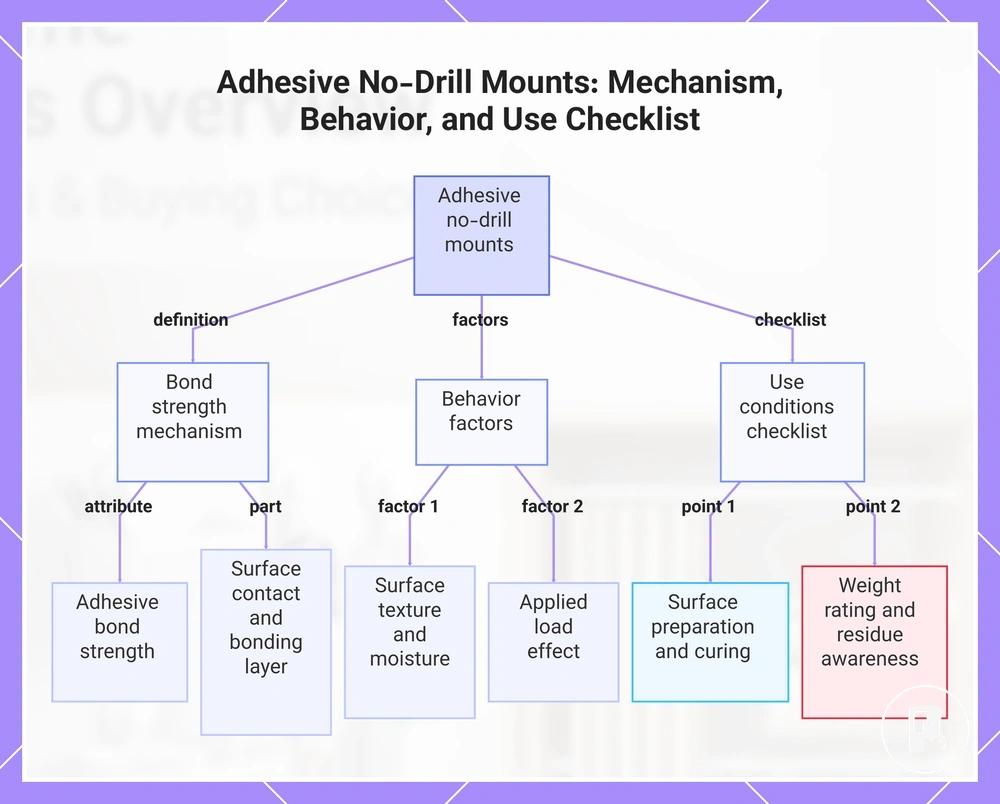
Adhesive strips, pads, hooks, and tapes refer to adhesive-based no-drill mounting components that use a bonding layer to attach accessories to a surface without drilling holes. These systems rely on adhesive bond strength and are commonly used in no-drill home accessories where installation depends on direct surface contact rather than mechanical fixing. Their performance depends on surface contact and the quality of the bonding layer, which influences stability and usage limits.
In typical home scenarios, adhesive strips, pads, hooks, and tapes behave differently depending on surface texture, moisture exposure, and applied load. For example, smooth and clean indoor surfaces may support a more stable bond, while uneven or humid environments can affect holding consistency and increase the likelihood of movement under weight. Replacement pad dependency also becomes relevant when reapplying or repositioning the accessory over time, and residue or removal risk is closely tied to surface condition and adhesive interaction.
Mini-checklist for adhesive-based use conditions:
- Clean surface condition before applying adhesive for stable bond formation
- Dry surface condition to reduce moisture-related bond weakening
- Proper curing time to allow adhesive strips or pads to stabilize
- Appropriate weight rating alignment with expected load
- Awareness of residue risk based on surface type and adhesive strength
- Availability of replacement pad for reapplication or repositioning needs
This chart explains what adhesive no-drill mounts are, how their performance depends on surface and load factors, and the key conditions for proper use.
Suction, tension, and clip-on mounting
Suction, tension, and clip-on mounting are non-adhesive no-drill methods that rely on different physical conditions to stay functional on a surface. Suction depends on a smooth surface with an airtight seal, tension depends on opposing surfaces or a frame under pressure, and clip-on mounting depends on fitting securely onto rails or edges where structural contact is available.
In real use, these methods behave differently because each one is tied to a specific physical setup. Suction may lose effectiveness when the surface is not smooth enough for a stable seal, tension may shift if frame pressure is not evenly maintained, and clip-on may not hold if the rail or edge does not match the required fit. Even though all three avoid drilling, they are not interchangeable due to these distinct surface and structural dependencies.
The differences between suction, tension, and clip-on mounting can be summarized based on required condition, typical use, and main limitation.
| Method | Required condition | Common use | Main limitation |
|---|---|---|---|
| Suction | Smooth surface with airtight seal | Glass and tile bathroom accessories | Weak performance on uneven or textured surfaces |
| Tension | Opposing surfaces or stable frame pressure | Curtain rods and temporary partitions | Can loosen if pressure balance shifts |
| Clip-on | Compatible rails, shelves, or edges | Door or shelf edge storage | Limited by fit compatibility of edges and frames |
Surface compatibility and damage-free limits
Surface compatibility and damage-free limits refer to how no-drill accessories depend on surface condition as much as the accessory itself. Tile, glass, painted walls, laminate, textured walls, and porous surfaces each behave differently, and these differences shape surface compatibility and overall surface fit. In practice, surface condition changes fit and stability, rather than the accessory functioning the same across all wall types.
In real use scenarios, smooth surfaces like tile and glass tend to support more stable contact, while textured walls, porous surfaces, and damp areas introduce limits due to uneven structure or moisture exposure. Painted walls and weak coatings may initially hold an accessory but can shift under load or show instability depending on surface condition. This separation between smooth and irregular surfaces helps distinguish basic compatibility from constrained usage conditions.
Myth suggests no-drill accessories are uniformly damage-free across all wall types, but damage-free limits depend on coating strength, moisture, and surface structure. Even when an accessory holds, removal risk or paint lift can still occur depending on surface behavior, which is why surface compatibility for no-drill accessories must be evaluated through real surface conditions rather than assumptions.
Compatibility across common surfaces can be summarized by comparing method suitability, surface condition, and expected limitations.
| Surface | Better no-drill method | Main condition to check | Risk or decision |
|---|---|---|---|
| Tile | Suction or adhesive | Smooth sealed surface | Generally stable if surface is even |
| Glass | Suction | Airtight smooth contact | May lose hold if seal breaks |
| Painted walls | Adhesive strips or pads | Coating strength | Possible paint lift on removal |
| Laminate or finished wood | Adhesive or clip-on | Surface finish integrity | Performance varies by coating type |
| Textured walls | Tension or clip-on | Structural grip points | Weak or inconsistent contact possible |
| Porous surfaces | Limited suitability | Material absorption | Unstable bonding or hold |
| Damp areas | Suction or selected adhesive | Moisture exposure level | Reduced stability under moisture |
Smooth tile, glass, painted walls, and finished surfaces
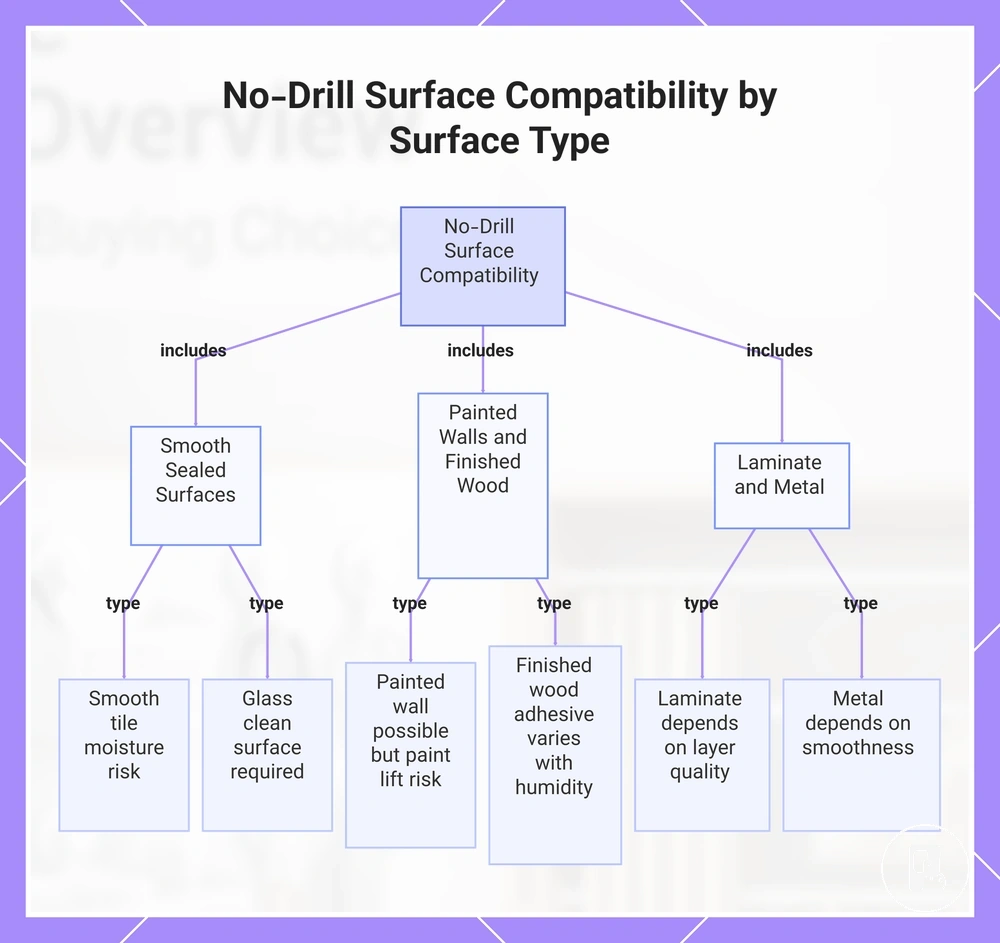
Smooth tile, glass, painted wall, finished wood, laminate, and metal define surface compatibility for no-drill accessories based on coating stability and surface smoothness. Smoother and more sealed surfaces often support suction or adhesive fit more consistently, while coating stability and surface condition determine how reliably contact can be maintained under load.
In dry rooms, smooth tile and glass often provide more predictable contact for no-drill mounting, while moisture exposure in bathrooms can reduce consistency depending on surface condition. Finished wood, laminate, and metal vary in behavior based on coating stability and local surface finish, and these differences affect both grip and long-term hold. Painted wall conditions may support adhesive-based placement in some cases, but removal risk such as paint lift can increase depending on coating strength and surface condition.
- Smooth tile: Usually supports suction or adhesive due to sealed surface, but moisture exposure in bathrooms may influence hold stability.
- Glass: Typically works well with suction-based mounting on clean smooth surfaces, depending on airtight contact.
- Painted wall: May support adhesive contact, but coating stability directly affects removal risk and potential paint lift.
- Finished wood: Adhesive fit varies with coating condition and surface finish, especially under changing humidity.
- Laminate: Performance depends on surface layer quality and coating stability, which may affect long-term grip.
- Metal: Can support suction or adhesive in some cases, depending on smoothness and surface condition.
This chart shows the main surface types and their key compatibility conditions for no-drill mounting.
Textured, porous, damp, or weak surfaces
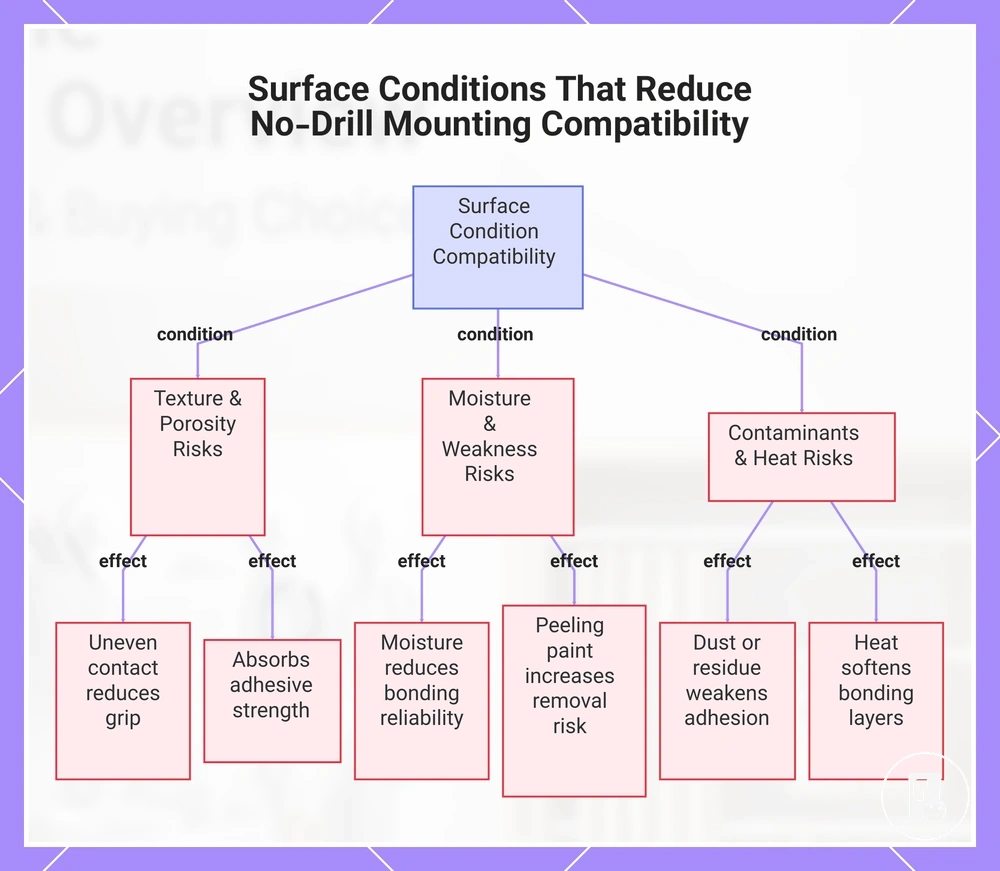
Textured surface, porous surface, damp surface, and weak surface conditions reduce no-drill compatibility because surface condition often affects hold more than the accessory itself. In many cases, dust, moisture, heat, peeling paint, and cleaning residue increase hold risk, making surface condition the main factor behind instability.
These surface types may still accept no-drill mounting in limited situations, but performance depends on coating stability, moisture exposure, and surface strength. When textured surface, porous surface, damp surface, or weak surface conditions are present, cautious testing is often required, and in some cases avoidance may be more suitable when instability is likely.
Caution checklist for high-risk surface conditions:
- Textured surface: uneven contact reduces grip and increases hold risk
- Porous surface: absorbs adhesive strength, weakening long-term stability
- Damp surface: moisture reduces bonding reliability and increases slip risk
- Weak surface: peeling paint or unstable coating increases removal risk
- Dust or cleaning residue: reduces surface contact and weakens adhesion
- Heat exposure: can soften bonding layers and reduce mounting stability
This chart identifies the high-risk surface conditions and their specific effects that reduce no-drill mounting compatibility, highlighting the need for cautious testing or avoidance.
Holding strength and load capacity conditions
Holding strength and load capacity conditions describe how no-drill accessories support weight based on surface condition, mounting method, force direction, moisture, and time under load. Holding strength is not a fixed promise and varies depending on how these conditions interact during use.
In practice, holding strength changes when static weight, pulling force, or repeated movement is introduced. A stable static load may behave differently from a hanging load that creates continuous force direction stress, especially when moisture exposure or long time under load affects adhesive or suction behavior. This is why failure risk increases when dynamic or wet-use conditions are present compared to simple stationary use.
Myth suggests load capacity is constant once installed, but real performance depends on mounting method, surface condition, and environmental exposure. Exact thresholds cannot be assumed across different surfaces or use cases, so evaluation must remain condition-based rather than relying on fixed values.
Load capacity changes with weight, mounting method, surface condition, moisture, and time under load, so comparison helps clarify suitability across different usage scenarios.
| Accessory/use | Attribute or criterion | Value or condition | Effect or decision |
|---|---|---|---|
| Light decor | Low weight rating, adhesive or suction | Dry, smooth surface | Suitable for stable static use |
| Towels | Medium load rating | Occasional moisture exposure | Works when surface remains stable and dry |
| Shelves | Distributed support capacity | Mounting method and surface condition dependent | Conditional stability over time |
| Rods | Tension or suction force direction load | Horizontal force and alignment requirement | Depends on balanced installation conditions |
| Higher-risk hanging needs | Dynamic load with movement | Moisture or weak surface condition present | Higher failure risk, use depends on conditions |
Light decor, towels, shelves, and heavier hanging needs
Light decor, towels, shelves, rods, and heavier hanging needs represent practical household load categories that depend on how weight, movement, and surface interaction occur during use. These load groups are not universal ratings but practical estimates that vary based on mounting method, surface condition, and usage pattern, grouping loads as practical categories.
In real use, light decor often stays in a static load state with minimal movement, while towels introduce repeated handling and moisture exposure that changes stress on the mounting point. Shelves and rods add distributed or directional load, and heavier hanging needs introduce higher force direction and higher failure consequence if the setup is not suited to the condition. This shows how static load behaves differently from frequently handled loads with movement, moisture, and failure consequence differences.
Light decor, towels, shelves, rods, and heavier hanging needs can be grouped by how load behavior changes risk levels across common household scenarios. :contentReference[oaicite:0]{index=0}
| Use case | Load behavior | Risk signal | Safer decision |
|---|---|---|---|
| Light decor | Static load, low movement | Low risk under stable conditions | Suitable for light mounting setups |
| Towels | Repeated handling, moisture exposure | Moderate wear from movement and damp use | Works when surface and mount remain stable |
| Shelves | Distributed static load | Stress from load over time and surface fit | Depends on mounting strength and surface condition |
| Rods | Directional pulling force | Risk increases with tension and imbalance | Requires stable alignment and support points |
| Heavier hanging needs | Higher load with movement | Higher failure consequence under weak support | Use only when mounting conditions are suitable |
Weight rating, surface preparation, moisture, and time under load
Weight rating, surface preparation, moisture, and time under load determine how holding strength changes after installation in no-drill accessories. Rated strength only matters when surface and use conditions support it, so actual holding performance depends on these conditions rather than the manufacturer rating alone.
In real use, weight rating interacts with surface preparation, cleaned surface quality, curing time, moisture, humidity, heat, repeated pulling, and time under load. Even when the rated load seems sufficient, weak surface prep or wet exposure can reduce stability, while long-term load duration and repeated pulling can gradually affect adhesion or grip over time.
Wet rooms, kitchens, and painted-wall conditions often change how these variables behave under daily stress, especially when humidity or surface condition is inconsistent. Understanding these factors helps clarify when to install no-drill home accessories with proper condition awareness.
Weight rating, surface preparation, moisture, and time under load influence holding strength through specific condition-outcome relationships.
- Weight rating: Sets expected load capacity, but actual hold depends on surface condition and force direction during use.
- Surface preparation: Cleaned surface improves adhesion or grip, while poor preparation increases early loosening risk.
- Moisture: Wet exposure can weaken bonding or suction stability, especially in bathroom environments.
- Curing time: Insufficient curing time may reduce bond strength and long-term stability.
- Repeated pulling: Frequent movement increases stress and can accelerate loosening over time.
- Humidity and heat: Environmental variation may affect material behavior and reduce consistency of hold.
- Time under load: Long-term load duration can gradually reduce performance depending on mounting method.
Damage-free and renter-friendly expectations
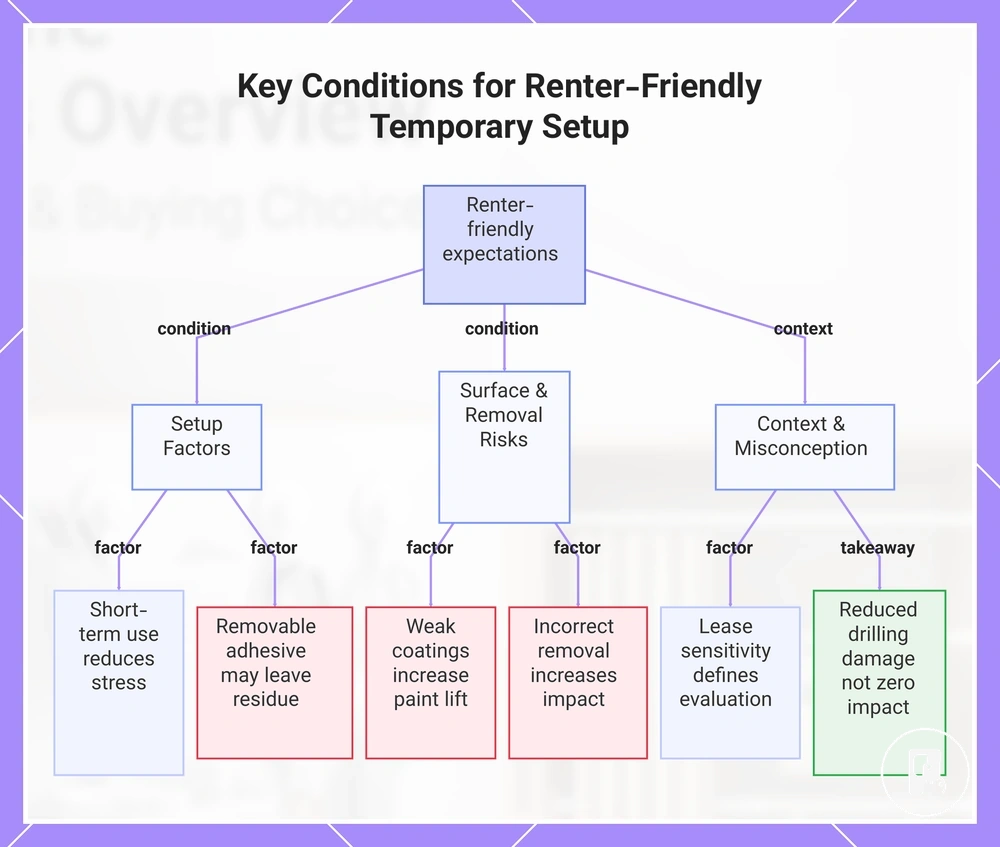
Damage-free and renter-friendly describe temporary setup use cases where no-drill accessories are expected to reduce wall impact while remaining removable under typical conditions. These expectations are conditional, and renter-friendly outcomes depend on wall condition, removable adhesive behavior, and removal method rather than being automatically guaranteed in all situations.
In real apartment use, temporary setup often relies on removable adhesive systems that may behave differently depending on wall condition, coating strength, and exposure to moisture or humidity. Residue or paint lift can still occur in some cases, especially when removal happens on sensitive surfaces, so risk is tied to both material behavior and surface condition. Lease sensitivity also influences how strictly users evaluate removal outcomes in practice.
Myth suggests that damage-free always means zero wall impact, but in practice it usually reflects reduced drilling damage rather than a guarantee of clean removal. The boundary lies between avoiding drilled holes and ensuring no residue or paint lift after removal.
To evaluate renter-friendly expectations, use the following condition-based checklist for temporary setup and removal behavior.
- Temporary setup: Suitable when short-term use reduces long exposure stress on adhesive and wall surfaces.
- Removable adhesive: May still leave residue depending on surface texture and bonding strength.
- Wall condition: Weak or painted coatings can increase paint lift risk during removal.
- Residue: Some marks may remain depending on duration and surface type.
- Removal method: Incorrect removal approach can increase wall impact even with removable systems.
- Lease sensitivity: Rental rules may define acceptable wall changes differently.
This chart shows the main factors that determine whether a temporary no-drill setup is truly renter-friendly, including setup conditions, surface risks, and common misconceptions.
Temporary wall decor, storage, curtains, and bathroom use
Temporary wall decor, storage, curtains, and bathroom use refer to common renter-friendly applications of no-drill accessories where expected load, mounting method, and surface condition shape suitability. These use cases depend on temporary setup behavior, adhesive strength, and surface interaction rather than a fixed performance outcome across all environments.
In typical apartment setups, temporary wall decor often uses lightweight adhesive mounting, storage introduces higher or distributed load depending on the setup, curtains rely on tension-based mounting methods, and bathroom use is influenced by moisture and surface stability. These differences show how mounting method and surface condition affect expected load handling and removal concern across different temporary accessories.
Temporary wall decor, storage, curtains, bathroom use, and kitchen organizers vary based on expected load, mounting method, surface requirement, and removal concern.
- Temporary wall decor: Uses adhesive strips on smooth walls; low expected load; removal concern may include residue on painted surfaces depending on wall condition.
- Storage: Uses adhesive hooks or clip-on systems; medium expected load; stability depends on surface condition and long-term adhesion.
- Curtains: Uses tension rods or frame-based mounting; load depends on fabric weight; removal concern relates to pressure marks or alignment shifts.
- Bathroom use: Uses suction or moisture-resistant adhesive; exposure to humidity may reduce stability; removal concern varies with wet surface conditions.
- Kitchen organizers: Uses adhesive or hook systems; expected load varies; heat and grease exposure may affect mounting stability and removal behavior.
Clean removal and residue risk
Clean removal and residue risk refers to how no-drill accessories detach from surfaces without leaving residue, paint lift, or surface mark. This depends on adhesive type and surface coating condition, so clean removal depends on adhesive type and surface condition.
Residue risk increases when adhesive type becomes stronger over time or when surface coating is weak, aged, or exposed to humidity and heat. Removal angle and long installation duration may also contribute to paint lift or visible surface mark formation, especially on sensitive wall finishes, so these risk signals should be assessed instead of assuming consistent removal behavior.
Clean removal and residue risk can be understood through key condition-based signals that indicate possible surface impact. The checklist below highlights these risk conditions without describing removal steps.
- Adhesive type: Strong or aged adhesive may increase adhesive residue on delicate surfaces.
- Surface coating: Weak or peeling coating may raise paint lift risk during detachment.
- Humidity: Moist environments may soften bonding and increase surface mark risk.
- Heat: Higher temperature can alter adhesive behavior and increase residue likelihood.
- Removal angle: Uneven pulling direction may contribute to surface marks or coating stress.
How to compare no-drill accessory choices
How to compare no-drill accessory choices depends on structured decision criteria that balance room conditions, surface behavior, load expectations, mounting type, removability, replacement parts, and value. The goal is to compare no-drill accessory choices using consistent decision criteria rather than surface-level feature checking.
Different room conditions influence how these criteria interact, especially where humidity, surface coating quality, and usage intensity vary. A smooth and stable surface may support adhesive-based mounting type options, while higher moisture or uneven surfaces may shift suitability toward suction or tension-based solutions. These differences directly affect how fit and stability behave in real use conditions.
Comparison becomes unclear when load expectations or removability needs are not aligned with surface or mounting type selection. A choice that looks suitable on paper may create risk in practice if replacement parts availability or surface sensitivity is ignored, separating compatible setups from risky configurations.
How to compare no-drill accessory choices is easier when decision criteria are grouped into a structured evaluation model before moving into examples through how to choose no-drill home accessories.
| Decision factor | What to check | Why it matters | Better choice signal |
|---|---|---|---|
| Room | Humidity level and usage intensity | Affects long-term stability | Stable mounting in high-use or humid areas |
| Surface | Smoothness and coating strength | Determines adhesion or suction reliability | Smoother, well-coated surfaces improve fit |
| Load | Expected weight and stress type | Prevents overload or failure | Light load for adhesive, higher load needs stronger support |
| Mounting type | Adhesive, suction, tension, clip-on | Controls holding mechanism | Select based on surface compatibility |
| Removability | Residue sensitivity and wall condition | Impacts surface protection | Low-residue needs for sensitive surfaces |
| Replacement parts | Availability of pads or suction cups | Extends usable lifecycle | Easier replacement improves maintenance |
| Value | Durability vs usage requirement | Balances cost and lifespan | Higher durability for long-term use cases |
Match room, surface, weight, and removal needs
Match room, surface, weight, and removal needs depends on checking these criteria together before making a decision. The matching framework works only when room condition, surface type, weight, and removal needs are evaluated as a combined decision set, so the criteria work together.
A bathroom with moisture exposure behaves differently from a dry room with low frequency of use, and this changes how adhesive or suction-based choices perform on different surfaces. When surface and weight align poorly, stability drops, while better alignment appears when a light load is placed on a compatible surface with low removal sensitivity, as in a kitchen organizer used on a smooth, easy-to-clean wall.
Match room, surface, weight, and removal needs using a compact criteria-based checklist for decision alignment.
- Room condition: High moisture exposure or frequent use increases stress, so choose more stable mounting types in such environments.
- Surface type: Smooth surfaces support better adhesion or suction, while rough or coated surfaces may reduce reliability.
- Weight: Heavier loads increase risk, so stronger mounting types are needed when weight increases.
- Removal needs: Sensitive surfaces require low-residue options to reduce paint lift or surface marks.
- Moisture exposure: Bathrooms or wet zones can weaken adhesion and influence mounting selection.
- Replacement adhesive: Availability of pads or strips helps maintain long-term usability and stable reapplication.
When a no-drill option is not the right fit
A no-drill option is not the right fit when room conditions, surface type, weight, and usage stress create clear rejection signals such as weak surface, heavy item, constant pulling, high heat, unstable paint, wet exposure, or safety-critical mounting needs. These conditions increase failure risk and indicate unsuitable use cases where no-drill mounting may not remain stable.
When these conditions appear together, the mounting can become less reliable over time, especially under movement, heat, or moisture. In such cases, safer decisions may be needed at a high level because the combined stress exceeds typical no-drill limits for consistent holding performance.
In situations where stability or safety becomes a concern, the setup may shift into no-drill accessories falling off conditions as failure signals increase.
- Weak surface: unstable paint or fragile wall layers can reduce grip and increase detachment risk.
- Heavy item: higher load increases stress and raises failure risk over time.
- Constant pulling: repeated movement can gradually loosen adhesion or suction.
- High heat: temperature exposure may weaken adhesive or mounting stability.
- Wet exposure: moisture can reduce bonding strength and increase slip risk.
- Safety-critical: high-consequence mounting requires more secure installation methods due to failure risk.
Buying context for no-drill home accessories
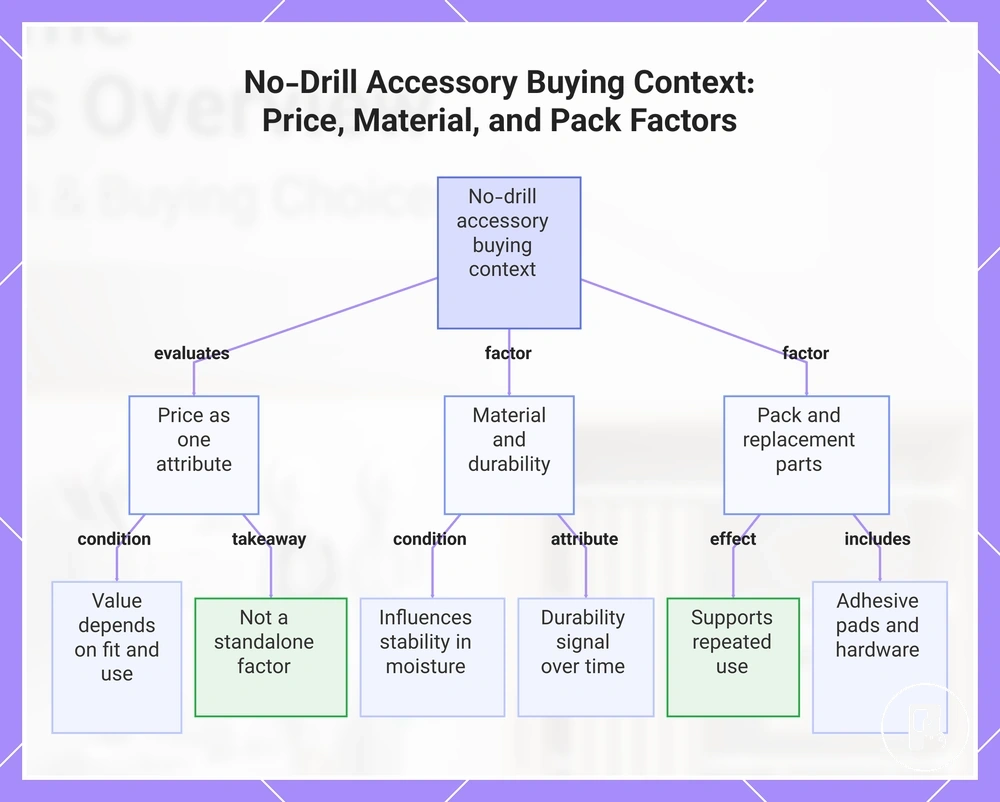
Buying context for no-drill home accessories depends on interpreting price through fit, expected use, and mounting conditions rather than treating cost alone as the main signal. Buying context becomes meaningful when price is evaluated together with material, pack quantity, replacement parts, adhesive pads, and mounting hardware, so price must be read through fit and use.
In real scenarios, bathroom or high-moisture environments often require stronger material selection and more reliable adhesive stability than dry-room setups with light use. At the same time, pack quantity may improve usability for repeated installations, while replacement parts such as adhesive pads and mounting hardware can influence continuity of expected use over time, especially when reapplication is needed.
The common assumption is that lower price automatically means better value, but value depends on durability signal, material consistency, and how the accessory performs under expected use conditions. A lower-cost option may become unsuitable if it lacks replacement parts or shows reduced stability, while a better-aligned option depends on fit and use rather than price alone.
Buying context for no-drill home accessories becomes clearer when price is treated as one attribute among multiple decision signals rather than a standalone factor.
- Price range: Indicates entry-level cost, but value depends on fit, material quality, and usage conditions.
- Pack quantity: Supports repeated or multi-room use, but only when aligned with expected use frequency.
- Material: Influences durability signal, especially in moisture or heat exposure environments.
- Replacement parts: Adhesive pads or mounting hardware can extend usable life and support reinstallation.
- Adhesive pads: Quality and availability affect stability during repeated mounting cycles.
- Mounting hardware: Impacts overall compatibility and secure attachment across different surfaces.
- Durability signal: Indicates expected performance over time under real usage conditions, not just initial appearance.
This chart shows how buying context for no-drill home accessories depends on evaluating price together with material, pack quantity, and replacement parts rather than treating cost alone as the main signal.
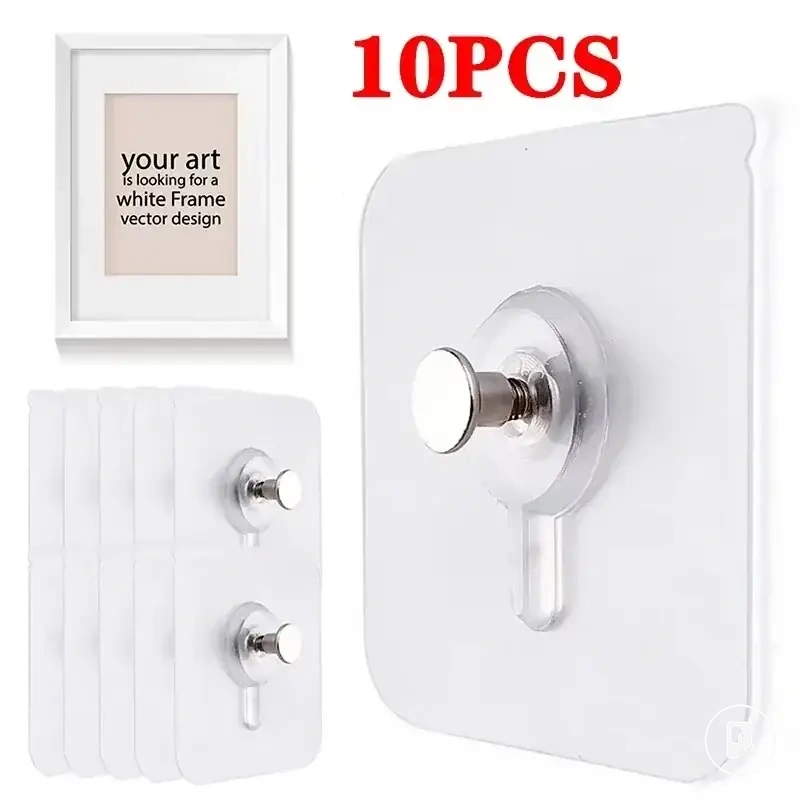
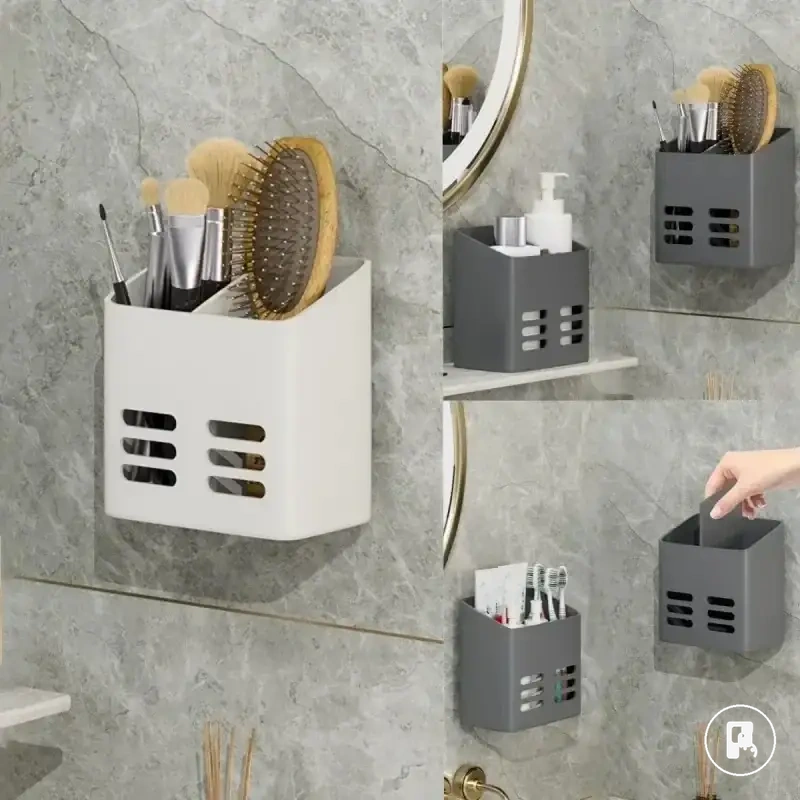
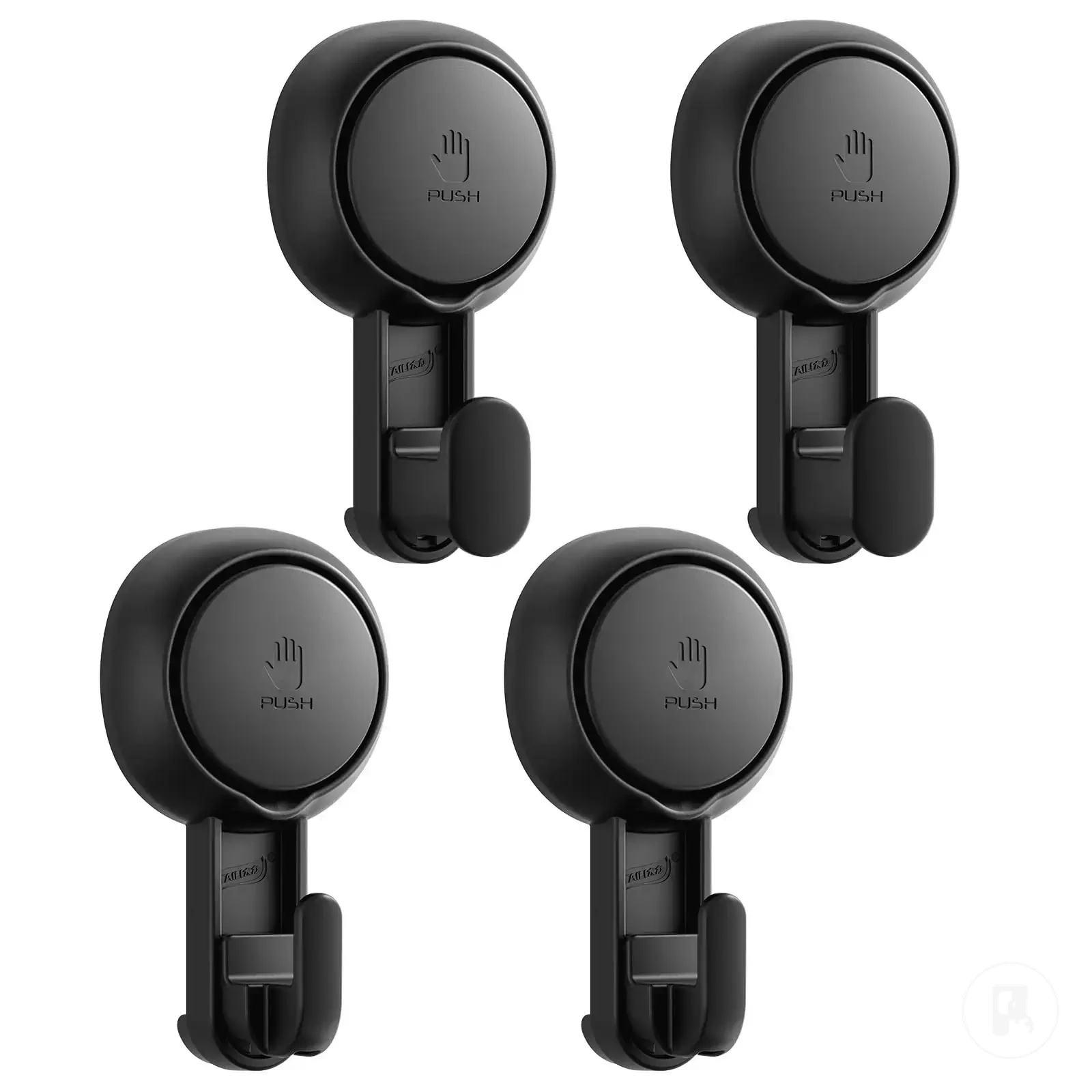
Product examples as category-level decision support
Product examples as category-level decision support are used to illustrate how no-drill accessories should be evaluated through fit, method, surface, and load rather than by product name alone. These examples are strictly illustrative and help clarify category-level decision support without turning into product-specific recommendations.
In practical use, an adhesive hook example type may align with light-load setups on smooth painted surfaces, while a suction holder example type may be more suitable for glossy tile surfaces in moisture-prone bathrooms. A tension rod example type may fit frame-based curtain setups where load distribution and mounting method differ, but each scenario still depends on surface condition, method compatibility, and expected use, along with price-check relevance as a secondary decision signal.
The assumption that product examples directly indicate better choices is misleading, because suitability depends on fit, surface behavior, and load conditions rather than product labels. These category examples remain illustrative and must always be validated against real use constraints rather than replacing proper fit evaluation.
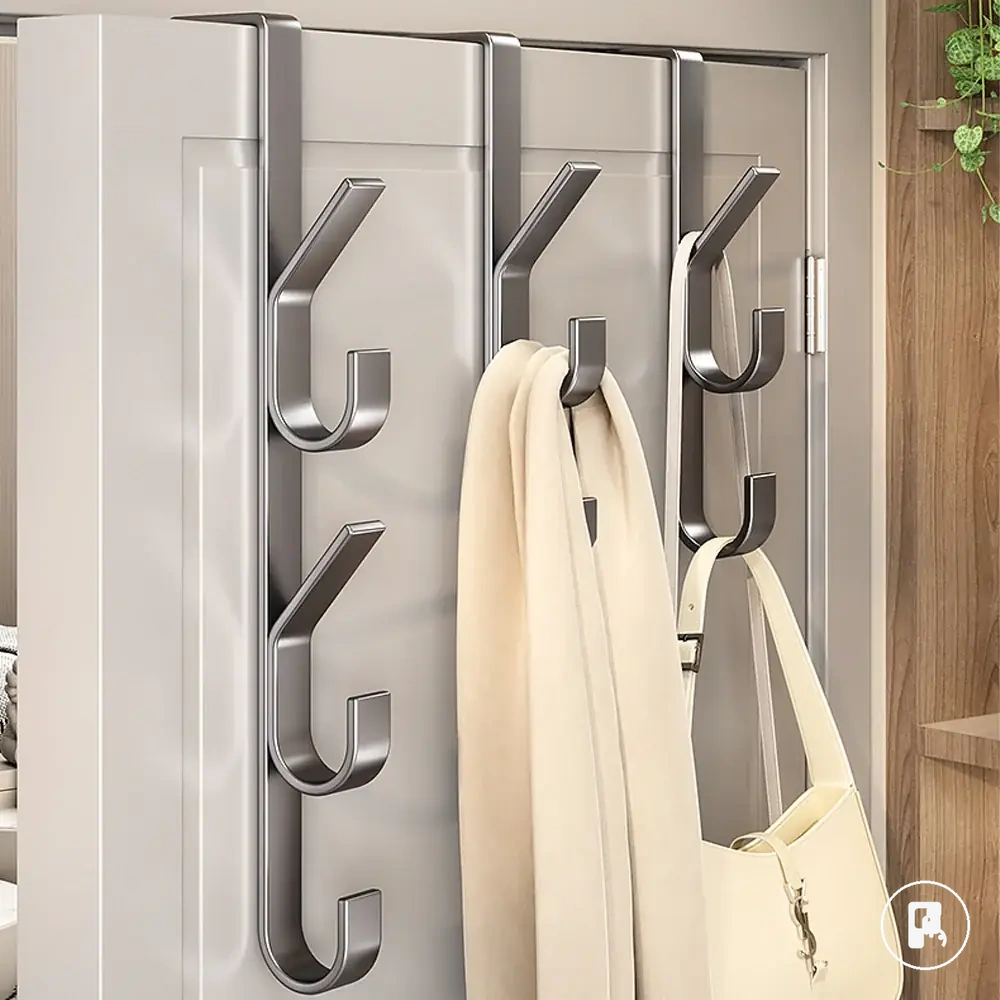
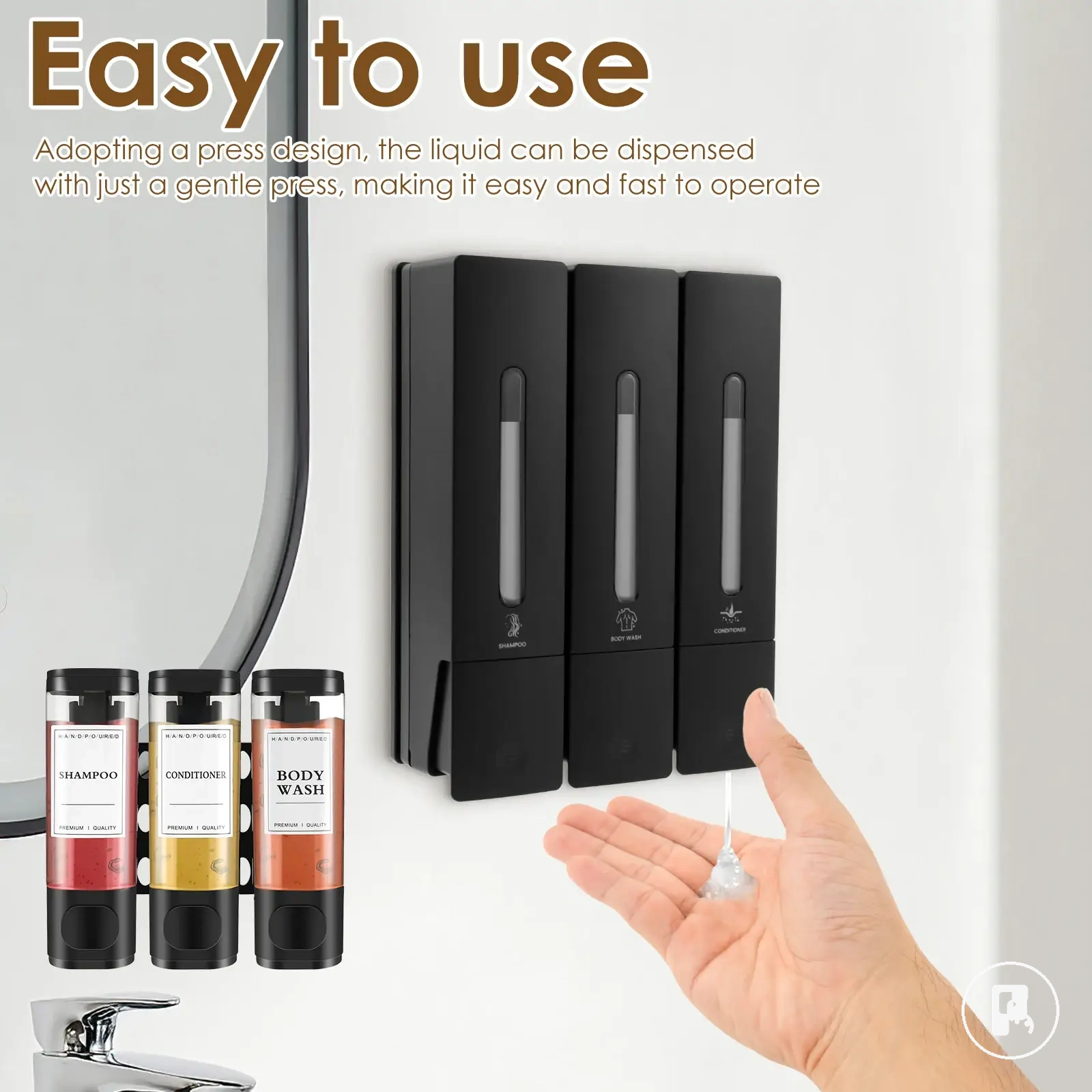
Here are product examples that may make comparison easier. Before buying, always review the compatibility criteria, essential features, and product details.
Price, quantity, material, and replacement-part signals
Price, quantity, material, and replacement-part signals define cost-value for no-drill accessories by showing what is included in the package and how often components may need replacement during expected use. These signals must be evaluated together because price alone does not represent practical value, and included parts often determine real usability over time.
In real scenarios, unit count and multipack value can support repeated or multi-area installation, especially when adhesive pads or suction replacement parts are needed during maintenance cycles. Stainless and plastic material options influence durability signal depending on environment, while waterproof claims vary in reliability based on surface and moisture conditions. Replacement-part signals such as adhesive pads or suction replacements directly affect how long the setup can remain functional under expected use.
A common misconception is that higher price automatically means better cost-value, but actual value depends on fit between material, included components, and usage requirements. Lower-cost multipacks may be useful for light temporary use, but they can become unsuitable when higher load or long-term stability is required, making fit and expected use more important than price level alone.
| Signal | What to check | Why it matters | Caution |
|---|---|---|---|
| Quantity | Unit count or multipack size | Affects reuse and installation flexibility | Higher quantity may not improve high-load suitability |
| Material | Stainless or plastic construction | Influences durability signal in different environments | Performance varies with moisture and heat exposure |
| Replacement parts | Adhesive pads or suction replacement availability | Supports long-term maintenance and reuse | Lack of replacements reduces lifecycle usability |
| Waterproof claims | Moisture resistance indication | Affects suitability in bathroom or kitchen conditions | Depends on actual surface and humidity exposure |
| Multipack value | Bundle size vs expected use | Improves cost-value for repeated installations | May be unnecessary for single or low-frequency use |