
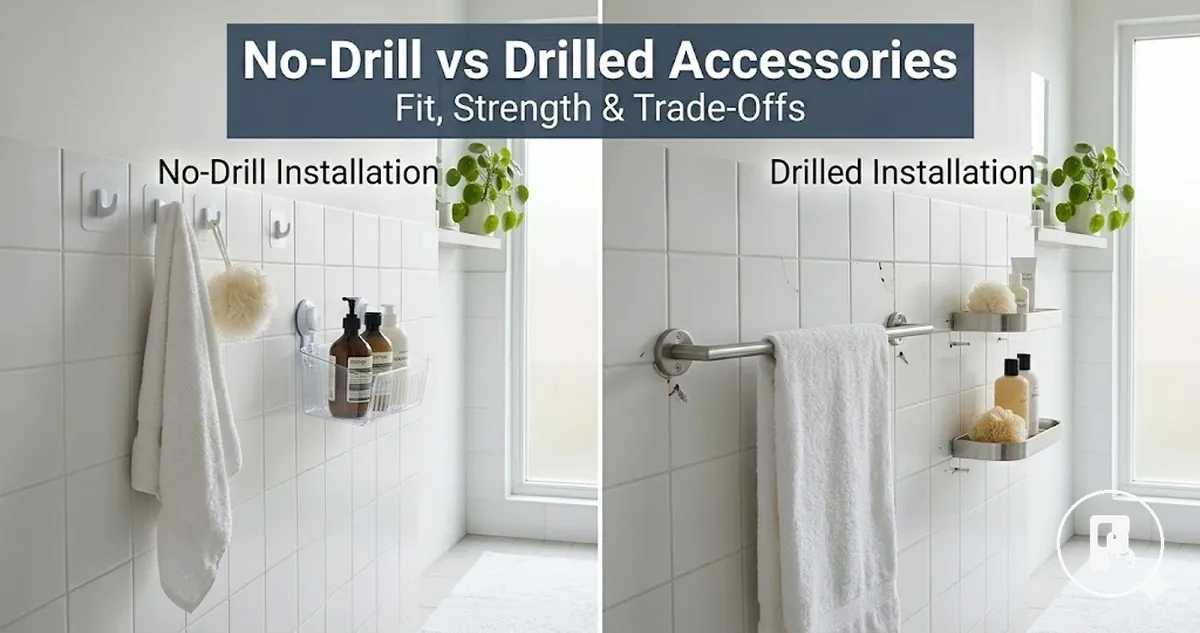
No-drill vs drilled home accessories compared
No-drill home accessories vs drilled accessories differ in a trade-off between flexibility and permanence, where no-drill options usually prioritize removable mounting and surface protection, while drilled fixing prioritizes mechanical stability through screws and anchors. This creates a clear decision split based on how much surface damage and how much load confidence the installation needs to handle. The main choice depends on balancing surface sensitivity, load, and permanence expectations.
No-drill home accessories refer to mounting method systems that use adhesive or suction to attach to a surface without creating holes, while drilled accessories rely on screws and anchors that mechanically fix into the surface. Adhesive and suction-based mounting tends to emphasize removable behavior and reduced surface alteration, while mechanical fixing emphasizes deeper structural engagement with the wall or base material. These two approaches are primarily compared through fit, strength under load, surface damage, and permanence of installation.
In renter environments or smooth finished surfaces, no-drill home accessories are often selected because removable mounting can reduce visible damage and allow repositioning. In contrast, drilled accessories are more commonly used in permanent setups or heavier fixture scenarios where load demands and long-term reliability become more important. Surface type, finish sensitivity, and expected movement over time strongly influence which mounting method fits better in practice.
Neither mounting method should be treated as universally superior, because performance depends on surface condition, installation quality, load distribution, and environmental stress over time. Each option involves trade-offs between damage risk, removability, and structural permanence, which must be evaluated against the specific use case rather than assumed as fixed outcomes.
How no-drill and drilled mounting differ
No-drill mounting and drilled mounting differ at the mechanical level in how they transfer load to a surface, with no-drill mounting relying on adhesive or suction contact and drilled mounting relying on screws and anchors embedded into the surface. No-drill systems distribute holding force through surface contact area, while drilled systems transfer force into the substrate through fixed penetration points. This difference in holding logic directly shapes surface dependency, removability behavior, and long-term permanence under load conditions.
How no-drill and drilled mounting differ becomes clearer when comparing adhesive or suction-based attachment against screw or anchor fixing under real surface conditions. Adhesive and suction systems depend heavily on smooth surfaces and consistent contact, while screws and anchors depend on the internal strength of the substrate rather than surface finish alone. In this context, no-drill home accessories typically align with removable mounting needs, whereas drilled systems align with fixed mounting requirements where mechanical fastening is prioritized. This distinction explains why similar-looking accessories can behave differently once load and movement are applied.
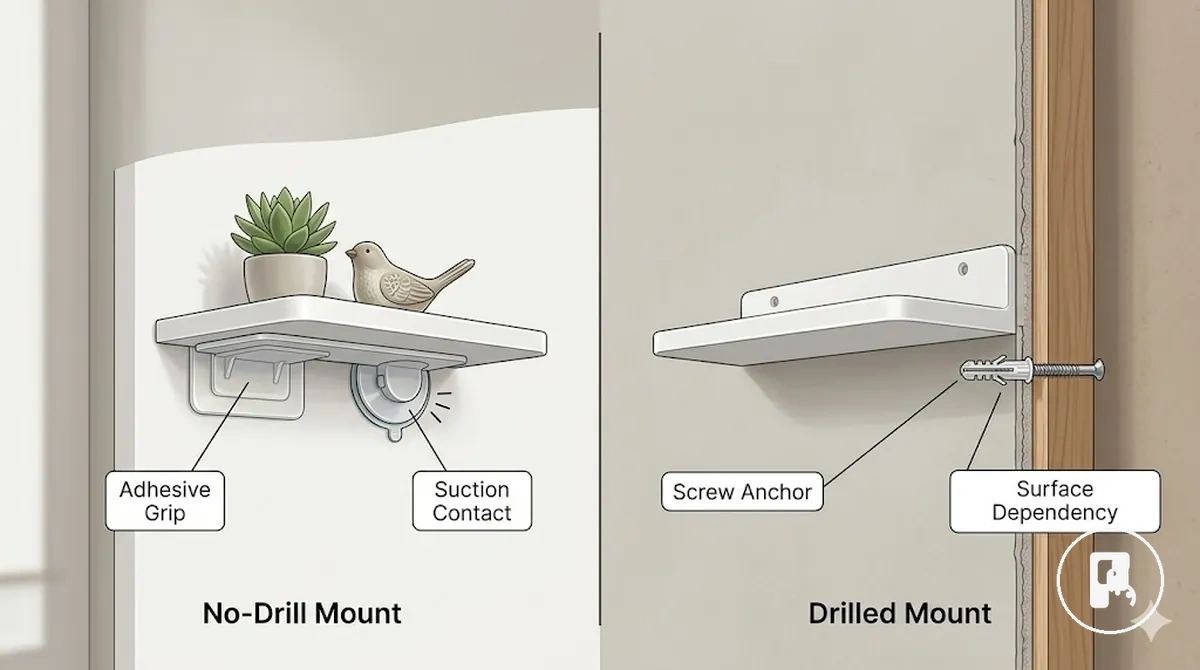
The visible similarity between no-drill and drilled installations does not indicate identical holding behavior, because the underlying mounting method determines how load is carried and how movement is absorbed over time. Adhesive or suction-based systems respond differently to stress compared to screw and anchor-based systems, especially when surface conditions and installation quality vary. How no-drill and drilled mounting differ becomes clearer in the comparison block below, which focuses on holding mechanisms rather than product types. The table compares attachment logic, surface dependency, removability behavior, and typical use context.
| Mounting route | What holds it | What it depends on | Practical trade-off |
|---|---|---|---|
| No-drill (adhesive or suction) | Surface contact adhesion or air pressure seal | Smooth surface and contact area | More removable but more sensitive to surface condition |
| Drilled (screws or anchors) | Mechanical fastening into wall substrate | Material strength and anchor placement | More permanent fixing with higher surface alteration |
Removable no-drill mounting without permanent holes
Removable no-drill mounting refers to a non-permanent mounting method that uses adhesive or suction to attach fixtures without creating holes in the surface. It depends on surface contact rather than mechanical fastening, so performance is shaped by contact area and surface smoothness. This makes its behavior closely tied to how well the adhesive or suction interface matches the surface condition.
Removable no-drill mounting without permanent holes reduces structural alteration because it does not require drilling into the surface.
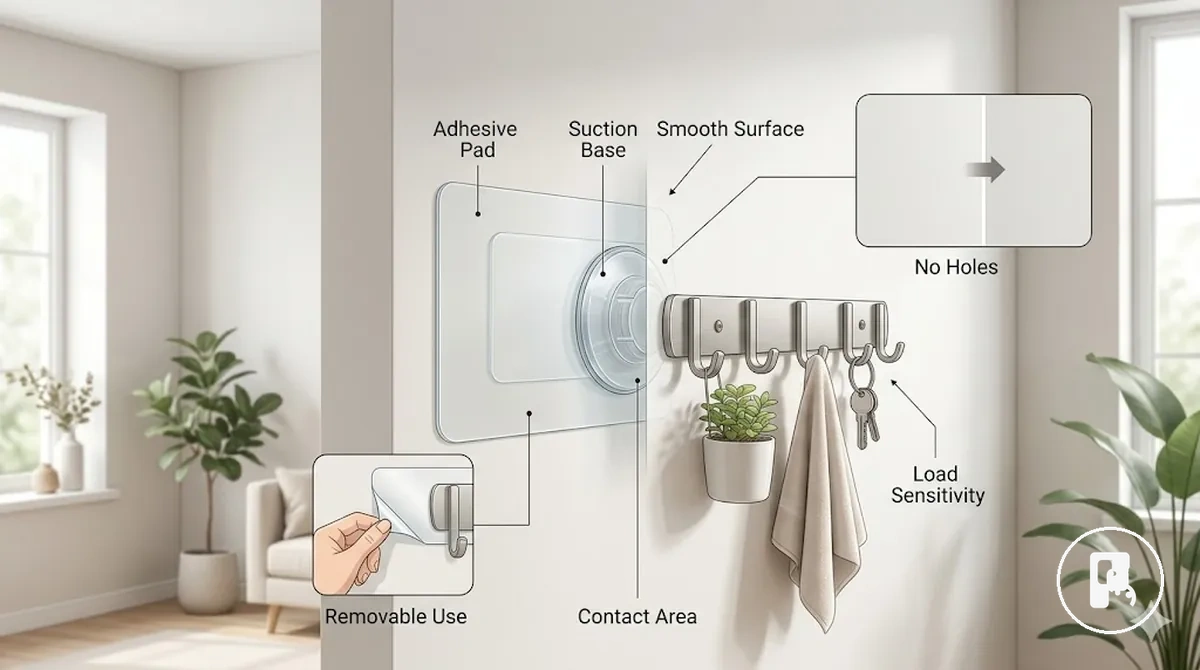 However, the absence of holes does not eliminate all surface effects, since adhesive type, suction quality, surface age, and load can influence residue or paint lift during removal.
Removable no-drill mounting without permanent holes depends on several local factors that determine how stable and reversible the attachment remains under real use conditions.
- Adhesive contact: performance depends on clean surface contact area and bonding consistency
- Suction seal: stability depends on smooth surface and airtight interface
- Surface condition: aging or uneven paint can affect removal outcome and residue risk
- Load sensitivity: higher movement or weight can increase failure or shift risk
Drilled fixing through the mounting surface
Drilled fixing refers to a mechanical fastening method where screws and anchors pass through a surface to secure an accessory into the substrate. It creates a hole in the mounting surface and relies on embedded anchors or plugs for mechanical fastening and load transfer into the wall material. This direct connection between screws, anchors, and substrate defines how drilled fixing distributes load and maintains attachment through the surface.
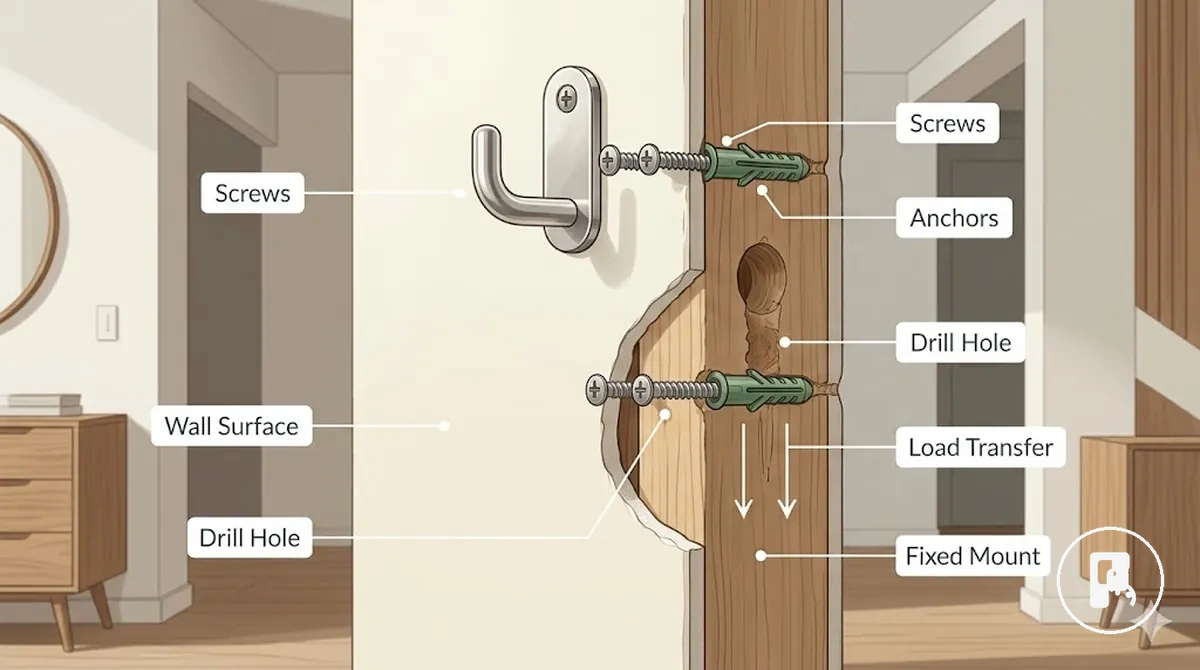
Drilled fixing through the mounting surface is generally associated with a more permanent setup because removal leaves a hole that requires repair in the substrate. Screws and anchors determine how securely the load is supported, and this depends on substrate condition, fixture weight, and installation quality. A light hook may require minimal mechanical fastening, while a heavier fixture places higher load transfer demands on anchors and increases the repair consideration after removal.
| Holding confidence Mechanical fastening via screws and anchors transfers load into the substrate |
Surface impact Creates a hole in the mounting surface and requires repair after removal |
Fit conditions that affect each mounting choice
Fit conditions depend on surface, room condition, use duration, and accessory weight when selecting between no-drill and drilled mounting. These factors determine how each mounting route behaves in real home contexts, especially in terms of stability, suitability, and long-term holding behavior. A mounting choice is rarely universal and changes based on these conditions.
In renters and temporary setup scenarios, removable no-drill mounting is often preferred when the surface is smooth and the accessory load is light, since it reduces permanent alteration and repair risk. In contrast, drilled fixing is more often aligned with permanent setup needs where accessory weight is higher or long-term stability is required. Room conditions such as moisture, heat, or frequent contact can further influence how each mounting route performs in practice.
Fit conditions can be evaluated by separating surface type, environment, load, and permanence needs, which helps clarify when each mounting choice becomes more suitable. This structured view supports comparing no-drill and drilled options without assuming one works universally across all home situations.
The table below organizes fit conditions for choosing between mounting routes based on common home contexts.
| Use context | Fit condition | No-drill implication | Drilled implication |
|---|---|---|---|
| Smooth surfaces | High contact potential | Often suitable with adhesive or suction | Optional unless load increases |
| Textured walls | Reduced surface contact | May reduce hold reliability | Better anchor bite for stability |
| Wet rooms | Moisture exposure | Performance may vary with adhesion | More stable when properly anchored |
| Light temporary accessories | Low load and short use duration | Often suitable for removable setup | Usually unnecessary |
| Permanent heavier fixtures | Higher load and long-term use | May lack sufficient stability | Preferred for mechanical load support |
Surface texture, material, and finish
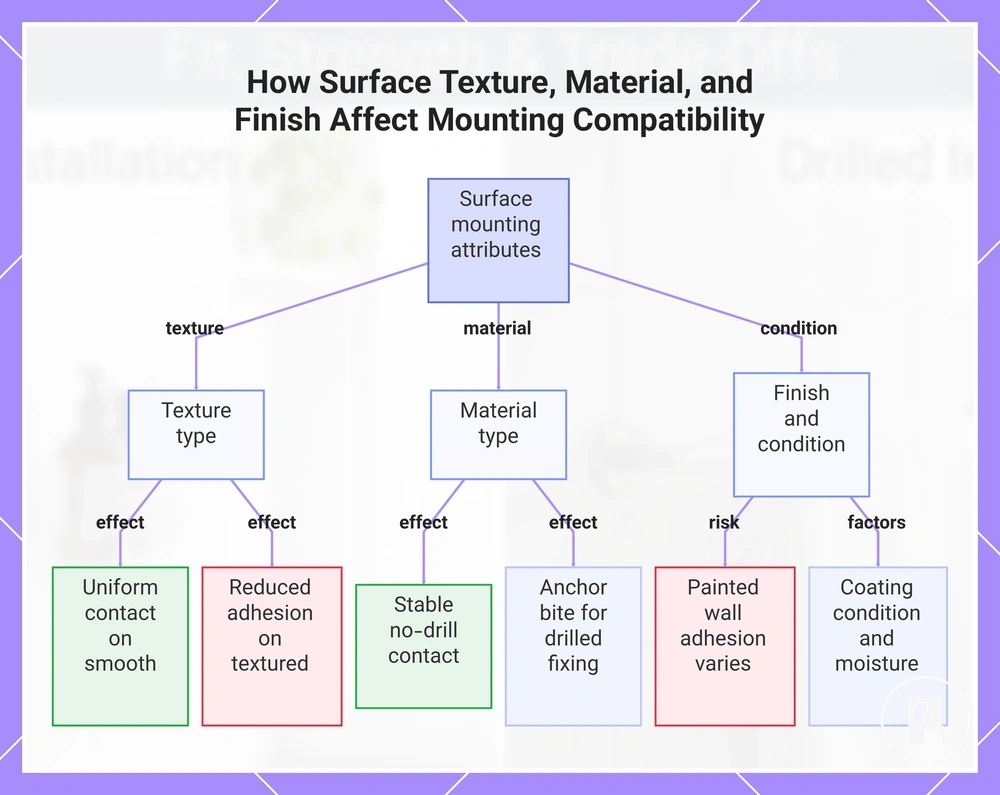
Surface texture, material, and finish determine how no-drill and drilled mounting behave because they directly influence adhesion, suction stability, and anchor bite. These surface attributes affect how force is distributed between the accessory and the substrate, which changes holding reliability under different use conditions. Surface texture, material, and finish therefore act as primary fit conditions for compatibility evaluation.
On smooth tile and glass, adhesion and suction tend to perform more consistently due to uniform contact and reduced surface interruption. On painted wall, porous surface, or uneven finish, adhesion may weaken because of absorption, coating variation, or reduced contact stability, while drilled fixing may achieve stronger anchor bite depending on substrate density. However, surface condition such as coating age, cleanliness, and finish quality can significantly alter both no-drill and drilled behavior.
Surface texture, material, and finish can be evaluated using a focused checklist that maps surface condition to expected mounting response without assuming universal compatibility.
- Surface texture: smooth surfaces support better adhesion and suction contact, while textured surfaces reduce contact area and increase failure risk
- Material: smooth tile and glass generally allow more stable no-drill contact, while porous surface materials often depend more on anchor bite for drilled fixing
- Finish: painted wall finishes may vary in adhesion stability and can increase residue or paint lift risk depending on coating quality
- Condition factors: cleanliness, age of coating, and moisture exposure can change both adhesion performance and drilled stability
- Compatibility note: suitability depends on combined surface texture, material, finish, and accessory load rather than a single attribute
This chart shows how surface texture, material, and finish determine the performance of no-drill and drilled mounting methods, including key condition factors.
Moisture, heat, and daily contact conditions
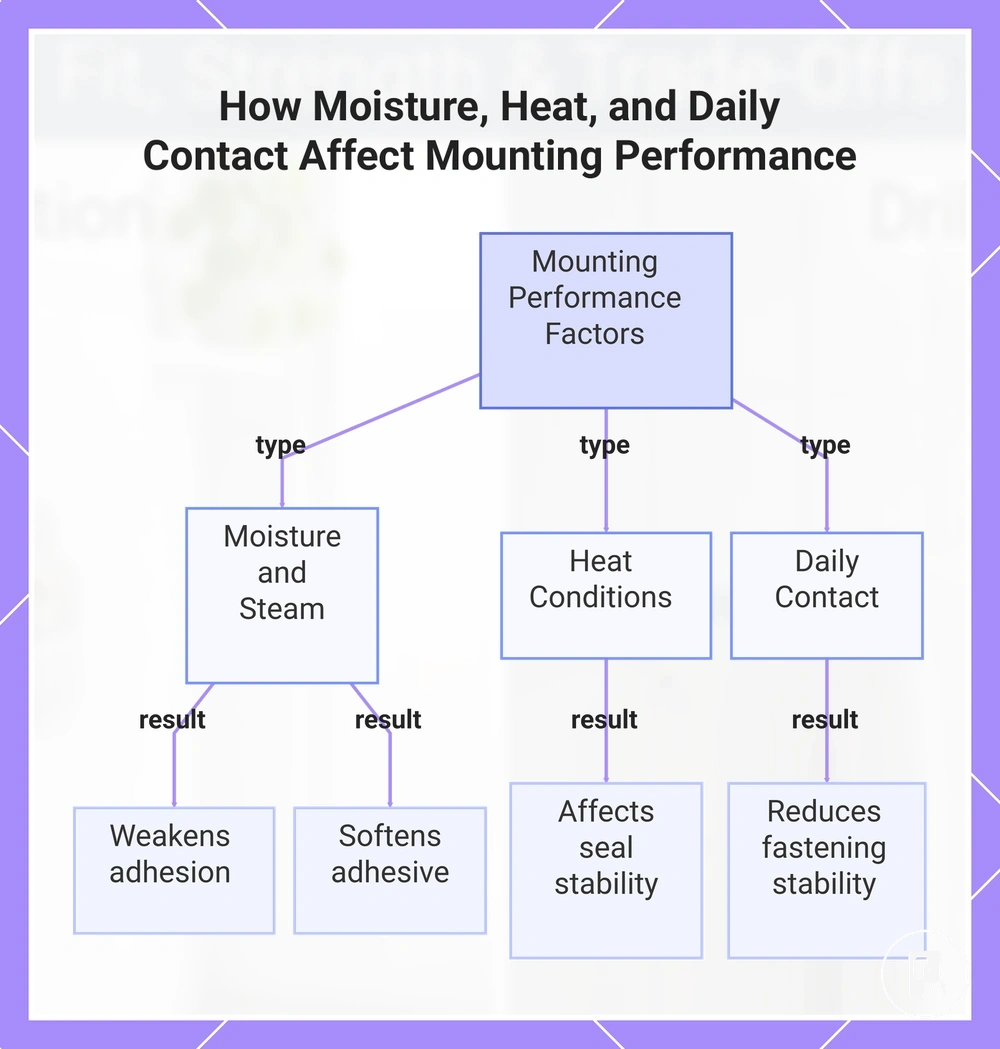
Moisture, heat, and daily contact conditions affect mounting performance over time by changing how room condition stress interacts with adhesion, suction, and fastener stability. In bathrooms, kitchens, and frequently used entry areas, humidity, steam, heat, and repeated interaction create variable load patterns that can influence long-term holding behavior. These environments combine environmental exposure with frequent physical use.
Moisture, heat, and daily contact conditions can gradually alter hold depending on accessory weight and installation quality. Moisture and humidity may contribute to adhesive softening, while steam exposure can reduce surface stability in some cases. Heat can affect sealing behavior, and repeated pulling force from daily contact may contribute to suction loss or gradual loosening over time.
- Moisture and humidity: may weaken adhesion depending on surface condition and exposure level
- Steam exposure: can contribute to adhesive softening in high-moisture zones
- Heat conditions: may influence seal stability and surface response
- Daily contact: repeated pulling force can gradually reduce fastening stability
This chart identifies the three main environmental and usage factors that can influence mounting performance over time, along with their specific effects.
Strength and load reliability compared
Strength and load reliability depend on load, real use conditions, pull direction, contact area, anchor type, and substrate rather than a single fixed rating. No-drill and drilled mounting differ in how force is transferred, which directly affects stability under movement and repeated stress. In practice, strength is evaluated as contextual holding confidence rather than a single universal value.
In light storage scenarios such as small organizers or low-weight accessories, no-drill solutions may maintain stable holding when contact area and surface conditions support adhesion. In moderate daily-use situations, repeated movement and pull direction can introduce slippage or gradual loosening depending on real use conditions and installation quality. For outward-pull situations or heavier fixtures, drilled systems generally provide more consistent load transfer through anchor type engagement with the substrate, reducing movement under stress.
For deeper evaluation of strength behavior, it is important to consider load capacity differences as they relate to rated load, real use conditions, and force direction rather than isolated assumptions.
The table below compares how load situations affect no-drill and drilled reliability under real use conditions and failure risk patterns.
| Load situation | No-drill reliability factor | Drilled reliability factor | Decision caution |
|---|---|---|---|
| Light items | Stable when contact area and surface condition are favorable | Consistent but often more than required | Check surface compatibility before selecting no-drill |
| Daily-use items | May show gradual loosening under repeated pull direction stress | More stable under repeated handling | Consider movement frequency and usage intensity |
| Outward-pull items | Higher slippage risk depending on adhesion and surface condition | Stronger load transfer through anchor type and substrate | Evaluate force direction before selection |
| Heavier fixtures | May be limited by adhesion and contact area constraints | More suitable for sustained load reliability | Prioritize substrate strength and fixing method |
Rated load, pull force, and movement
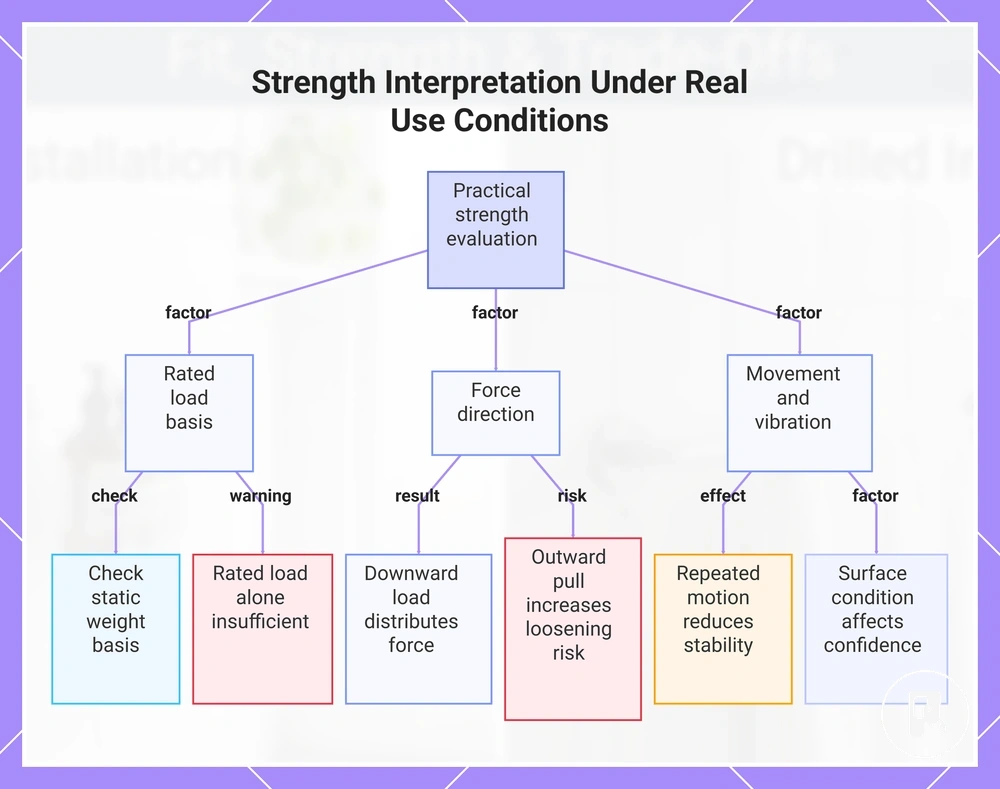
Rated load is only one input in practical strength because real reliability depends on how rated load, pull force, shear force, and movement interact under actual use conditions. Strength interpretation changes when downward load, outward pull, and vibration are applied, since each condition affects practical confidence and failure risk differently. In many cases, rated load alone does not reflect real-use behavior.
A downward load condition distributes force through shear force and contact area, which can appear stable even at higher rated load values. However, outward pull introduces pull force and movement that may increase loosening risk even when the same load claim is listed. Vibration and repeated daily movement further affect stability and can reduce practical confidence depending on surface condition and accessory weight.
Rated load, pull force, shear force, and movement should always be interpreted together when evaluating strength behavior under real use conditions.
- Rated load basis: check whether the load claim reflects static weight or real-use conditions
- Force direction: distinguish downward load from outward pull impact on stability
- Movement and vibration: assess how repeated motion may increase loosening or failure risk
- Surface condition: evaluate how contact area affects practical confidence under stress
This chart shows the key factors to consider when interpreting rated load claims for real-world strength, including load basis, force direction, and movement effects.
Long-term hold under everyday use
Long-term hold under everyday use changes after the initial mount because repeated contact, vibration, humidity, and cleaning gradually influence stability over time. In real usage like towel holders, kitchen organizers, and bathroom shelves, continuous interaction can introduce loosening, peeling, or wobble depending on how the surface and mounting method respond to ongoing stress. These changes usually develop progressively rather than immediately after installation.
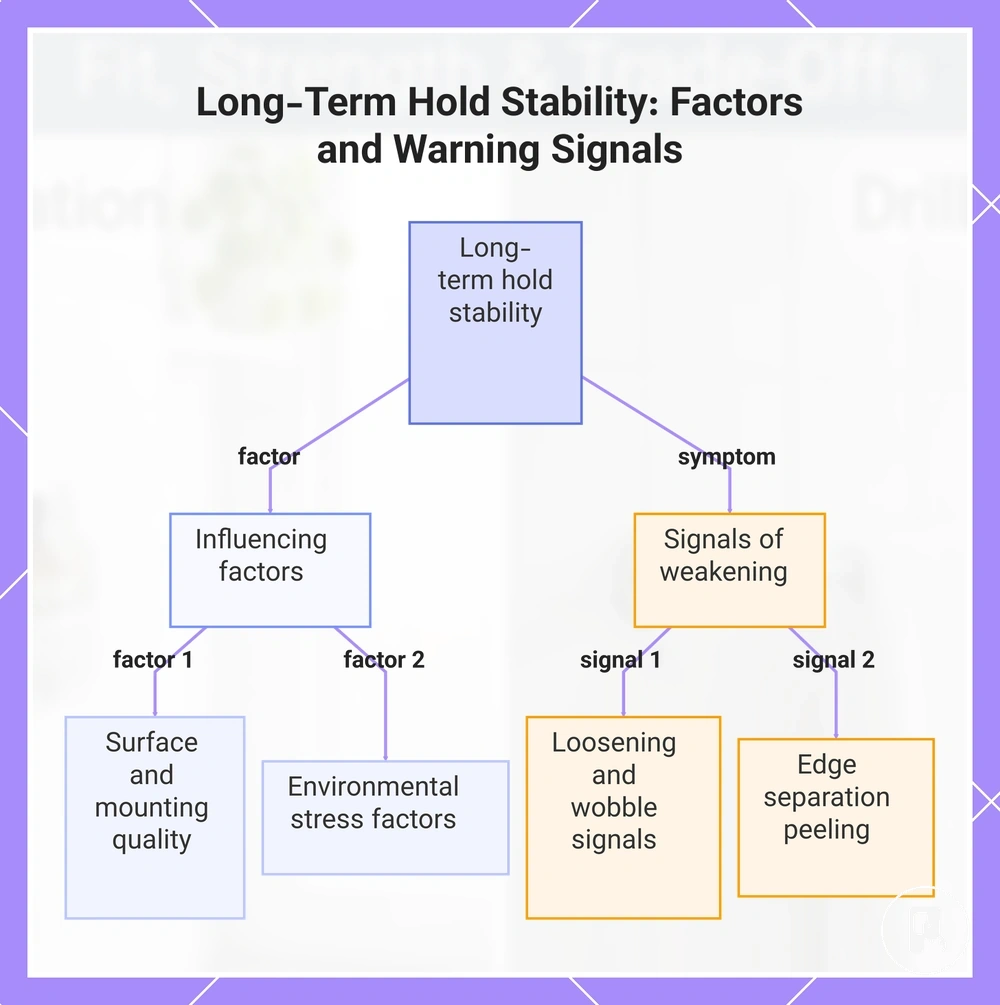
Long-term hold under everyday use depends on surface condition, humidity, cleaning frequency, vibration, and repeated contact intensity. In many cases, continued stability is maintained when these factors remain mild, but gradual weakening can appear when stress accumulates across time on the same mounting point. Differences in material response and environmental exposure determine whether the fixture maintains steady support or begins to shift slightly.
- Loosening signal: minor movement during repeated use or light pulling
- Peeling signal: edge separation between adhesive and surface
- Wobble signal: side-to-side motion during everyday interaction
This chart shows the main factors influencing long-term adhesive hold stability under everyday use and the observable signals that indicate gradual weakening.
Damage, removal, and permanence trade-offs
Damage, removal, and permanence trade-offs depend on how the mounting method changes the surface during installation and how it behaves during removal. No-drill mounting usually reduces permanent holes, while drilled mounting creates a more predictable anchor-based change through holes in the wall surface. These differences define the balance between reversibility and permanence.
In renter environments, no-drill options are often preferred to reduce renter risk linked to holes, patching, and visible surface change on painted walls, although residue or paint pull can still occur depending on surface condition and removal behavior. In owned homes, drilled mounting is more commonly accepted because anchor holes and patching are treated as part of a permanent setup approach. On visible walls and high-value finishes, both approaches require careful consideration, while tile surfaces may shift the choice based on drilling feasibility and finish sensitivity.
Damage, removal, and permanence trade-offs are not absolute because both methods involve different types of surface change rather than zero-impact outcomes. No-drill solutions may leave adhesive marks or cause light paint pull in some cases, while drilled mounting introduces anchor holes that require patching as part of restoration.
Damage, removal, and permanence trade-offs comparison:
| Trade-off | No-drill implication | Drilled implication |
|---|---|---|
| Holes | No structural holes, surface generally remains intact | Anchor holes created in wall surface |
| Residue / mark | Possible adhesive mark depending on removal conditions | Minimal residue, but patching area remains after removal |
| Removability | More reversible depending on adhesion strength and surface type | Less reversible due to fixed anchor points |
| Repair effort | Lower structural repair, possible cleaning or surface treatment | Higher repair effort due to patching requirement |
| Finish risk | May affect paint or delicate finishes during removal | More predictable structural change but requires restoration work |
Clean removal and renter-friendly limits
Clean removal in renter-friendly mounting refers to lower permanent alteration risk rather than zero risk, because a removable accessory such as adhesive or suction systems can still lead to residue or paint lift depending on surface conditions and finish sensitivity. The benefit is reduced likelihood of permanent holes, not guaranteed clean removal in all cases.
Renter-friendly behavior depends on surface soundness, adhesive type, suction quality, and the removal technique used during detachment. Smooth and stable surfaces may support cleaner release, while weaker finishes or aged paint layers can increase residue or paint lift risk. The outcome also changes depending on how the removable accessory was bonded and how controlled the separation process is.
- Surface soundness: weaker or aged finishes may increase residue or paint lift risk
- Adhesive type: stronger bonding adhesives may leave more residue after removal
- Suction: loss of seal integrity can affect clean release consistency
- Removal technique: faster or uneven detachment can increase surface marks
Permanent holes, anchors, and repair needs
Permanent holes, anchors, and screws define the permanence side of drilled mounting because they create fixed points in the substrate that affect holding confidence and increase repair burden after removal. Drilled mounting typically results in permanent holes and possible visible marks, while anchors distribute load into the wall material but still leave a defined surface change once removed.
Permanent holes, anchors, and repair needs vary depending on substrate type, hole size, and fixture load, because these factors determine how much visible change remains after dismantling. Heavier fixtures often require stronger anchors, which can increase hole size and influence patching requirements. In some cases, drilled mounting is still sensible when holding confidence and load safety outweigh the later repair burden, especially in thicker or more stable substrates where anchoring is structurally justified.
- High-load fixtures: stronger anchors improve holding confidence but may increase visible marks after removal
- Soft or coated surfaces: holes and anchor points may remain more visible, increasing patching needs
- Balanced trade-off cases: drilling may be acceptable when structural load risk is higher than repair burden
Installation effort, tools, and flexibility compared
Installation effort, tools, and flexibility compared differ between no-drill and drilled mounting because setup burden and adjustability are distributed differently across each method. No-drill solutions typically reduce installation effort and tool dependency, while drilled mounting increases setup effort but offers more fixed positioning once installed. Flexibility during adjustment and repositioning also changes depending on how the system is secured to the surface.
Installation effort, tools, curing time, alignment, and repositioning vary based on surface condition and mounting type. No-drill setups often rely more on preparation quality and correct alignment before final placement, since repositioning may become limited after adhesion or suction is set. Drilled mounting usually requires tools for mechanical fixing and offers more stable alignment during placement, but reduces flexibility after anchors are fixed. In adhesive-based no-drill systems, curing time can also affect how quickly full stability is reached and how much rework is possible if alignment is off.
Temporary mounting and permanent mounting create a clear trade-off between flexibility and installation burden. No-drill options are generally more suitable for temporary mounting scenarios where repositioning and adjustment are important, while drilled systems align more with permanent mounting where stability and fixed alignment take priority over flexibility.
Installation effort, tools, curing time, alignment, and repositioning comparison:
| Setup factor | No-drill implication | Drilled implication | Decision cue |
|---|---|---|---|
| Tools | Lower tool requirement, simpler setup preparation | Higher tool requirement for mechanical fixing | Choose based on tool access and setup preference |
| Surface preparation | Requires clean and stable surface for adhesion or suction | Requires suitable substrate for secure anchoring | Surface condition influences method choice |
| Curing time | May require waiting period depending on adhesive type | Typically stable immediately after fixing | Time sensitivity affects selection |
| Alignment | More sensitive before final set | More controlled during fixed installation | Precision needs may favor drilled mounting |
| Repositioning | More flexible before final bonding or setting | Limited once anchors are fixed | Flexibility needs favor no-drill systems |
When no-drill accessories are worth choosing instead of drilling
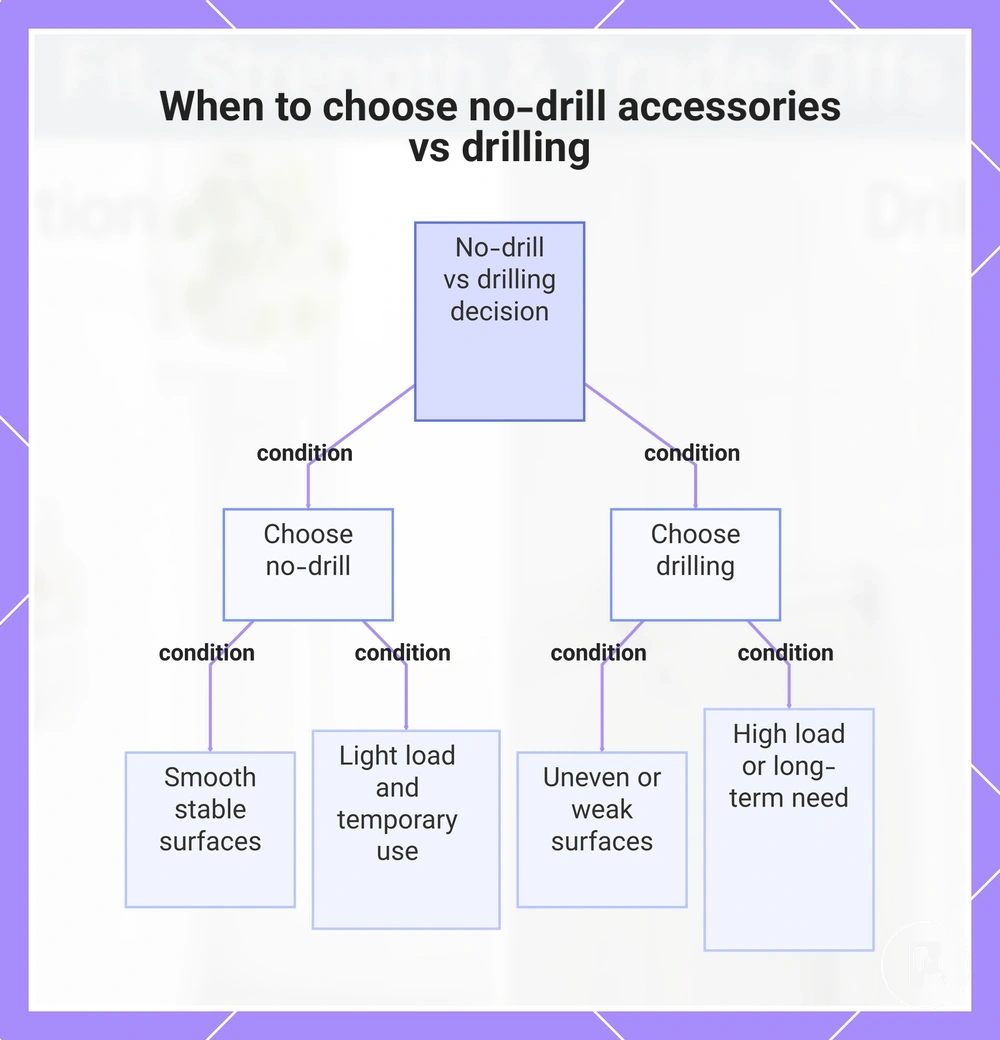
No-drill accessories are worth choosing instead of drilling when removable use, surface safety, and flexibility matter more than fixed permanence. They are typically suitable for situations where light to moderate load is expected and the installation may need to be changed or removed later. In these cases, value comes from adaptability rather than long-term structural fixing.
The decision depends on key criteria such as surface safety, load level, room condition, permanence expectations, and overall value trade-offs. Smooth and stable surfaces often support no-drill use more effectively, while uneven or weak surfaces may reduce reliability and shift preference toward drilling. Room condition and expected usage intensity also influence whether flexibility or fixed stability delivers better practical value.
Convenience can make no-drill accessories attractive, but it does not always outweigh stability requirements. In environments with higher load stress, moisture exposure, or long-term installation needs, drilling may offer more consistent outcomes even if it reduces flexibility. This creates a clear boundary where ease of use must be balanced against structural reliability and risk.
Users can choose the right no-drill option by evaluating surface condition, load expectations, and permanence needs before installation. This decision framework helps avoid situations where convenience leads to unsuitable mounting choices, especially in mixed-condition environments.
No-drill accessories are generally worth choosing when removable setup, lower surface impact, and adaptable positioning provide more value than permanent fixing. However, when conditions demand stronger long-term stability, drilled mounting may be the more appropriate choice based on overall decision criteria.
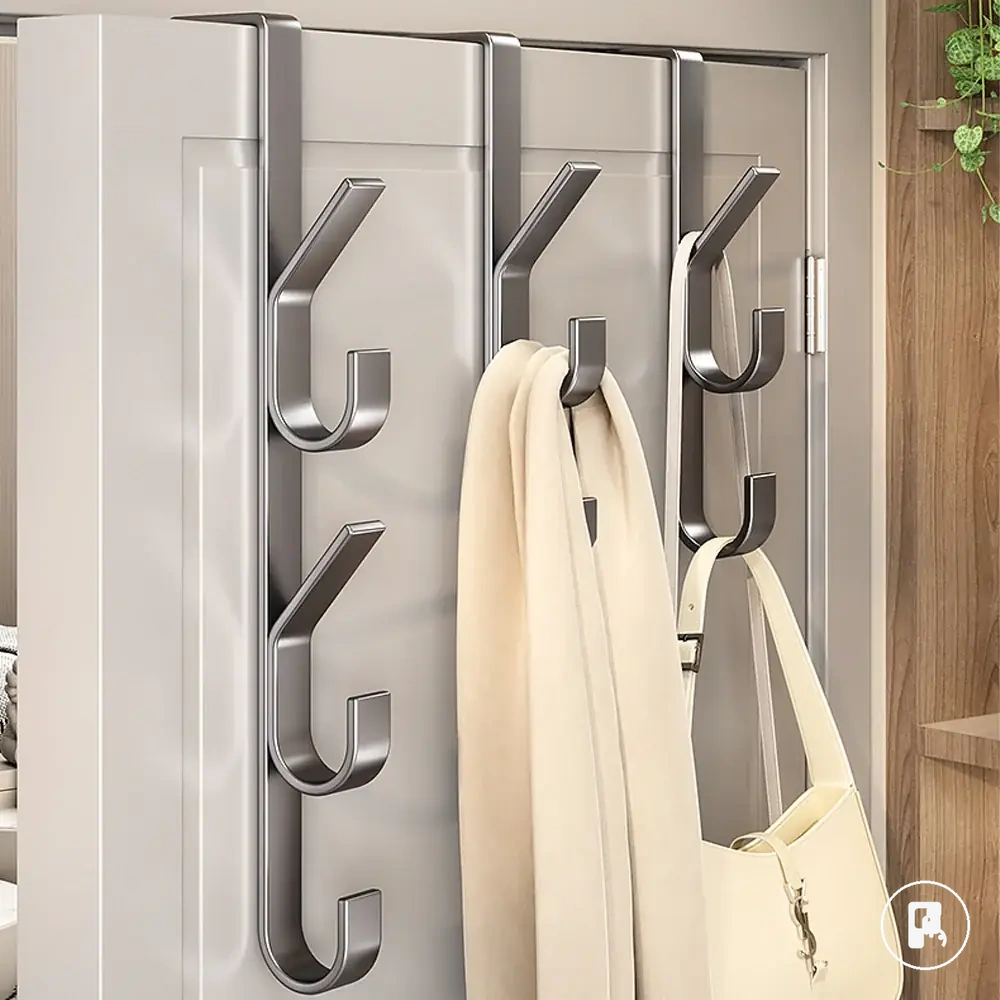
Here are product examples that may make comparison easier. Before buying, always review the compatibility criteria, essential features, and product details.
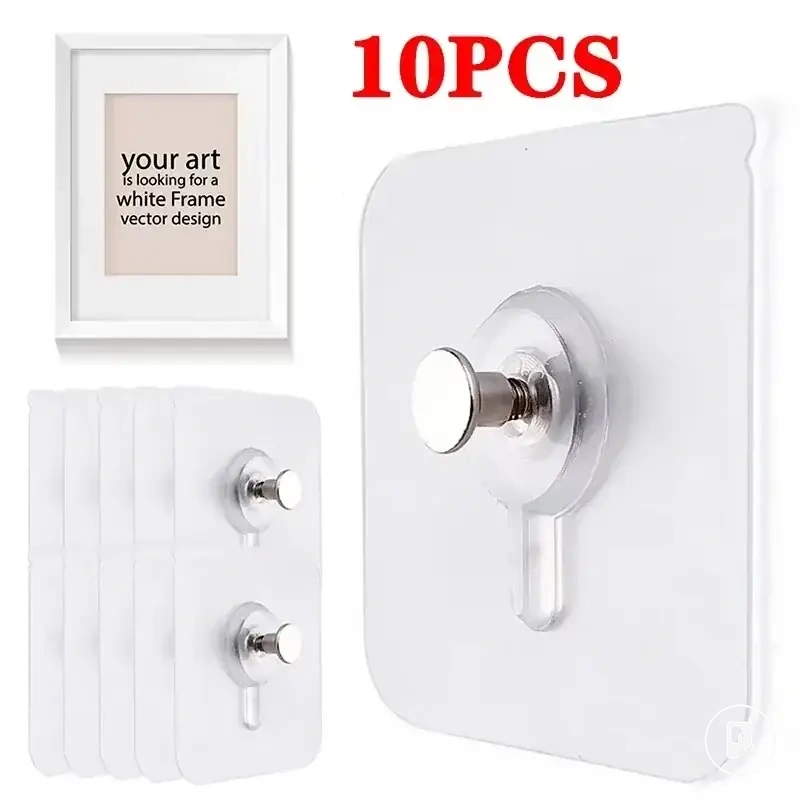
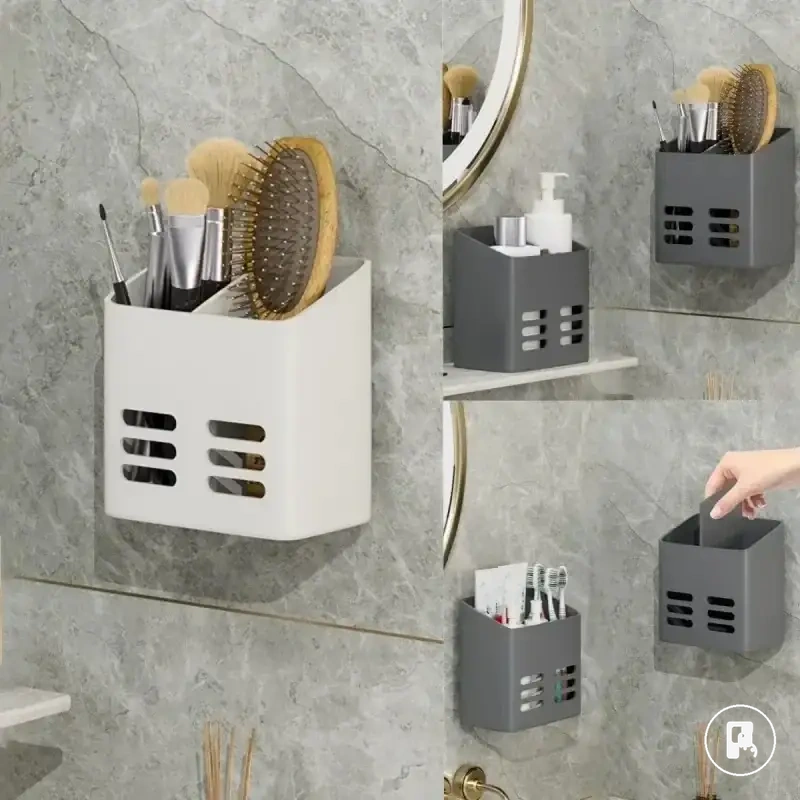
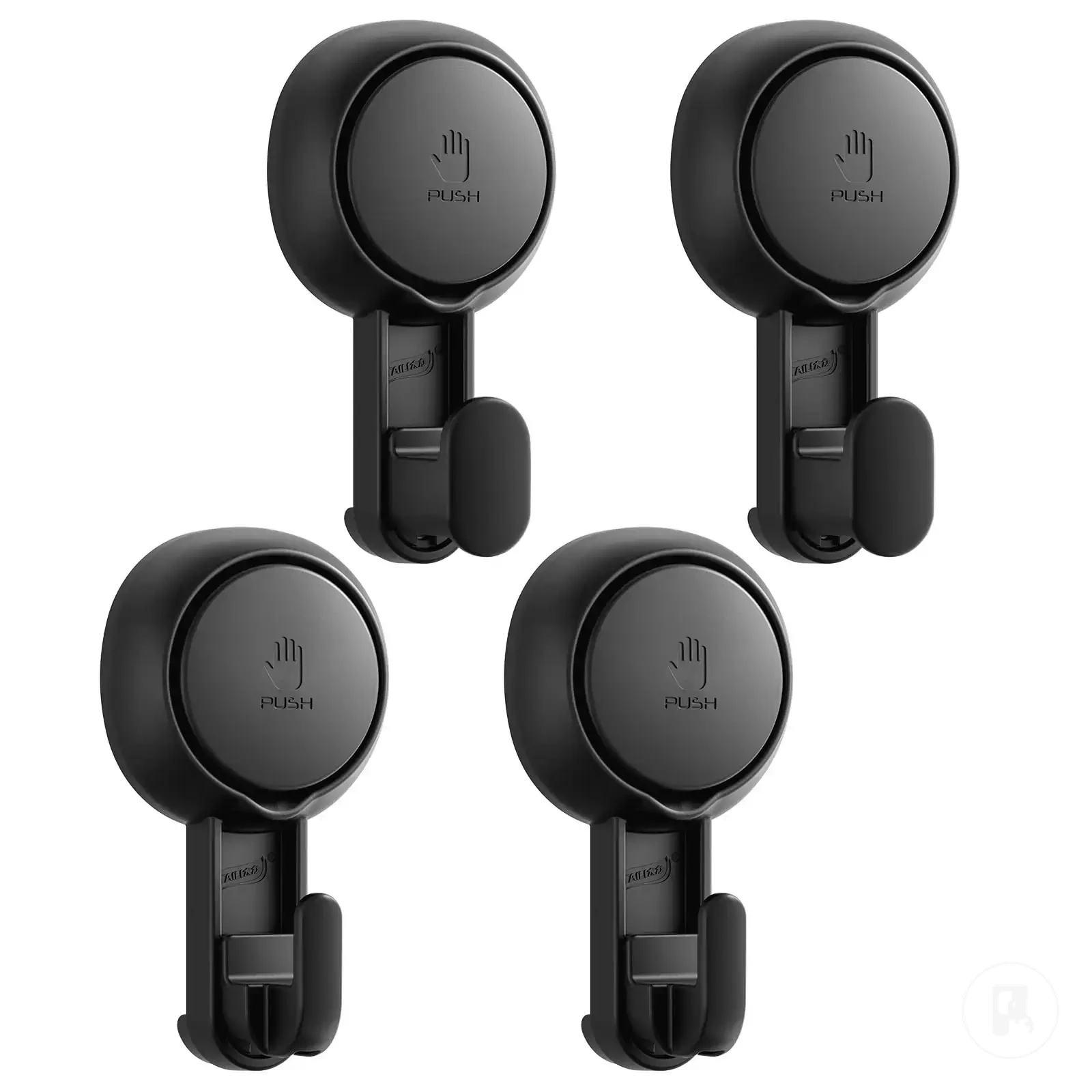
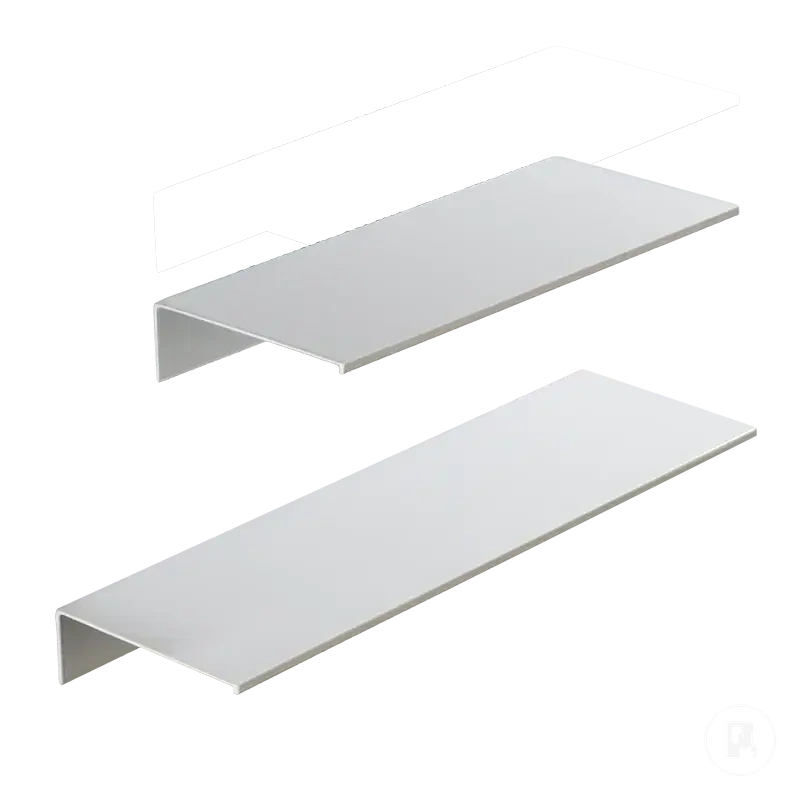
This chart shows when to choose no-drill accessories over drilling based on surface condition, load, and permanence needs.
Best fit for light, removable, and damage-sensitive setups
Light setup, removable use, and damage-sensitive conditions define the strongest fit for no-drill accessories when flexibility and surface protection are more important than permanent fixing. In these situations, drilling is often unnecessary because load demands remain low and installation may need future adjustment or removal. The practical value comes from reduced surface impact and easier reversibility.
These cases usually involve smooth surface areas where temporary use is preferred and visible finish preservation is important. Rental concern environments and spaces where wall appearance must remain intact also increase suitability for removable wall accessories. However, actual performance still depends on surface condition, contact stability, and how consistently the load is distributed during use.
- Light hooks used on smooth surface areas where low load allows removable mounting without drilling
- Small organizers in temporary use setups where flexibility and repositioning are more important than fixed installation
- Rental concern environments where damage-sensitive surfaces require lower alteration risk and reversible application
- Visible finish protection cases where maintaining wall appearance takes priority over permanent anchoring strength
Poor fit for heavy, permanent, or safety-sensitive setups
Heavy setup, permanent setup, and safety-sensitive use cases are generally a poor fit for no-drill accessories because they require stricter support than removable mounting systems can reliably provide. In these scenarios, fixture load and repeated force increase structural demands, which often exceed what no-drill solutions are designed to handle under long-term use conditions.
These situations often involve higher fall consequence risk, especially when valuable objects, daily-use fixtures, or overhead storage are involved. Weak surface conditions can further increase instability, and repeated force from daily interaction can gradually reduce reliability. In such cases, drilled preference or other fixed solutions are typically evaluated based on substrate strength and expected load behavior.
In contexts where these limits of no-drill accessories are relevant, evaluating safety expectations and permanence needs helps determine whether removable systems should be avoided or only used in low-risk conditions. Even then, the final decision depends on balancing fixture load, surface quality, and acceptable risk of failure.
Caution checklist for no-drill rejection scenarios:
- High fixture load where weight exceeds light or temporary use assumptions
- Fall consequence risk where failure could cause damage or safety issues
- Permanent setup requirement where long-term fixed stability is needed
- Repeated force exposure from daily use that may reduce holding reliability
- Weak surface condition where adhesion or contact stability may be inconsistent