No-Drill Home Accessories Explained
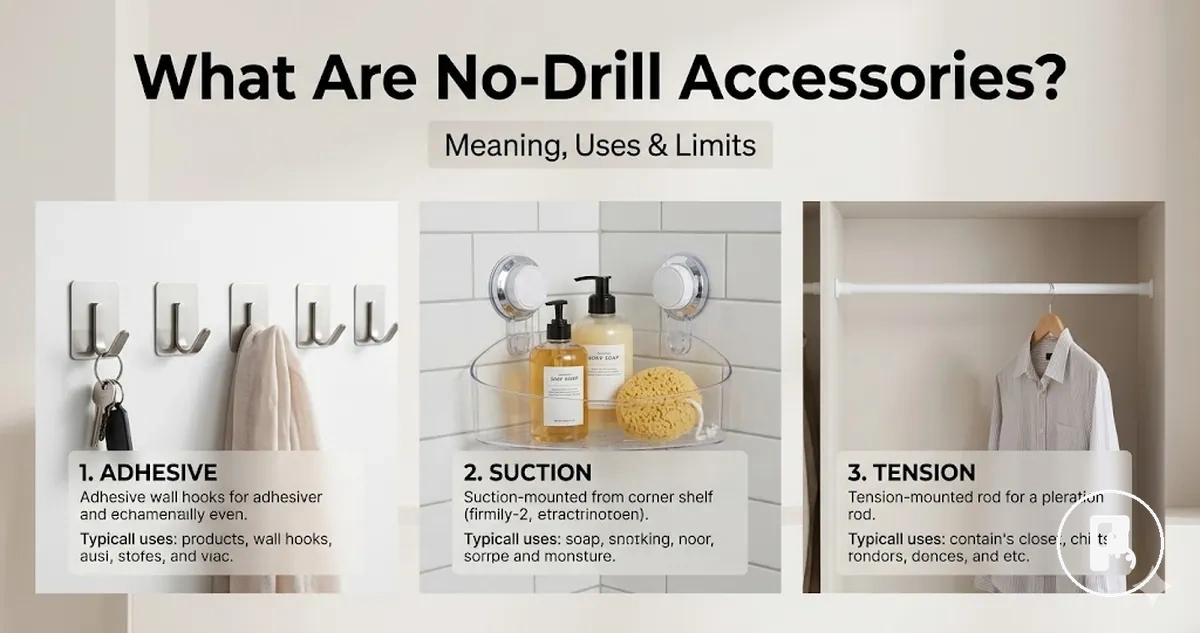
No-drill home accessories are removable household wall accessories designed to attach without drilled holes, screws, or nails. They typically use adhesive, suction, or tension-based mounting methods to stay in place on suitable surfaces. The term refers to non-invasive fittings intended for temporary or semi-permanent use depending on conditions.
Users often choose these renter-friendly wall accessories to avoid wall damage concerns in temporary homes or spaces where drilling is not allowed. Their performance depends on surface condition, load, moisture exposure, and the mounting method used, which can affect stability and longevity. These factors determine how well adhesive, suction, or tension-based systems hold over time.
While no-drill home accessories reduce the need for permanent fixing, they do not replace every heavy-duty or safety-critical fixture. Their suitability varies by use case and should be evaluated based on limits related to weight, surface compatibility, and intended duration of use.
What No-Drill Home Accessories Are
No-drill home accessories are household accessories designed to attach to surfaces without drilled holes. They avoid the use of screws or nails and rely instead on removable mounting methods. These fittings are used when drilling is not required for installation or placement.
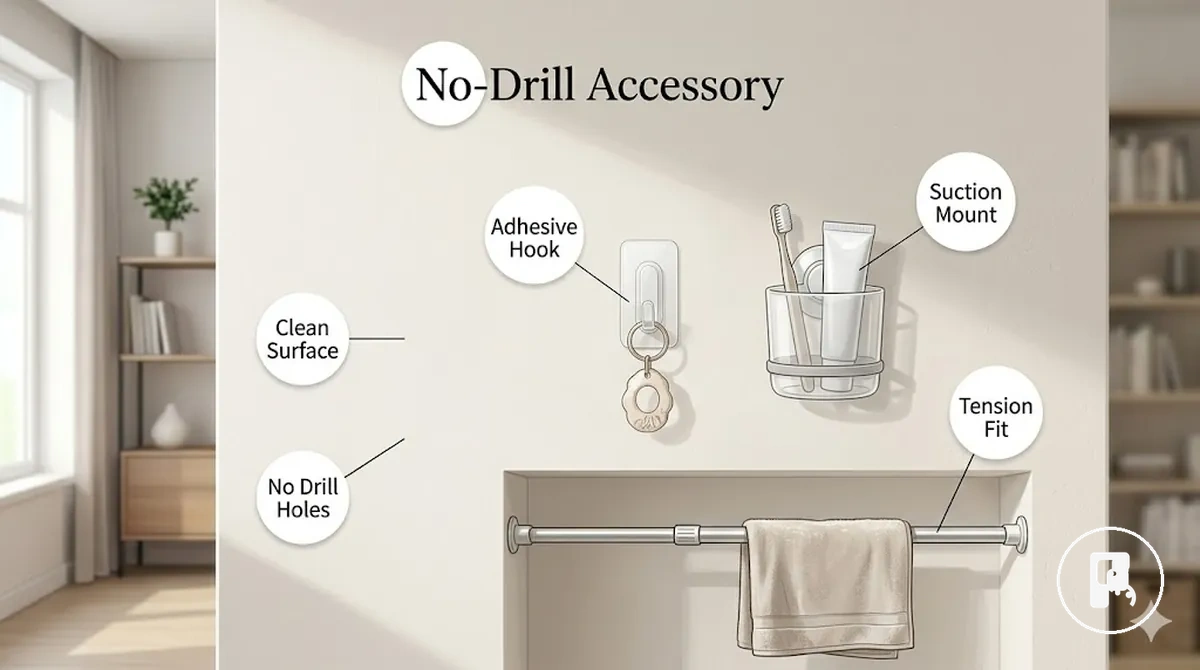
no-drill home accessories refer to removable household fittings that attach through adhesive, suction, or tension-based methods rather than structural fixing. Examples can include wall hooks, holders, or organizers that remain usable under suitable surface conditions. Their meaning stays within non-invasive attachment and excludes structural fixtures that are intended for permanent installation into walls or load-bearing surfaces.
What Counts as a No-Drill Home Accessory
What Counts as a No-Drill Home Accessory refers to household items that attach without drilled holes. These items qualify when they use adhesive, suction cups, or tension-based support instead of screws or nails. Classification depends on how the accessory attaches to the surface rather than its shape or room use.
This classification explains which items fall under this category, and the image below groups common types with clear labels for quick understanding.
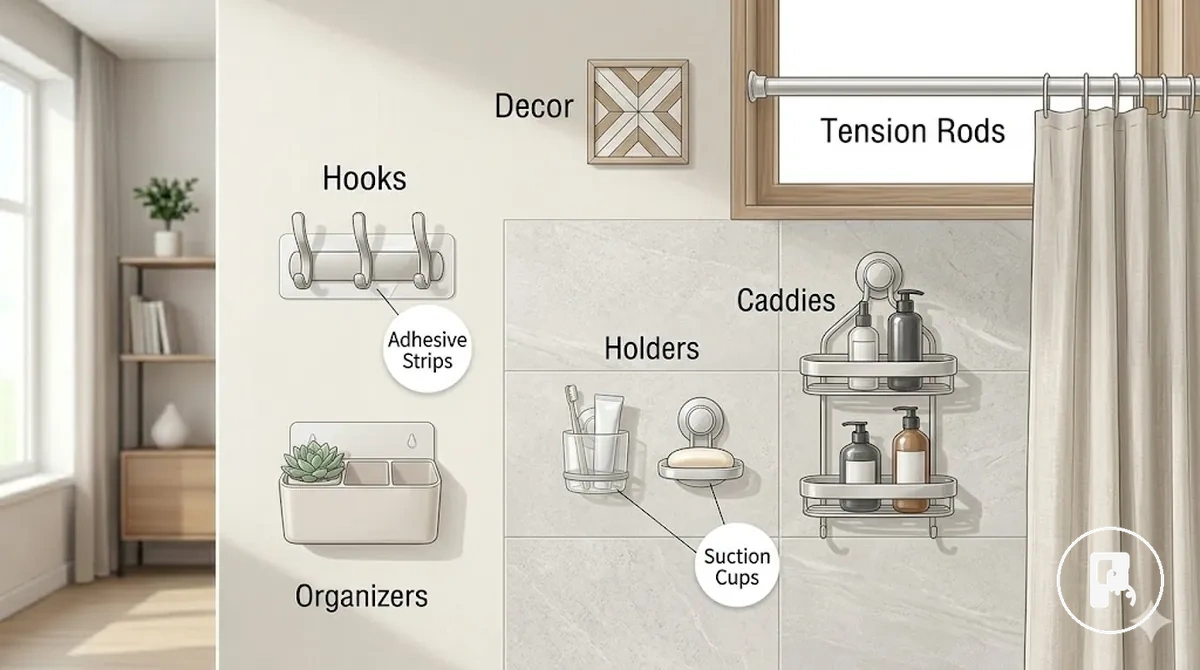
- Hooks: wall accessories using adhesive strips for light hanging use and limited load support.
- Holders: removable fittings using suction cups for smooth surfaces like tiles or glass.
- Caddies: storage accessories using suction or adhesive for bathroom or kitchen organization.
- Organizers: removable units using adhesive backing for temporary wall storage setups.
- Light shelves: wall-mounted accessories using tension or adhesive support for minimal loads.
- Wall decor: drill-free decor using adhesive strips for surface-safe temporary display use.
- Tension rods: adjustable fittings using pressure fit inside frames without surface drilling.
Fit depends on mounting method and surface conditions.
What No-Drill Accessories Do Not Replace
No-drill accessories do not replace permanent fixtures or drilled fixtures used for load-bearing or safety-critical installation. These solutions are designed for removable use and lighter household attachment, while permanent fixtures are intended for structural support. The boundary is defined by load demand, wall material, and long-term stability requirements rather than convenience alone.
What No-Drill Accessories Do Not Replace clarifies where removable solutions reach their limits, especially in higher-consequence use cases. The comparison below highlights how scope changes when safety or structural load becomes central to the installation choice.
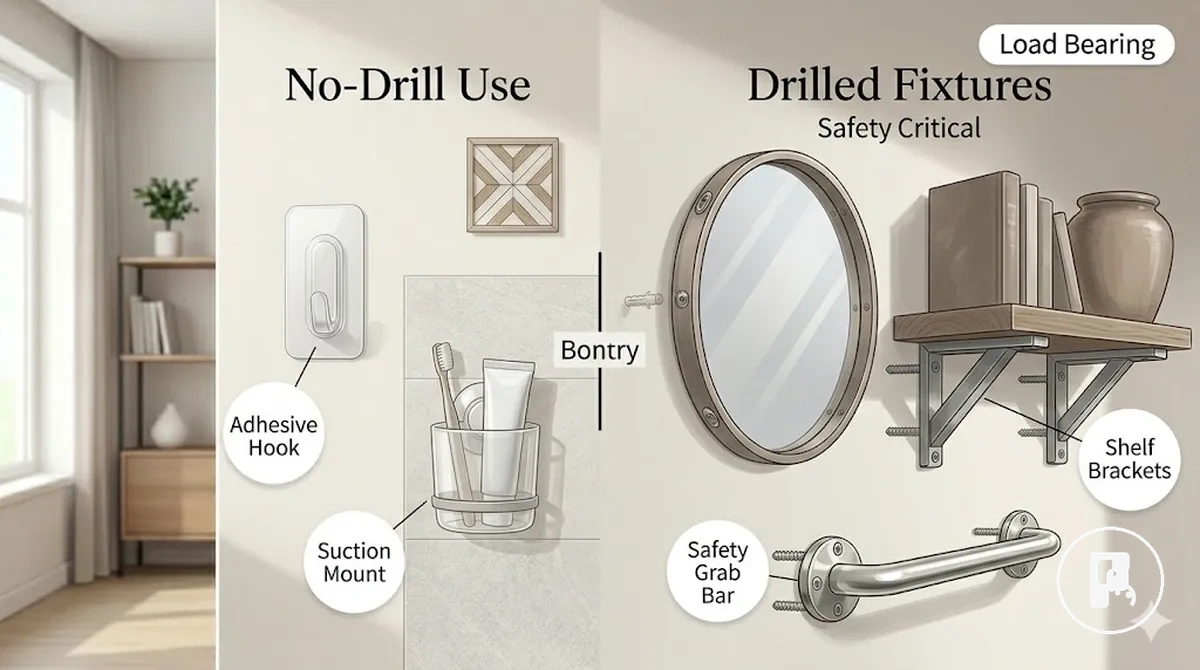
No-drill accessories can help with:
- Light hooks and holders for temporary, low-load wall use
- Organizers and caddies using removable mounting methods
- Light shelves supported through adhesive or tension-based setups
- Wall decor placed without structural wall modification
They should not replace:
- Heavy mirrors requiring load-bearing drilled fixtures
- Grab bars that depend on safety-critical permanent mounting
- Large shelves needing structural wall support and stability
These boundaries become more relevant when load-bearing demands, wall material, or safety-critical conditions require permanent fixtures rather than removable accessories.
How No-Drill Accessories Hold Without Screws
No-drill accessories hold without screws through a combination of adhesive bond, suction seal, tension pressure, and clip-on grip that rely on surface contact instead of drilled anchors. This holding principle works by distributing force across surfaces rather than fixing into the wall structure, and the effectiveness depends on surface condition and attachment method.
Holding behavior changes based on how force interacts with surface contact over time. Adhesive bond depends on bonding area and adhesion stability on clean surfaces, while suction seal relies on air-tight contact on smooth, non-porous surfaces. Tension pressure works through compression between frames or edges, and clip-on grip holds through mechanical edge engagement. In all cases, load direction and time under load influence how consistently the hold is maintained under real use conditions.
| Holding method | How it grips | Best-fit condition | Main limitation |
|---|---|---|---|
| Adhesive bond | Surface bonding through adhesive layer | Clean, dry, smooth surfaces | Performance varies with time under load |
| Suction seal | Air-pressure seal against surface contact | Non-porous smooth surfaces | Reduced stability with moisture or texture |
| Tension pressure | Compression force between frame edges | Stable frames or tight gaps | Depends on consistent surface condition |
| Clip-on grip | Edge-based mechanical holding | Rigid edges or defined shapes | Limited by fit compatibility |
Common Adhesive, Suction, Tension, and Clip-On Methods
No-drill accessories use adhesive, suction, tension, and clip-on mounting methods as different ways to create grip without screws. Each mounting method forms a temporary hold through a specific type of surface interaction rather than structural fixing. Performance depends on surface condition, frame stability, edge shape, and load behavior.
These mounting methods function as distinct ways of attachment under varying conditions. Adhesive relies on surface bonding, suction depends on air-tight sealing on smooth surface contact, tension works through compression inside a frame, and clip-on relies on edge grip. Each method changes in reliability based on surface condition and load direction.
These approaches are grouped as part of main no-drill mounting types for clearer understanding of how no-drill systems are structured.
| Method | How it holds | Better-fit conditions | Main caution |
|---|---|---|---|
| Adhesive | Surface bonding layer creates grip | Smooth surface with stable contact area | May leave residue and vary with load over time |
| Suction | Air-tight seal on surface contact | Flat, non-porous surfaces like tile or glass | Reduced grip on uneven or moist surfaces |
| Tension | Pressure fit inside frame structure | Stable frame or fixed gap conditions | Depends on consistent frame compression |
| Clip-on | Edge-based mechanical grip | Defined edge or rigid shape support | Limited by edge compatibility and fit |
Surface Contact, Load, and Moisture Conditions
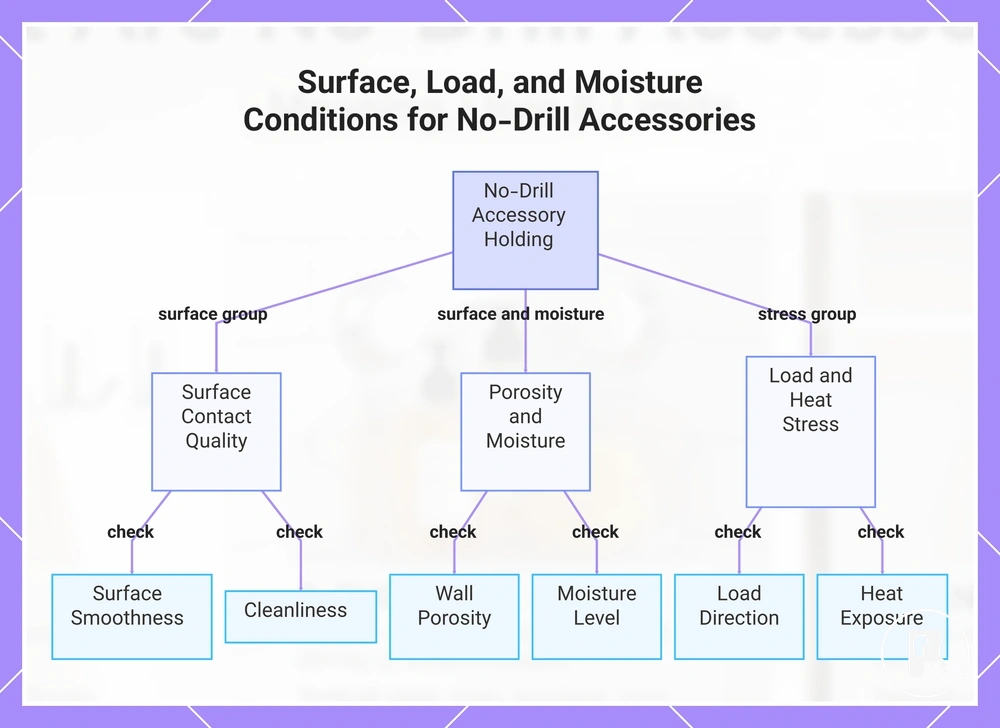
Surface contact, load, and moisture conditions determine whether a no-drill accessory can hold under real use. The outcome depends on how surface contact quality, load direction, and environmental exposure interact with the mounting method. Variations in smoothness, cleanliness, porosity, humidity, heat, and curing time change grip behavior, which leads to different levels of holding risk across surfaces.
These conditions influence holding behavior because each mounting approach reacts differently to surface stability, weight demand, and environmental stress such as humidity or heat. When these variables shift, surface contact quality changes, and this can increase or reduce holding risk over time depending on how the accessory interacts with the surface.
Condition checklist for surface-based holding reliability:
- Surface smoothness: Check if the surface is smooth; uneven texture can reduce surface contact and weaken grip.
- Cleanliness: Check for dust or residue; poor cleanliness reduces adhesion and increases holding risk.
- Porosity: Check if the wall is porous or painted; higher porosity can affect adhesion and stability.
- Moisture level: Check humidity or wet area exposure; moisture can weaken suction seal performance in wet areas.
- Load direction: Check how weight is applied; angled or pulling force increases holding risk over time.
- Heat exposure: Check temperature conditions; heat can affect surface contact and adhesive behavior.
- Curing time: Check settling time after placement; insufficient curing time may reduce holding consistency.
This chart shows the key surface, load, and moisture conditions that determine whether a no-drill accessory can hold under real use.
Common Places and Uses for No-Drill Accessories
Common Places and Uses for No-Drill Accessories refers to typical home environments where light, removable fittings are used for temporary or low-impact organization. These use contexts appear where surface contact solutions like holders, caddies, shelves, and organizers are preferred for temporary use without permanent wall modification, and they vary based on room conditions and load limits.
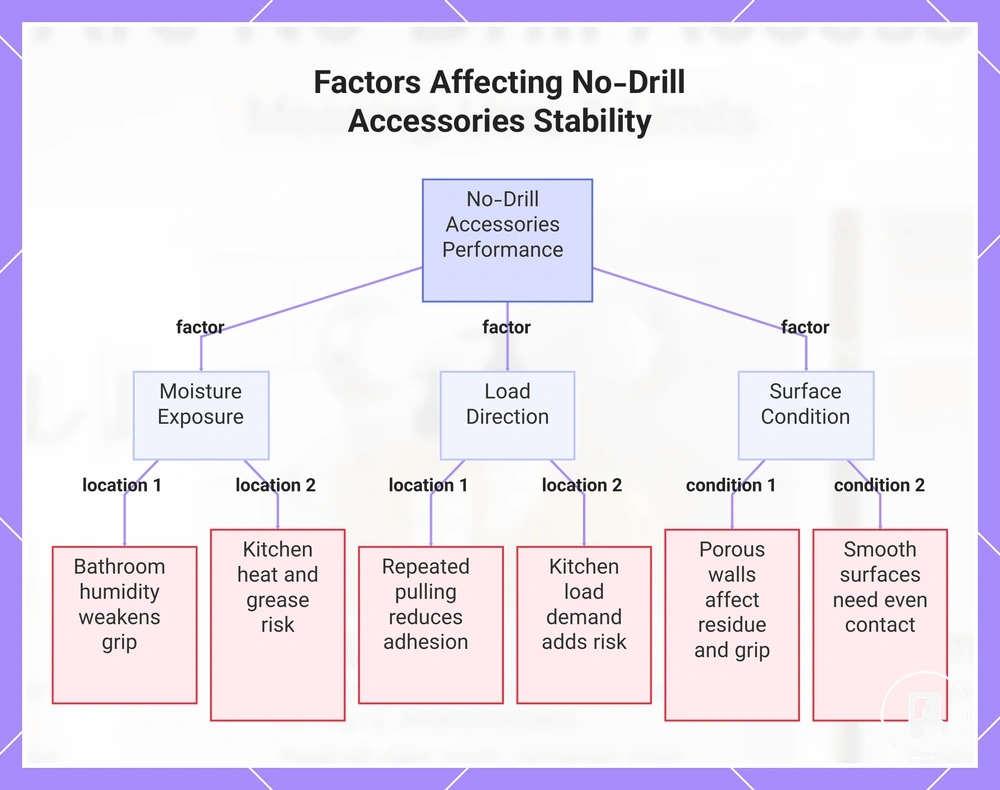
These use cases depend on surface condition, load direction, and moisture exposure, which means performance can change across different home areas. Bathroom humidity, kitchen heat, and painted or porous walls can each influence how stable a temporary setup remains over time.
- Bathroom storage: holders and caddies used on tiled or glass surfaces with suction or adhesive mounting; caution: moisture and humidity can weaken surface contact and reduce grip stability.
- Kitchen organization: hooks, holders, and small organizers used for light utensils or containers; caution: heat, grease, and load demand may increase holding risk.
- Entryway hooks: adhesive hooks used for keys, bags, or small items on painted walls; caution: repeated pulling and load direction can reduce adhesion over time.
- Rental wall use: removable shelves and organizers used for temporary setups without wall damage; caution: surface porosity and coating type may affect residue risk and grip strength.
- Light decor: wall-mounted decorative items using adhesive strips on smooth surfaces; caution: uneven surfaces and poor surface contact may reduce stability over time.
This chart shows the three key factors—moisture exposure, load direction, and surface condition—that influence the stability of no-drill accessories in different home environments, along with specific location examples and cautions.
Why People Choose Removable Home Accessories
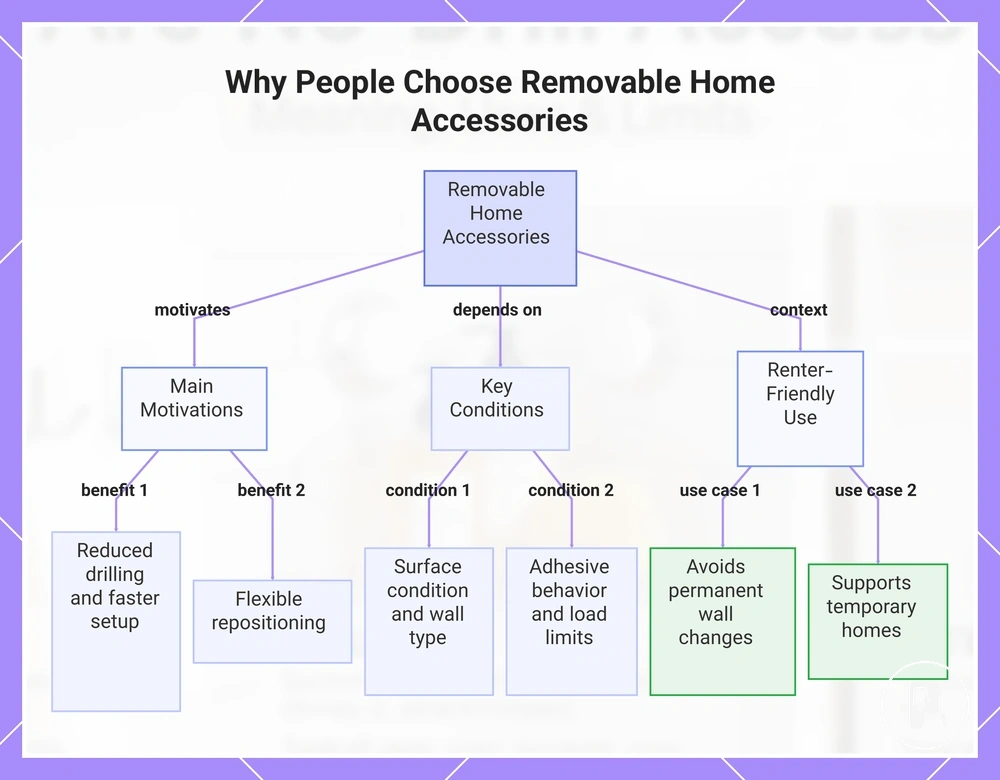
Removable home accessories are often chosen in temporary homes or changing living spaces where reduced drilling and flexible setup are preferred over permanent wall changes. These removable home accessories allow repositioning of holders, caddies, shelves, and organizers, which supports flexibility in layout while still depending on surface condition and load limits. This makes them practical in renter-friendly situations where avoiding permanent wall changes is a common requirement.
The main motivations include reduced drilling, fewer tools, faster setup, and flexibility in repositioning, but each benefit depends on conditions such as wall type, adhesive behavior, and load demand. Reduced drilling limits wall damage risk in many cases, but adhesive use may still create wall damage or residue depending on surface interaction. Faster setup reduces tool dependency, although it may still require careful surface preparation. Repositioning supports flexible layouts, but repeated adjustments can affect adhesion stability over time.
A renter in a temporary apartment may use removable fittings to adjust storage without making permanent changes, especially when moving frequently between spaces. In this context, a renter-friendly no-drill setup can help organize temporary homes while still requiring attention to surface condition and load limitations.
This chart shows the main motivations, key conditions, and renter-friendly context for choosing removable home accessories.
Safety and Practical Limits of No-Drill Accessories
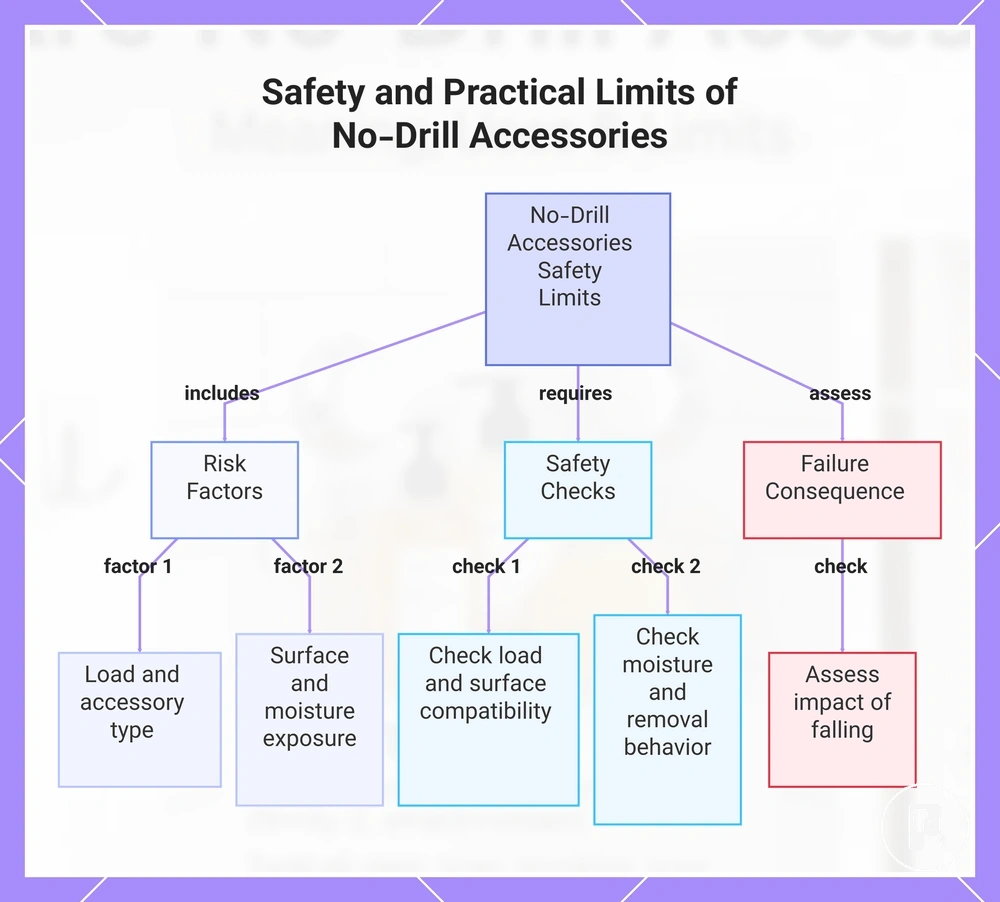
No-drill accessories are generally safe within practical limits when rated load, surface compatibility, and moisture exposure match the intended use conditions. Safety is not absolute because performance depends on how these conditions interact with the mounting method and surface contact, which means caution is required when limits are unclear or exceeded.
Risk factors include rated load, accessory type, surface compatibility, and moisture exposure, all of which influence how stable the attachment remains over time. Removal risk can affect wall surfaces, especially on painted or coated walls where adhesive interaction may leave residue. Falling risk increases when load demand exceeds expected limits or when surface conditions reduce grip strength. In higher stress situations, the consequence of failure may involve damage to objects or surrounding surfaces.
Light organization use cases such as small holders, caddies, or organizers typically fall within lower risk conditions, especially when surface contact is stable and load is minimal. However, higher-consequence applications involving heavier items or unstable surfaces require more caution due to increased failure impact. The safety boundary depends on matching use conditions with practical limits rather than assuming universal suitability across all setups. For broader usage considerations, see common no-drill accessory limits.
- Load: check rated load vs actual weight; overload can increase falling risk.
- Surface: check surface compatibility; uneven or porous walls reduce contact stability.
- Moisture: check moisture exposure; humidity can weaken adhesion or suction grip.
- Removal: check adhesive behavior; removal risk may include residue or paint impact.
- Failure consequence: assess what happens if it falls; higher impact increases caution level.
This chart shows the key risk factors, safety checks, and failure consequence assessment for no-drill accessories.
Weight and Holding Limits
Weight and holding limits for no-drill accessories depend on accessory design, mounting method, surface compatibility, and load behavior. Holding limits change based on weight, object weight, leverage, movement, adhesive area, and suction seal performance, which together determine how stress is distributed and how stable the attachment remains under use conditions.
Light hooks used for small items usually stay within lower holding limits because object weight and leverage remain minimal, and adhesive area or suction seal contact is less stressed. Heavier setups like shelves increase load demand and leverage, which raises the risk of movement-related stress and increases the likelihood of failure consequence if the surface or mounting method cannot support the load.
| Attribute | What changes | Why it matters | Safer interpretation |
|---|---|---|---|
| Load rating vs object weight | Balance between rated capacity and actual load | Mismatch increases holding stress | Keep object weight within intended load behavior |
| Leverage | Distance and pull force on the mount | Higher leverage increases strain on adhesion points | Reduce depth and outward force where possible |
| Movement | Repeated shifting or pulling | Gradual weakening of grip over time | Limit frequent stress cycles on the mount |
| Adhesive area / suction seal | Contact surface strength and coverage | More stable contact improves holding limits | Ensure full surface contact and clean alignment |
| Failure consequence | Impact severity if detachment occurs | Higher impact increases risk sensitivity | Stronger caution needed where damage impact is higher |
Surface Damage and Removal Limits
No-drill accessories do not guarantee no surface damage, no marks, or completely clean removal, and surface damage and removal limits depend on real usage conditions. What looks like a “no-drill” solution can still lead to marks or residue depending on adhesive type, dwell time, and how the material interacts with paint, tile, wallpaper, or plaster, so outcomes vary by surface and use context rather than by category label.
Surface outcome is shaped by multiple variables working together. Adhesive type influences how strongly material bonds to paint or wallpaper, while longer dwell time can increase adhesive residue or surface marks during detachment. Moisture and heat may change how adhesives behave over time, and the removal method itself can affect whether surface damage appears or remains minimal. Because of these factors, removal limits are determined by both surface finish and interaction conditions rather than a fixed outcome.
Conditions affecting surface marks and residue:
- Adhesive type: stronger bonding adhesives may increase adhesive residue or surface marks depending on paint or plaster sensitivity.
- Dwell time: longer attachment periods can increase surface damage risk on wallpaper, paint, or plaster.
- Surface type: tile, paint, wallpaper, and plaster each respond differently to adhesion and removal stress.
- Moisture exposure: humidity can alter adhesive behavior and increase variability in removal outcomes.
- Heat exposure: temperature changes can affect bonding strength and surface interaction stability.
- Removal method: how the accessory is detached influences whether marks or residue remain on the surface.
When No-Drill Accessories Make Sense
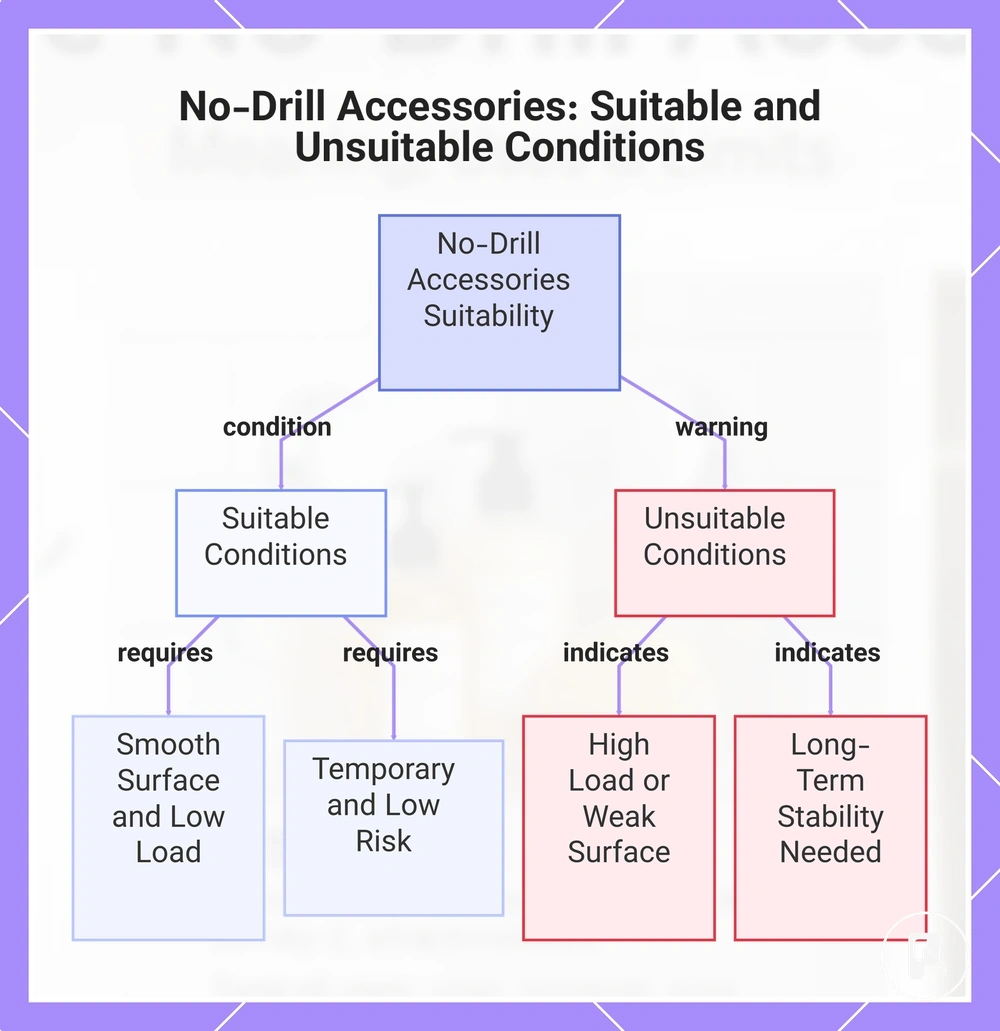
No-drill accessories make sense depending on the use case, surface, load, temporary attachment need, and tolerance for light-to-moderate use conditions. They are a reasonable fit when the surface is smooth, the load demand is low to moderate, and the overall consequence of failure is low, making temporary attachment a suitable choice. The decision depends on how well these use conditions align with manufacturer limits and the intended use scenario.
In situations where the load is higher, the surface is uneven or weak (such as unstable paint, plaster, or wallpaper conditions), or long-term stability is required, no-drill solutions may not make sense. In such cases, a drilled fixture, professional fixing, or another safer alternative can provide more stable support. These options are generally preferred when the use case involves higher stress or when failure risk must be minimized over time.
Decision signals for suitability:
- Light-to-moderate use: makes sense when everyday items create limited load on the surface.
- Smooth surface condition: suitable when the surface allows stable temporary attachment.
- Temporary attachment need: appropriate for rental or short-term setups requiring removability.
- Low consequence of failure: suitable when accidental detachment does not create significant risk.
- Manufacturer limits alignment: relevant when use stays within rated load or stated constraints.
- Surface strength suitability: depends on whether paint, plaster, or finish supports adhesion or pressure methods.
- Safer alternative requirement: indicates when drilled or fixed mounting is the more reliable option.
This chart shows the conditions under which no-drill accessories are suitable or unsuitable, based on surface, load, and risk factors.