No-Drill Home Accessories Safety FAQ
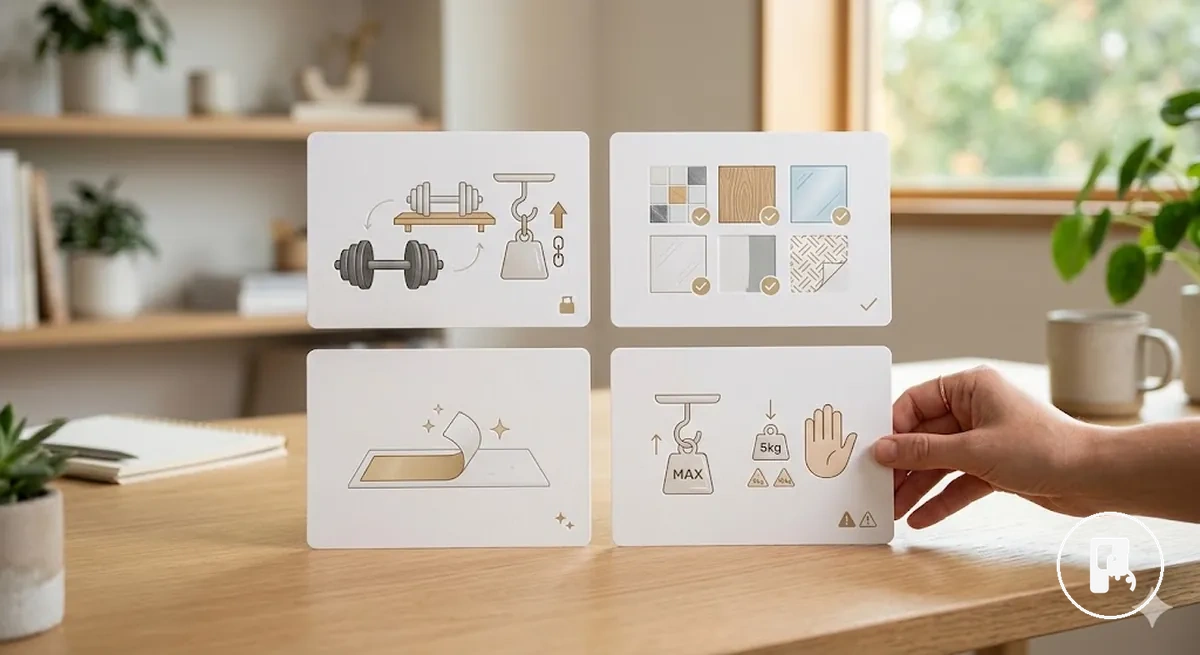
No-Drill Home Accessories Safety FAQ explains how no-drill home accessories function as removable mounting choices where safety depends on surface condition, mounting method, load, and removal behavior. These accessories are often used for damage-free setups, but safety remains conditional rather than absolute.
Users usually look for clarity on safety, wall damage, weight limits, and failure risks because no-drill systems combine different mounting approaches such as adhesive, suction, and tension. Confusion often appears when all no-drill options are treated as identical, even though performance changes based on surface quality, moisture exposure, and load behavior. As a result, outcomes vary depending on real installation conditions rather than a single fixed rule.
The answers in this section stay conditional and focused on key variables such as surface condition, load, mounting method, and removal behavior. These factors determine whether no-drill home accessories perform safely in everyday use or show reduced stability over time.
Q: Are no-drill home accessories safe for everyday use?
A: No-drill home accessories can be safe for everyday use when surface condition, load level, and mounting method are properly matched. Light, stable items on clean and smooth surfaces generally perform better, while heavier or moving loads can increase risk depending on installation conditions.
Q: Are adhesive, suction, and tension mounts equally safe?
A: They are not equally safe under the same conditions because each mounting method relies on a different holding mechanism. Adhesive depends on bond strength, suction depends on an airtight seal, and tension depends on pressure support. Their safety varies with surface smoothness, moisture, and load direction.
Q: Which surfaces are safest for no-drill accessories?
A: Smooth, clean, and non-porous surfaces such as tile, glass, or metal generally provide more stable contact. Painted or textured surfaces may require more caution because coating strength and surface texture can reduce holding performance. Surface stability remains a key factor in overall safety.
Q: Why do no-drill accessories fail or fall off?
A: Failure often happens due to surface mismatch, insufficient cleaning, overload, moisture exposure, or incorrect mounting method selection. Weak adhesive contact or loss of suction over time can also contribute. In most cases, failure is linked to conditions rather than a single defect.
Q: Can no-drill accessories damage walls or painted surfaces?
A: Yes, damage can occur when surface strength is weak, adhesive is too strong for the coating, or removal creates stress on painted layers. Older or poorly prepared surfaces are more vulnerable. Risk depends on both surface condition and removal behavior.
Q: Can no-drill accessories be removed without damage?
A: Many no-drill accessories can be removed cleanly when adhesive type, surface quality, and usage duration are favorable. However, residue or paint lifting may occur if bonding strength increases over time or if the surface coating is weak. Removal outcome depends on combined material and environmental conditions.
Are no-drill home accessories safe for everyday home use?
No-drill home accessories are generally safe for everyday use when surface condition, load, and mounting method match the accessory and its instructions; safety depends on how well these real conditions align in practice.
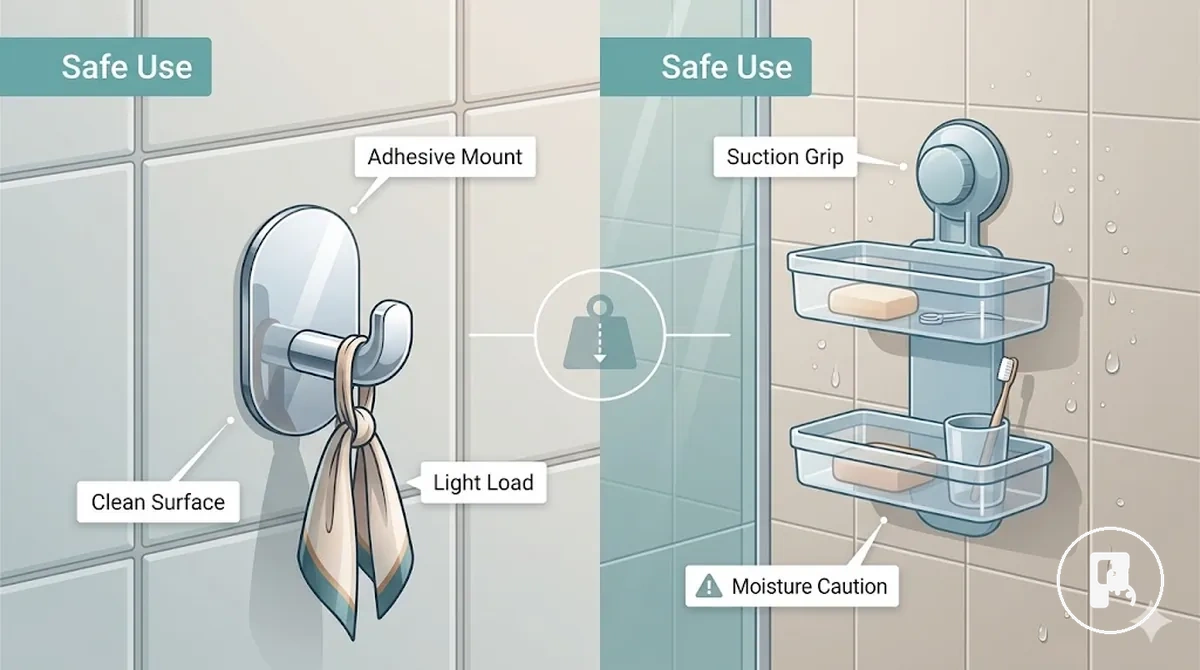
Everyday safety depends on matching no-drill home accessories to real household conditions such as surface quality, weight expectations, and correct use of adhesive, suction, or tension systems. Are no-drill home accessories safe for everyday home use? The answer becomes more reliable when surface stability, load limits, and environmental factors like moisture are considered together. The image below shows how these conditions interact in typical setups.
Safe everyday use usually depends on light items, clean and smooth surfaces, and correct installation following instructions. Load balance matters because static weight behaves differently from movement-based stress, especially when adhesive or suction is used. Moisture exposure and residue on the surface can also reduce stability, so the surface-load-mounting relationship must stay consistent for safer performance.
A common example is placing a lightweight organizer on a dry, smooth kitchen tile using adhesive mounting. This can remain stable during everyday use when the load stays light and the surface is properly cleaned. In contrast, the same setup in a humid bathroom or under repeated pulling force may reduce reliability, so careful placement and usage limits are important.
- Surface: Must be clean, dry, smooth, and stable for better contact.
- Load: Keep weight within light everyday use limits.
- Moisture: Avoid damp areas unless the mounting method supports it.
- Mounting method: Choose adhesive, suction, or tension based on surface type.
- Waiting time: Allow proper setting time before applying load.
- Handling: Avoid pulling, swinging, or repeated stress on the item.
Are adhesive, suction, and tension mounts safe in the same conditions?
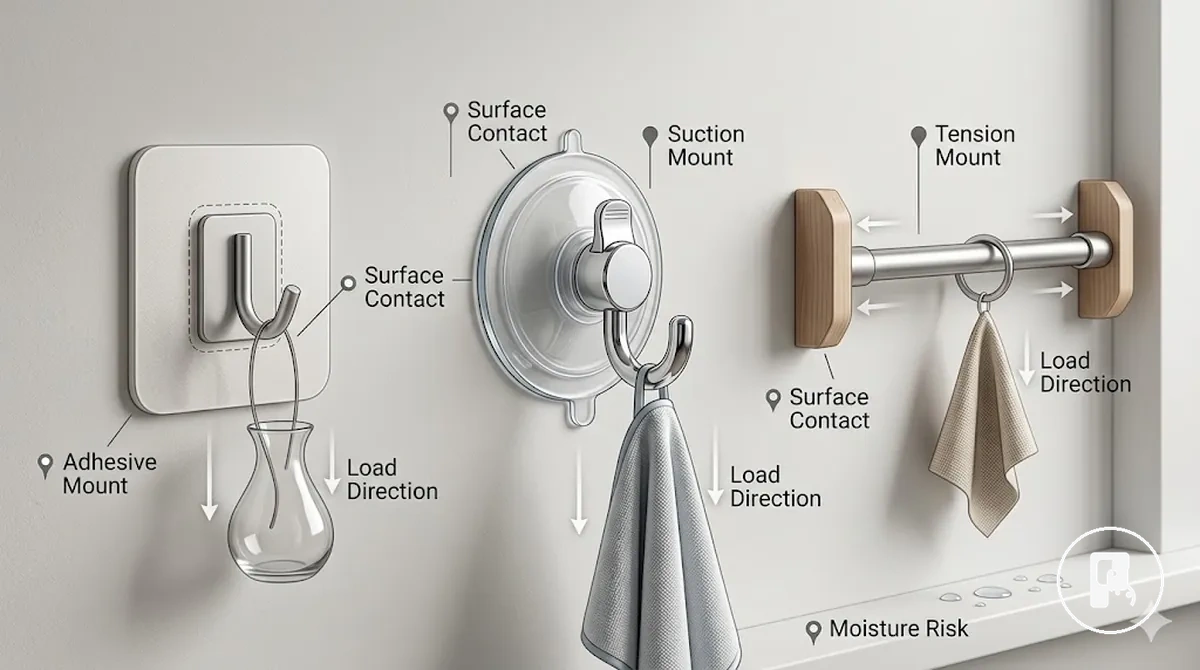
Adhesive mount, suction mount, and tension mount are not equally safe in the same conditions because each relies on a different holding mechanism; safety changes based on bond, seal, and pressure behavior under real use conditions.
Are adhesive, suction, and tension mounts safe in the same conditions? Their safety varies because adhesive depends on bond strength, suction depends on a sealed surface contact, and tension depends on pressure between fixed points. The image below helps visualize how each mounting type behaves under the same environmental conditions before the comparison table.
| Mount type | What it depends on | Main risk condition | Safer use case |
|---|---|---|---|
| Adhesive mount | Bond with clean surface and proper curing time | Residue, weak surface, or moisture affecting bond | Dry, smooth surfaces with light static load |
| Suction mount | Air seal on smooth non-porous surface | Moisture or air leakage breaking seal | Glass or tile with stable light load |
| Tension mount | Pressure between fixed points or frame | Movement or uneven load direction | Stable frame setups with balanced pressure |
Can no-drill accessories damage walls or painted surfaces?
No-drill accessories can damage walls or painted surfaces when paint, plaster, adhesive strength, moisture, surface preparation, or removal method creates weakness; wall damage risk depends on how these conditions interact over time.
Can no-drill accessories damage walls or painted surfaces? The risk increases when weak paint, poor surface preparation, or porous plaster is involved, since these conditions affect how adhesive residue behaves and how the coating responds to stress. The image below shows how surface layers, adhesive contact, and removal direction can influence wall damage risk.
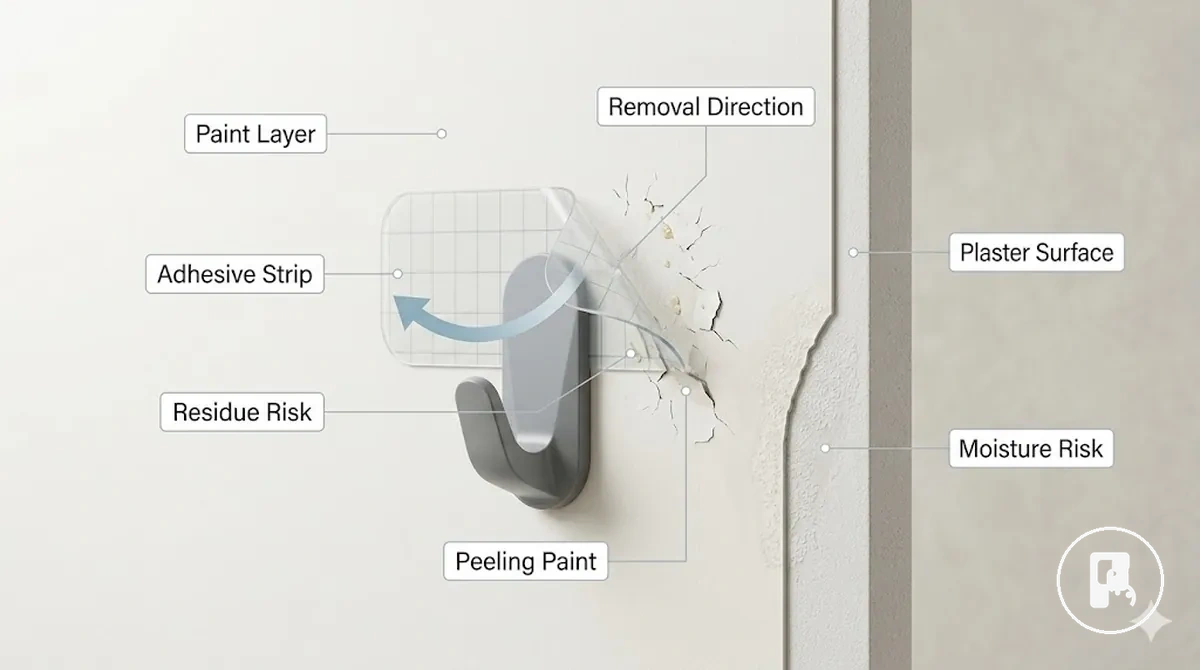
Painted surface condition plays a major role because old paint, low-quality coatings, or damp walls may not hold adhesive cleanly, which can lead to peeling paint or surface marks during use. Plaster type also matters, since porous or uneven surfaces can reduce stability and increase coating damage risk when load or pressure is applied over time.
Can no-drill accessories damage walls or painted surfaces and what are the main risk factors?
- Paint age: Older paint may weaken and lift under adhesive stress.
- Surface preparation: Dust or residue can reduce bonding stability.
- Adhesive residue: Strong bonding may leave marks after removal.
- Plaster condition: Weak or porous plaster increases surface damage risk.
- Moisture: Damp walls can reduce paint and adhesive stability.
- Time attached: Longer application may increase stress during removal.
How much weight can no-drill home accessories safely hold?
Safe weight or load capacity for no-drill home accessories depends on the accessory rating, mounting method, surface condition, and whether the load is applied as a static load or a moving load; there is no universal safe hold across all use conditions.
How much weight can no-drill home accessories safely hold depends on how the load is applied and how stable the installation environment remains over time. A static load typically creates a more stable condition, while a moving load introduces pull force and shear stress that increases failure risk even when the rating appears sufficient. Surface condition, including smoothness, dryness, and cleanliness, also affects adhesive bond, suction seal, or pressure stability, which directly influences safe hold behavior.
Manufacturers’ weight claims should be interpreted as conditional load capacity ratings that assume ideal surface condition and correct mounting method. To evaluate real-world use, it is important to refer to strength and load capacity as a criteria-based reference for how rating, surface, and load direction affect actual performance under different conditions.
How much weight can no-drill home accessories safely hold can be understood through these condition-based use cases:
| Accessory/load context | Rating or claim | Surface and mounting condition | Safety implication |
|---|---|---|---|
| Light decorative load | Low to moderate rated load | Smooth, dry surface with stable mounting | Generally stable under static conditions |
| Daily-use load | Mid-range load claim | Consistent surface contact and correct mounting method | Performance varies with movement stress |
| Wet-area load | Reduced effective rating in moisture | Damp or humid surface affecting bond or seal | Increased risk of reduced adhesion |
| Moving or pull-prone load | Higher stress than static rating | Frequent pulling, swinging, or directional force | Higher failure risk even within rated capacity |
Why do surface type and mounting method change the safe weight?
Safe weight changes because surface type and mounting method determine how force is transferred through an adhesive bond, suction seal, or tension pressure, and how effectively the contact area can distribute load.
Why do surface type and mounting method change the safe weight? The same accessory can behave differently because force transfer depends on how well the surface allows grip and how the load is directed. A smooth surface typically improves consistent contact, while porous or textured surfaces reduce effective bonding and increase instability under load. Moisture can weaken both adhesive bond and suction seal, and directional forces like shear force and pull force further influence how the load stresses the mounting point. These variations change the actual safe weight even when the rated claim is similar.
Surface type and mounting method affect performance because each condition changes how load is distributed across the contact point. When contact area is reduced or force direction becomes uneven, stability decreases and failure risk increases, even under moderate weight. This is why safe weight must always be interpreted as condition-dependent rather than fixed.
| Condition | Holding mechanism affected | Effect on safe weight |
|---|---|---|
| Smooth surface | Adhesive bond / suction seal | More stable contact and improved load distribution |
| Porous or textured surface | Adhesive bond | Reduced contact area and lower stability under load |
| Moisture exposure | Adhesive bond / suction seal | Weakened grip and increased slippage risk |
| Pull or shear direction | Tension pressure / adhesive bond | Higher stress on mount and reduced safe weight |
Which surfaces work safely with no-drill accessories?
Which surfaces work safely with no-drill accessories depends on surface condition, with smooth, clean, stable, and non-porous surfaces generally offering better compatibility, while weak, dusty, textured, damp, or flaking surfaces require caution; compatibility is always condition-dependent rather than universal.
Surface safety depends on how the mounting method contacts and holds the material, especially across different surfaces like tile, glass, metal, painted wall, textured wall, stone, laminate, and bathroom surfaces. Smooth surfaces such as tile, glass, and metal usually provide more consistent contact because they reduce gaps and improve sealing or bonding. In contrast, uneven or coated surfaces can reduce grip stability depending on cleanliness and surface integrity.
Some surfaces may appear suitable but still behave unpredictably due to hidden conditions such as weak paint layers, dust buildup, moisture exposure, or unstable coatings. Painted wall and textured wall surfaces are especially sensitive to these factors, even when they look visually smooth. The key boundary is that surface appearance alone does not guarantee stable mounting performance.
Which surfaces work safely with no-drill accessories can be understood by comparing how each surface interacts with mounting contact and stability conditions.
| Surface | Works best when | Use caution when | Safety implication |
|---|---|---|---|
| Tile | Smooth, clean, dry, non-porous surface | Grout lines, moisture, or residue present | Generally stable contact and reliable hold |
| Glass | Clean, smooth, fully sealed surface | Condensation or dust is present | High compatibility with proper contact |
| Metal | Flat, smooth, non-corroded surface | Rust, dust, or uneven coating exists | Stable support when properly clean |
| Sealed wood | Properly finished, smooth sealed surface | Unsealed or rough grain exposed | Moderate stability depending on finish |
| Painted wall | Strong, clean, well-cured coating | Weak, dusty, or aging paint layer | Variable hold depending on coating strength |
| Textured wall | Light texture with stable surface base | Deep or porous texture present | Reduced contact area increases risk |
| Bathroom surfaces | Low moisture and sealed finish | High humidity or water exposure | Performance varies with moisture conditions |
Which surfaces are risky for adhesive or suction mounting?
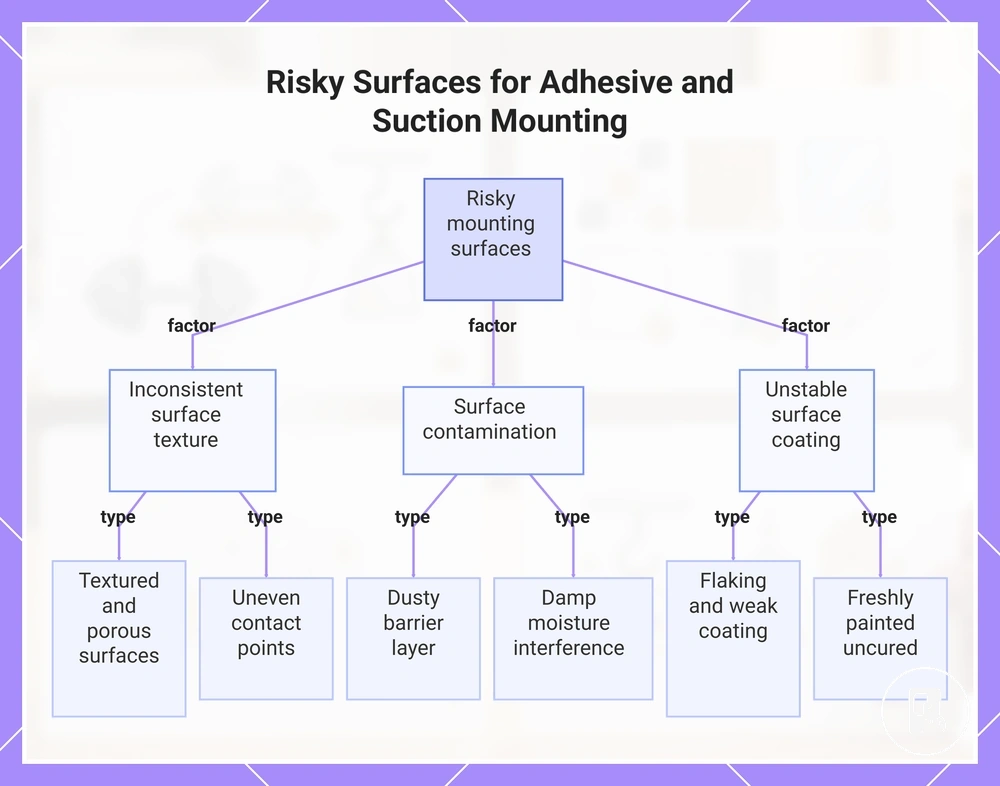
Which surfaces are risky for adhesive or suction mounting depends on surface condition, with risky surfaces including textured, porous, dusty, damp, flaking, uneven, freshly painted, or weak coating surfaces where adhesive or suction contact cannot form stable hold.
Adhesive and suction mounting failures often begin with poor contact between the mount and surface. When the adhesive cannot bond evenly or the suction cannot maintain a sealed contact, stability drops quickly. The risk increases when surface conditions interrupt continuous contact, creating weak points under load.
- Textured surface → uneven contact → poor adhesive grip or suction loss
- Dusty surface → barrier layer → weak bond leading to slipping or detachment
- Damp surface → moisture interference → reduced suction seal or adhesive strength
- Flaking surface → unstable coating → peeling or surface lifting under load
- Uneven surface → inconsistent contact → weak hold and early failure risk
- Freshly painted surface → uncured coating → residue marks or peeling risk
- Weak coating surface → low surface integrity → detachment under moderate weight
This chart shows the main surface conditions that cause adhesive or suction mounting failures, grouped by texture, contamination, and coating issues.
Can no-drill accessories be removed without residue or wall damage?
Can no-drill accessories be removed without residue or wall damage is condition-dependent, where many no-drill accessories can be removed cleanly, but residue or wall damage may still occur based on adhesive type, time attached, paint quality, pulling angle, heat, and moisture during removal.
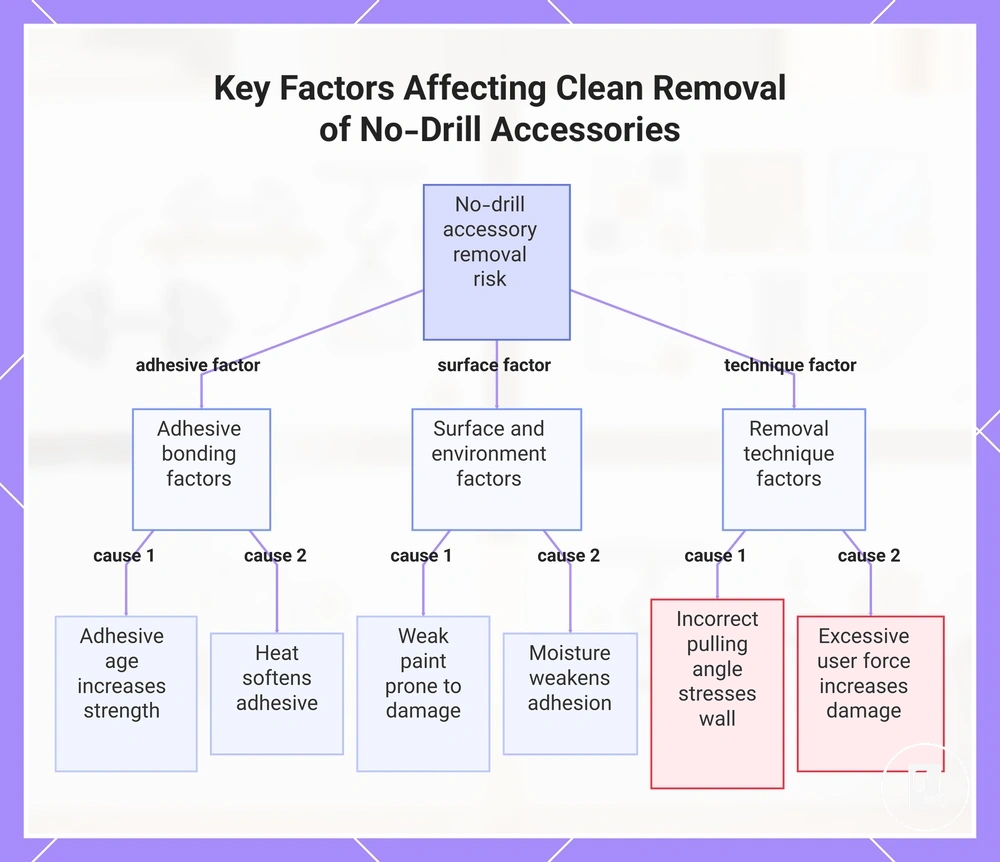
Clean removal depends on the interaction between adhesive type and surface condition over time. When adhesive strength increases after longer time attached, residue becomes more likely, especially on weaker paint quality or uneven surfaces. Heat and moisture can soften or destabilize bonding in different ways, while an incorrect pulling angle may concentrate stress on the wall surface. These factors together influence whether removal remains smooth or leads to visible residue or wall damage.
Safe removal outcomes usually depend on evaluating these variables before detachment. Older adhesive type, sensitive painted wall surfaces, or moisture-exposed areas like bathrooms can increase risk, especially in rental environments where surface preservation matters. For structured guidance on handling different cases, refer to safe removal practices based on surface and adhesive conditions.
- Adhesive age: longer time attached may increase bonding strength and residue risk
- Surface quality: weak paint or fragile coatings may increase wall damage risk
- Heat exposure: temperature changes may affect adhesive release behavior
- Moisture: damp conditions may weaken or destabilize adhesion unevenly
- Pulling angle: uneven force may increase peeling or surface stress
- Residue behavior: sticky or hardened adhesive may leave visible marks
- User force: excessive force may increase likelihood of surface damage
This chart identifies the main adhesive, surface, and technique factors that influence whether no-drill accessories can be removed without residue or wall damage.
Why do no-drill accessories fail or fall off?
No-drill accessories usually fail or fall off because of surface mismatch, poor cleaning, overload, moisture, wrong mounting method, weak adhesive contact, or movement over time, where mounting stability breaks due to condition issues rather than a single universal defect.
Immediate failures often occur when weak adhesive contact, surface mismatch, or insufficient cleaning prevents proper initial bonding, causing the accessory to fail or fall off shortly after installation. In these cases, the issue is usually tied to surface preparation and contact quality at the point of mounting rather than long-term wear.
Delayed failures develop over time when repeated movement, overload, or moisture gradually reduces adhesion strength and leads to loosening before the accessory eventually detaches. This pattern is commonly associated with falling off problems that emerge from ongoing condition stress rather than immediate installation faults.
Why do no-drill accessories fail or fall off can be diagnosed through the following condition-to-cause patterns:
| Symptom | Likely attribute issue | Check | What it means |
|---|---|---|---|
| Immediate drop | Poor cleaning or surface mismatch | Surface dust, alignment, initial grip | Initial bonding failure at installation |
| Slow slipping | Weak adhesive contact or movement stress | Load stability and usage motion | Gradual loss of hold under repeated force |
| Bathroom loosening | Moisture affecting adhesive or suction | Humidity exposure level | Environmental weakening of bond |
| Adhesive residue failure | Strong aged adhesive or surface interaction | Time attached and removal behavior | Bond breakdown leaving surface residue |
| Overload failure | Excess weight or load beyond stable limit | Weight distribution and force direction | Structural stress exceeding holding capacity |
What are the main safety limits of no-drill home accessories?
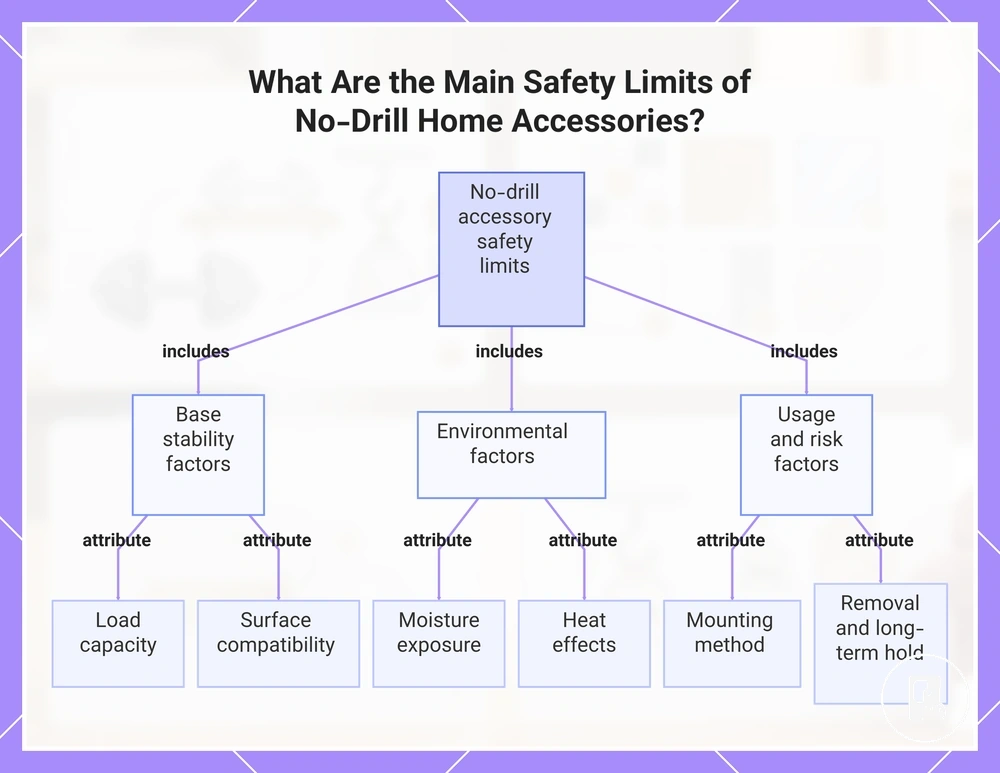
The main safety limits of no-drill home accessories are defined by load capacity, surface compatibility, mounting method, moisture exposure, heat, removal risk, and long-term hold, and these limits determine suitability depending on real use conditions and stability requirements.
These safety limits help users judge when no-drill accessories are suitable and when a more conservative use approach may be required based on environment and load behavior. Each limit reflects a different aspect of stability, from how well a surface supports adhesion or suction to how environmental factors influence performance over time. The meaning and limits define how these constraints shape overall usability and boundary conditions.
The safety limits can be understood as interconnected categories where load capacity and surface compatibility define base stability, while mounting method affects how force is held across the surface. Moisture exposure and heat can weaken adhesive or suction performance, and removal risk relates to how safely the accessory detaches without damaging the surface. Long-term hold reflects how stability changes with time and repeated use conditions.
Conservative use is generally more appropriate for heavy, valuable, fragile, overhead, child-accessible, or high-movement items, where even minor instability can increase risk. In such cases, no-drill systems may have suitability boundaries depending on the installation environment and usage demands.
Which safety limits of no-drill home accessories can be evaluated using the following criteria checklist:
- Load capacity: higher weight or movement can reduce stability under stress
- Surface compatibility: uneven or weak surfaces may reduce adhesion or suction performance
- Mounting method: adhesive, suction, or tension behave differently under load
- Moisture exposure: humidity may weaken bond or seal over time
- Heat: temperature changes can affect adhesive strength and stability
- Removal risk: stronger adhesion may increase residue or surface stress
- Long-term hold: extended use may gradually reduce holding consistency
This chart identifies the main safety limits of no-drill home accessories, grouped into base stability, environmental, and usage factors.